Watering observation & volume worksheet.
Work from your own plant checks. Compare recorded drying intervals and calculate the difference between water poured and runoff. This worksheet does not choose your next watering date or dose.
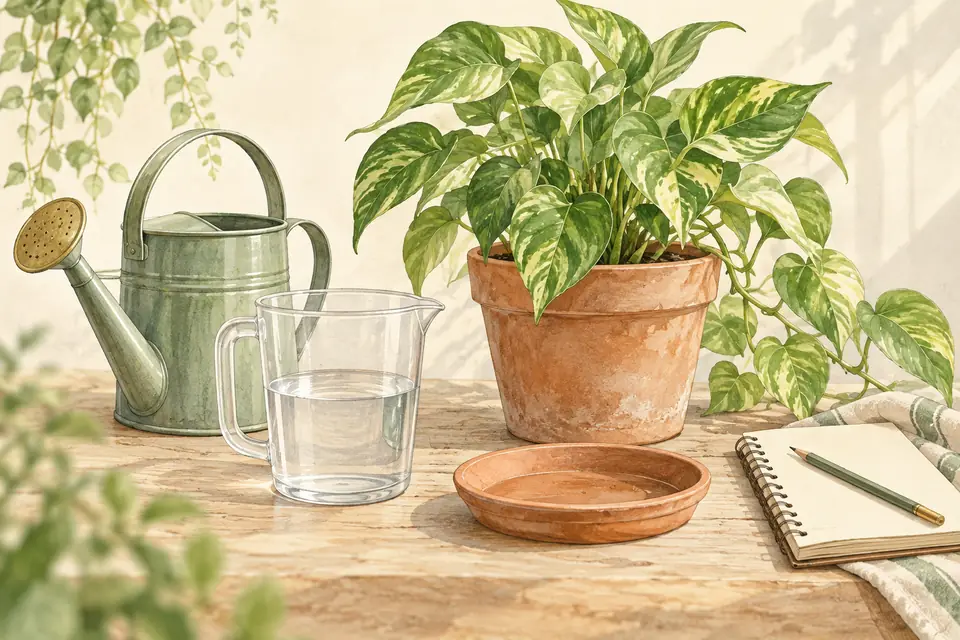
1. Record completed drying intervals
After a real watering, record how long it took until your species-specific moisture check indicated watering was needed again. Use the same plant, pot, mix, and check method. Do not water to create a record.
Leave unused fields empty. At least two completed intervals are needed to summarize variation.
2. Compare your observations
—
Your observations describe the past. Check the actual mix and species requirements before watering today.
Repeat observations after a change in season, light, pot, or mix. A history of similar intervals is not a guarantee of the next one.
Measure water after a real watering
Measure the water you poured and collect the runoff after drainage. Use milliliters for both. Empty the saucer or decorative pot afterward.
Water retained by difference
—
Poured minus collected runoff.
Collection losses and water already in the pot affect interpretation. This difference does not measure root-zone moisture, uptake by the plant, or the amount you should pour next time.
Worked example: a care record
Example inputs, not a Doofer growing experiment: completed intervals of 5, 7, and 6 days have a middle value of 6 and a range of 5–7 days. They describe those checks, not a prescription to water every 6 days.
If 500 ml was poured and 120 ml collected, the measured difference is 380 ml.
Keep a useful plant record
- Write the plant name, date, potting mix, drainage setup, and how you checked moisture.
- Record both the surface and below-surface observations. Include standing water, pot weight, or a recent move when relevant.
- Note the care change and inspect new growth later. Record no improvement as carefully as improvement.
Snake plant watering example · Bottom watering method and limits
Frequently Asked Questions
Answers to common questions about plant care and this tool.
Further reading and references
- How to grow houseplants — Royal Horticultural Society General care guidance. The worksheet summarizes your observations and measured amounts; it does not predict drying. [Source ]