Overwatering or underwatering: what to check.
Wilting and yellow leaves can occur when a plant gets too little water or when its roots struggle in wet mix. Check the pot and growing conditions before deciding what to do. A single leaf symptom cannot tell these problems apart reliably.
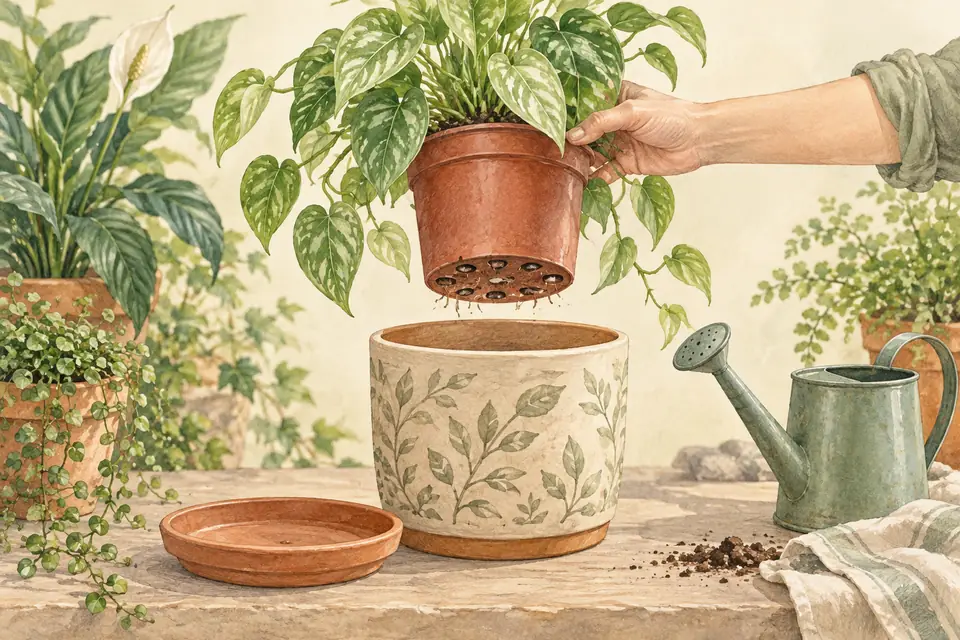
Should I water this houseplant now?
1. Check below the surface
Compare the moisture near the roots with the needs of the species. A dry top layer alone is not enough to decide.
2. Check the drainage route
Look for open holes and water collected in a saucer or outer pot. Remove standing water before reassessing the plant.
3. Choose the next step
If the mix is too dry for this plant, water and let it drain. If it is still wet and the plant is declining, inspect other causes before adding water.
1. Why wet and dry plants can both wilt
Water helps plant cells remain firm. When roots cannot supply enough water to the leaves, the plant may droop. Very dry mix is one possible cause, but roots damaged in persistently wet conditions may also fail to supply the leaves.
Roots need access to air as well as moisture. Poor drainage, a pot standing in water, or watering again before the plant needs it can keep the root zone too wet. This can stress roots and favor some root diseases, but wet soil alone does not identify a disease or mean every root is dead.
Dry mix
Check whether your species needs water now. Dryness is normal between waterings for some plants, but stressful for others.
Wet mix
Check drainage and the rest of the plant. More water may worsen the problem, even when leaves look wilted.
2. Build a picture from several observations
| What to inspect | What to note | Keep in mind |
|---|---|---|
| Moisture below the surface | Is the mix dry, lightly moist, or persistently wet near the roots? | The surface can dry before the rest of the pot. |
| Pot and saucer | Are drainage holes open? Is water standing in an outer pot? | A decorative container may hide collected water. |
| Pot weight | Compare with how the same pot feels after watering and after drying. | Material and plant size affect weight; there is no universal threshold. |
| Leaves and stems | Note new symptoms, soft areas, and which leaves changed first. | Color and texture can overlap between different problems. |
| Recent care | Record watering, repotting, light changes, and temperature changes. | A routine that worked previously may no longer fit. |
Check the moisture step by step
- Push a finger about 5 cm into the potting mix, away from the main stem.
- Compare what you feel with the needs of the species. Most leafy houseplants need water when this layer is dry; cacti and other succulents need much less.
- Lift the pot. Dry mix weighs much less than freshly watered mix.
- Look into the saucer or outer pot for standing water.
If your finger cannot get into the mix, the mix may be too dense or the plant may be root-bound. Root-bound means roots fill most of the pot. University of Maryland Extension suggests a more porous potting mix or a larger pot in that case.
A moisture meter or wooden probe can add information, but neither replaces judgment. Read the device instructions and check more than one location when appropriate. Avoid forcing a probe through roots, and do not assume every species should become completely dry.
Which leaves change first
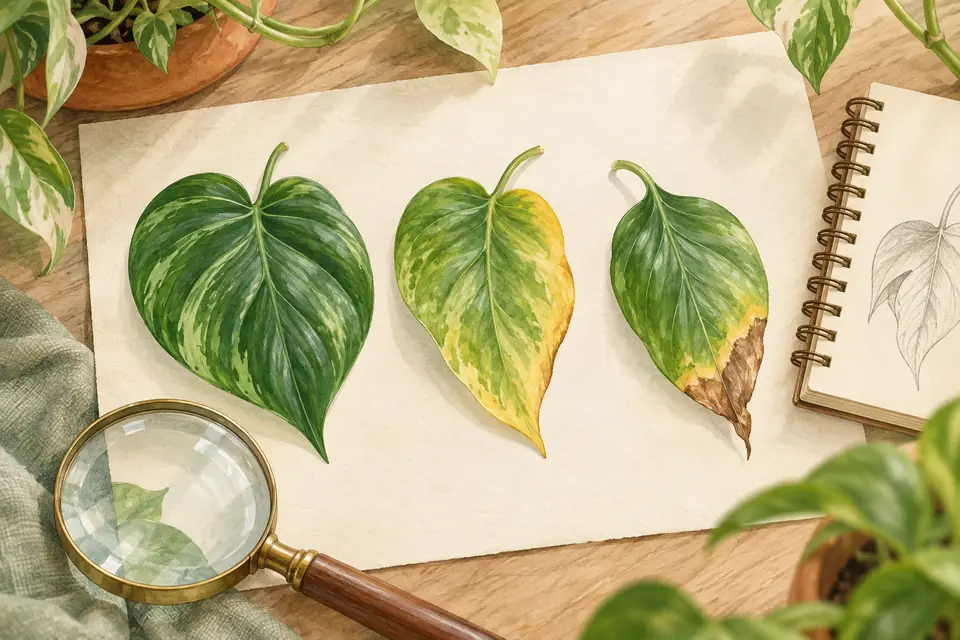
The pattern of damage gives a clue. These patterns draw on RHS guidance. They make one cause more likely, but only the moisture check confirms it.
| Sign | More typical of dry potting mix | More typical of wet potting mix |
|---|---|---|
| Yellow leaves | Older leaves at the base yellow and fall first. | Old and new leaves yellow and drop at the same time. |
| Brown areas | Brown, crisp leaf edges. | Brown patches in the middle of leaves. |
| Flowers | Flowers fade or fall quickly. | Mould patches on leaves and flowers. |
| Stems and roots | The root ball may shrink from the pot edge. | Stem rot, and dark, mushy roots. |
3. If the mix is too dry for your plant
When watering is needed, moisten the mix evenly and allow excess water to drain. If water runs straight through a very dry mix without wetting it, check the product guidance and whether the root ball has shrunk from the pot edge.
Let the pot drain and empty the saucer or outer container. Watch how the plant responds, but do not promise yourself recovery within a fixed number of hours. Severely damaged roots or leaves may not recover, and continued wilting needs another inspection.
Do not compensate for missed watering by leaving the pot permanently submerged. Record how the mix dries in its present position and use future reminders to check moisture rather than water automatically.
4. If the mix stays too wet
Remove standing water and check that the drainage route is clear. Review the plant’s light, pot size, mix, and watering frequency. The goal is suitable moisture for the species, not drying every plant to the same extreme.
If the plant keeps declining, inspect its roots carefully or ask a local horticulturist. Soft, decaying tissue deserves attention, but root color alone is not a reliable test of health. Healthy root appearance varies between plants.
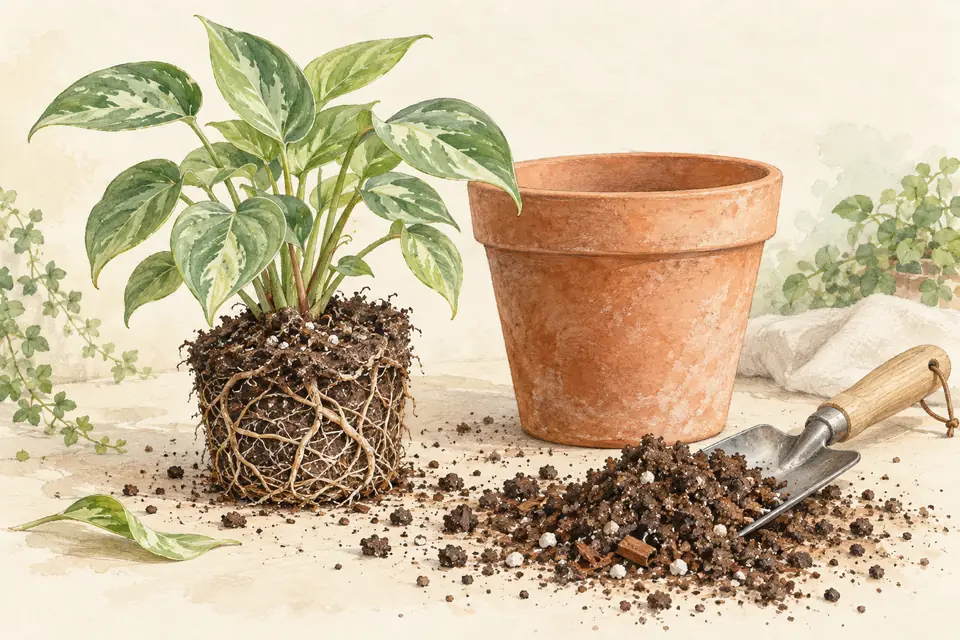
Repotting may be appropriate when the mix or roots have deteriorated. Choose a suitable fresh mix and a clean container with drainage, and follow advice for the species. Avoid unnecessary disturbance to healthy roots and do not use peroxide baths or other chemical treatments without reliable, specific guidance.
If damage is rapid, several plants are affected, or the cause is unclear, contact a plant diagnostic service. An online guide cannot confirm the pathogen or guarantee recovery.
Salt build-up: a third cause of wilting
Fertilizer and the minerals in tap water leave salts behind as water evaporates from the potting mix. A high salt level makes it harder for roots to take up water. Signs include brown leaf tips, slow growth, falling lower leaves, and wilting even in moist mix. A white crust may form on the mix, around the drainage hole, or on clay pots.
To leach the pot, scrape off any crust first. Pour clear water equal to at least twice the pot’s volume through the mix, then let it drain completely. University of Maryland Extension suggests leaching every four to six months, before you fertilize. It also advises against softened water for houseplants.
Watering through the seasons
The same pot dries at different speeds through the year. The RHS warns that overwatering is easy in winter, when growth slows. In a Mediterranean climate such as Lebanon’s, the contrast is strong. In hot, dry summers, small pots near sunny windows can dry much faster, so check them more often. In mild, wet winters, unheated rooms stay cool and the mix stays wet longer. A pot near a stove or radiator dries faster than one across the room.
5. Prevent the same problem returning
- Group plants by their actual moisture needs rather than watering every pot together.
- Check again when seasons, heating, light, or pot size change.
- Keep drainage holes open and empty collected water after watering.
- Use a short care record to connect changes with the plant’s response.
How to use the watering worksheet with this guide
The watering worksheet summarizes your recorded drying intervals and measured water amounts. It cannot measure roots or moisture, or predict the next watering. Make care decisions from the plant and mix in front of you.
- Water only when your moisture check says the plant needs it, and note the date.
- When the check says “water” again, count the days. This is one completed drying interval.
- Enter at least two intervals. The worksheet shows the middle value and the range.
- To see how much water the mix held, enter the water you poured and the runoff you collected, in milliliters.
- Start a new record after a change of season, pot, potting mix or position.
For example, intervals of 5, 7 and 6 days give a middle value of 6 days and a range of 5–7 days. Use that to plan when to check the plant, not when to water it. If you pour 500 ml and collect 120 ml, the mix held about 380 ml.
Open the watering observation worksheetBottom watering: what it does and what it cannot tell you
Bottom watering lets water rise through drainage holes into the potting mix. Use a clean saucer or shallow container only when this plant actually needs water; then remove the pot, let it drain, and empty any remaining water. Do not leave a houseplant standing in water.
Check that moisture has reached the part of the root zone you intended to water. Bottom watering does not prove the whole pot is evenly moist, and it does not tell you when to water again. University of Maryland Extension also advises watering from the top when needed to help carry accumulated fertilizer salts out through the drainage holes.
How often should I water a snake plant?
There is no reliable number of days for every snake plant. The Royal Horticultural Society advises watering sansevierias only after the compost has dried out; check the mix rather than watering on a calendar. Their drought-tolerant leaves store water, while consistently wet mix can damage roots.
Light, season, pot size, temperature, and the growing mix change how long drying takes. Check below the surface, water when the plant and mix call for it, allow excess water to drain, and empty the saucer. A drying interval recorded in the worksheet describes your past conditions, not the date of the next watering.
Frequently Asked Questions
Answers to common questions about plant care and this tool.
Your plant observation record
Keep a dated record you can compare later or take to a local expert. These notes are your observations, not an identification or diagnosis.
Include the moisture-check method, below-surface observations, drainage, and changes since the previous check.
Notes stay on this page and are not uploaded or saved automatically. Download them before leaving. Keep photos separately.
Related plant guides and tools
View all guides
Further reading and references
- How to grow houseplants — Royal Horticultural Society General guidance on watering, drainage, potting mix, and repotting. [Source ]
- How to help a poorly houseplant — Royal Horticultural Society Practical checks for both insufficient and excessive watering. [Source ]
- Watering Indoor Plants — University of Maryland Extension Top and bottom watering methods, drainage, and soluble-salt considerations. [Source ]
- How to grow sansevierias — Royal Horticultural Society Snake plant watering based on the drying compost rather than a calendar. [Source ]