How to identify a flower: a step-by-step guide for beginners.
To identify a flower, record its features in a set order: where it grows, its symmetry and petal count, what its leaves look like, and whether the flowers grow singly or in clusters. Then compare those notes with a regional field guide, a plant database, or a photo-identification app. No single feature is enough on its own, but the combination usually narrows the possibilities to a few species. Identification is easiest when the plant is in bloom and you have clear photographs. Always check a suggested name against the actual plant, and never taste or eat an unknown plant.
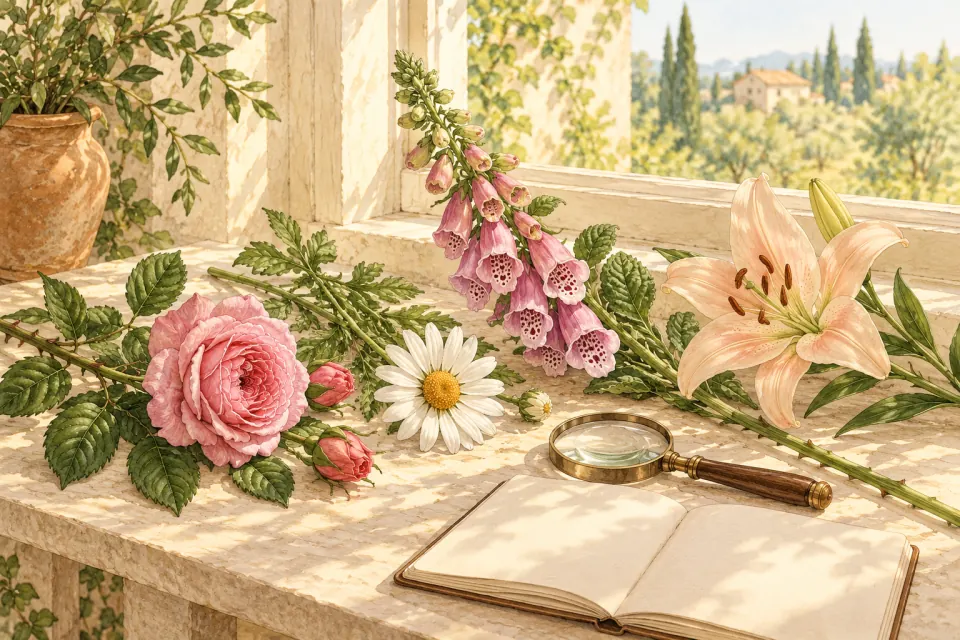
Why order matters when identifying a flower
Beginners often start with color and get stuck. Botanists classify plants mainly by the number and arrangement of their floral parts, because those details say more about relationships between species than color does. Following the same sequence of observations every time makes sure you do not skip the traits that separate one plant from its lookalikes.
Step by step: how to identify a flower
Step 1: Note where and when you found it
Record the date, the region, and the habitat, such as woodland, roadside, meadow, or a pot, and whether the plant is growing wild or was planted. Location alone cannot name a plant, but it rules out many wrong candidates. Work with the plant in bloom whenever you can: most identification keys depend on flower characters, so a plant without flowers is much harder to name with confidence.
Step 2: Photograph the plant before touching it
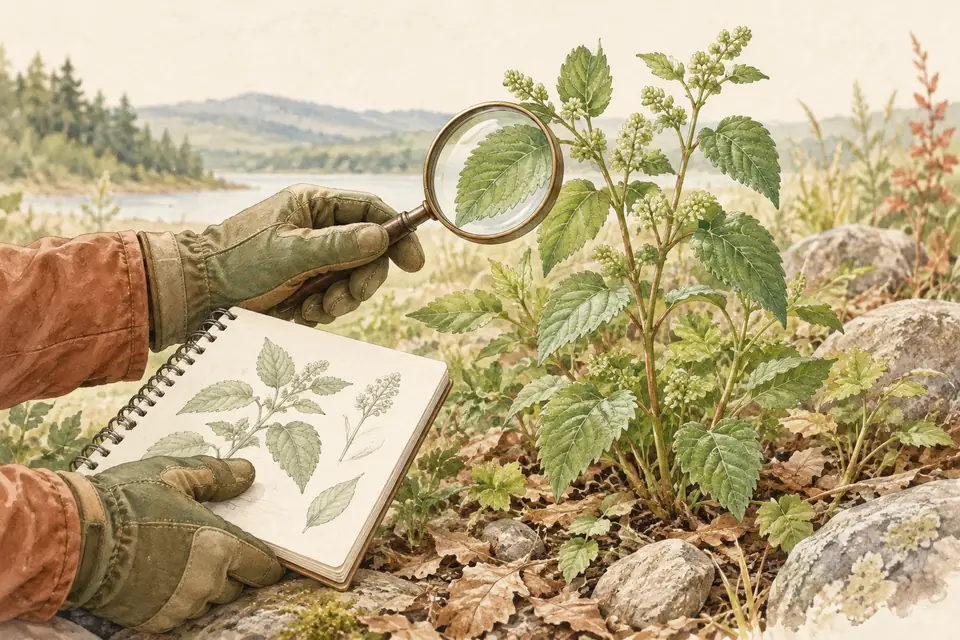
Take a wide shot of the whole plant, a photo of the leaves attached to the stem, and the flower from the front and from the side. Poison centers that offer plant identification ask for the same views, showing the stem, seeds, flowers, and the whole plant, so that a specialist can examine them. Do not pick or cut the plant, and avoid handling an unknown plant with bare hands: some have irritating sap, fine hairs, or thorns.
Step 3: Check the flower’s symmetry
A radially symmetrical (regular) flower can be divided into three or more identical parts, like a wheel. A bilaterally symmetrical flower, such as an orchid or a snapdragon, can be divided into two mirror-image halves in only one way. Be careful with daisy-like heads: a sunflower or a dandelion looks like a single flower but is actually many tiny flowers packed together.
Step 4: Count the petals and see whether they are joined
Most flowers have 3, 4, or 5 petals. They may be separate, or fused into a tube or bell, as in the bottle gentian, whose five petals are joined along their whole length. Look behind the petals too. Green sepals protect the bud, and in some plants brightly colored bracts, which are modified leaves, do the job of petals.
Step 5: Read the leaves
Check how the leaves attach to the stem: alternate (staggered), opposite (in pairs), or whorled (three or more at one point). Then look at the blade. Is the venation or lobing pinnate, arranged like a feather, or palmate, spreading like the fingers of a hand? Note whether the edges are smooth, toothed, or lobed.
Step 6: Decide whether flowers grow alone or in clusters
The structure that carries a group of flowers is called an inflorescence. Common types include the spike, raceme, corymb, panicle, umbel, and cyme. A description of the cluster, such as a flat-topped head or a spike along a stem, is an extra clue for matching a reference book.
Read how to tell a raceme from a spike or umbel
Step 7: Narrow the list with a key or database
A simple key is a series of questions. The method in Newcomb’s Wildflower Guide asks about flower symmetry, the number of petals, the type of plant, and the arrangement and margins of the leaves, then sends you to a page with a description and an illustration. For plants in the United States, the USDA PLANTS database covers vascular plants, mosses, liverworts, hornworts, and lichens of the US and its territories; elsewhere, use a national or regional flora.
| Clue | What to look for | Example |
|---|---|---|
| Symmetry | Wheel-like or two mirror halves | Daisy-like vs. orchid |
| Petals | Number, separate or fused | 3, 4 or 5 petals; bell or tube |
| Leaf arrangement | Alternate, opposite, whorled | Pairs at each node |
| Leaf shape | Pinnate or palmate; edge type | Feather-like vs. hand-like |
| Flower cluster | Single, spike, umbel, panicle | One bloom vs. flat-topped head |
Using photo apps for flower identification
| Method | Best for | Main limit |
|---|---|---|
| Field guide or key | Learning which features matter | Needs correct terms; color-sorted guides can mislead |
| Plant database | Checking a shortlisted name | Often covers one country or region |
| Photo app | A fast list of possible matches | Accuracy varies by species and photo quality |
| Local expert or extension office | Unfamiliar or risky plants | Slower |
Apps are a good starting point, not a final ruling. They tend to do better on species that are commonly observed and well photographed. Doofer’s identifier returns possible matches with a model score, and even a high score cannot show that a plant is safe to eat, touch, or keep near pets. Compare every suggestion with your real specimen: leaf arrangement, petals, stem, and flower cluster.
Common mistakes beginners make
- Relying on color. What you call purple may be classed as white, blue, or pink by a botanist.
- Using one photo. A close-up of a petal cannot show leaf arrangement.
- Skipping the leaves. Many flowers look alike; the leaves often separate them.
- Trusting a confidence score. A score is the model’s estimate, not proof.
Safety: what to do with an unknown plant
Never eat any part of an unknown plant, and do not assume it is safe because birds or animals eat it. If someone swallows an unknown plant, a poison control center may not be able to identify it from a verbal description alone, so keep photographs and, if possible, a sample of the plant. When you ask for help, give the botanical name if you have it, because different plants can share a common name. In the United States, Poison Help is 1-800-222-1222; elsewhere, contact your local poison control center.
Frequently Asked Questions
Answers to common questions about plant care and this tool.
Related plant guides and tools
View all guides
Further reading and references
- Newcomb’s Wildflower Guide — Lawrence Newcomb, Little, Brown and Company A key based on flower symmetry, petal number, plant type, and leaf arrangement, covering the northeastern and north-central United States and adjacent Canada.
- PLANTS Database — USDA Natural Resources Conservation Service Standardized names, distribution maps, and images for vascular plants, mosses, liverworts, hornworts, and lichens of the United States and its territories. [Source ]
- Poison Help: 1-800-222-1222 — America’s Poison Centers Free, confidential help in the United States for suspected poisonings, including plant ingestions. Outside the US, use your national poison center. [Source ]