Inflorescence types: how to tell a raceme from a spike or umbel.
An inflorescence is a cluster of flowers arranged on a plant’s stem, and the fastest way to separate a raceme, a spike, and an umbel is to look at the flower stalks. A raceme has a long axis with flowers on short individual stalks. A spike has the same long axis, but its flowers sit directly on it with no stalks. In an umbel, every flower stalk starts from one point at the top of the stem and fans out like an umbrella. Check the stalks first and the overall shape second, and you can name most flower clusters quickly.
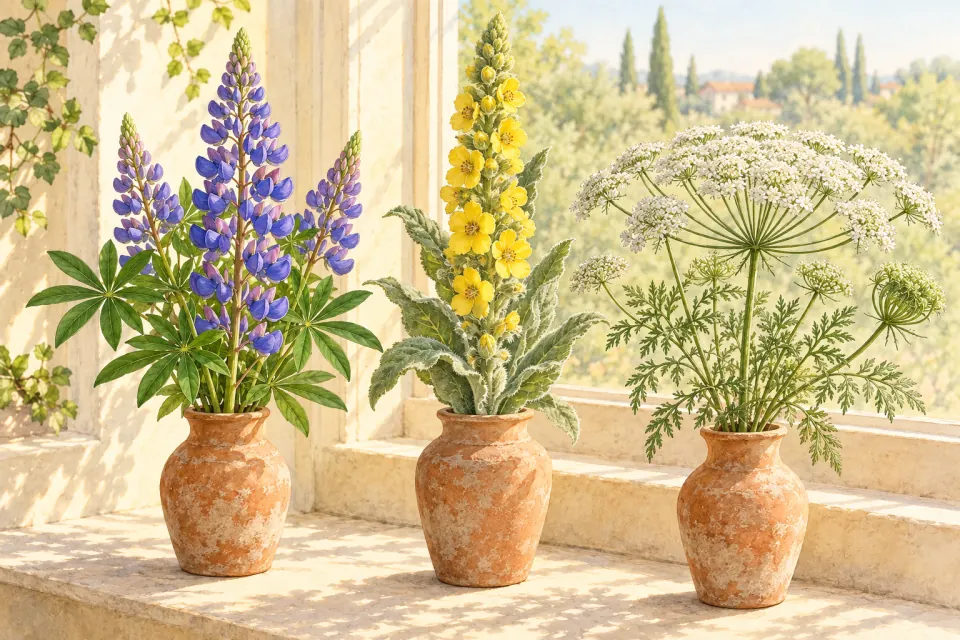
What an inflorescence is and the terms you need
Botanists classify inflorescences by how the flowers are arranged on the main axis and by the order in which they open. Structure also affects pollination. Flat-topped clusters give pollinators a wide landing area, while upright or hanging columns make them move up or down to reach each flower.
Four terms appear throughout this guide:
- Peduncle: the stem holding the whole inflorescence.
- Pedicel: the stalk of each individual flower.
- Sessile: having no stalk, so the flower attaches directly to the axis.
- Rachis: the main axis that the flowers attach to.
Raceme, spike, and umbel sit in the racemose (indeterminate) group. In an indeterminate inflorescence there is no true terminal flower, so the tip keeps producing new flowers and the oldest ones are at the base of a raceme or spike. In the determinate (cymose) group, each axis ends in a flower. Most references place the umbel with the racemose group, although some note that umbels can be determinate or indeterminate.
Raceme, spike, and umbel compared
| Feature | Raceme | Spike | Umbel |
|---|---|---|---|
| Main axis | Long, unbranched | Long, unbranched | Very short; stalks meet at the top of the peduncle |
| Flower stalks | Present (pedicels) | Absent (sessile flowers) | Present, about equal in length |
| Overall shape | Long and narrow | Long and narrow | Flat-topped or rounded, like an open umbrella |
| Opening order | Bottom to top | Bottom to top | Varies |
| Examples | Lupin, mustard, foxglove | Mullein, bottlebrush, plantain | Onion, hogweed, coriander |
Raceme: flowers on short stalks along one axis
A raceme has a single, unbranched axis that keeps growing at the tip while flowers open along its length. Each flower sits on its own short stalk, the pedicel, and the pedicels are usually about the same length, so the cluster looks like a long, loose column. Because the axis is indeterminate, the oldest flowers and the first fruits are at the bottom, buds are at the top, and a single raceme can show buds, open flowers, and developing pods at the same time.
Lupins, foxgloves, and many plants in the mustard family (Brassicaceae) carry typical racemes. Hyacinths and grape hyacinths are smaller examples that are easy to examine in a garden. In the mustards you can often see the whole sequence on one stem: open flowers near the top with a ladder of elongating seed pods below them.
To separate a raceme from a spike, pick a mature flower in the lower half of the cluster and follow it back to the axis. If there is a visible stalk between the flower and the axis, however short, the inflorescence is a raceme. If the flower base touches the axis directly, it is a spike. Buds can be misleading because the pedicel often lengthens as the flower matures.
Spike inflorescence: flowers without stalks
A spike inflorescence is elongated, unbranched, and indeterminate, with sessile flowers. Mullein (Verbascum) is a commonly cited example, and so are bottlebrush (Callistemon) and plantain (Plantago).
Three related forms often get mixed up with spikes:
- Catkin: a spike whose flowers are unisexual and lack a conspicuous perianth. Birch, hazel, and willow catkins are familiar examples.
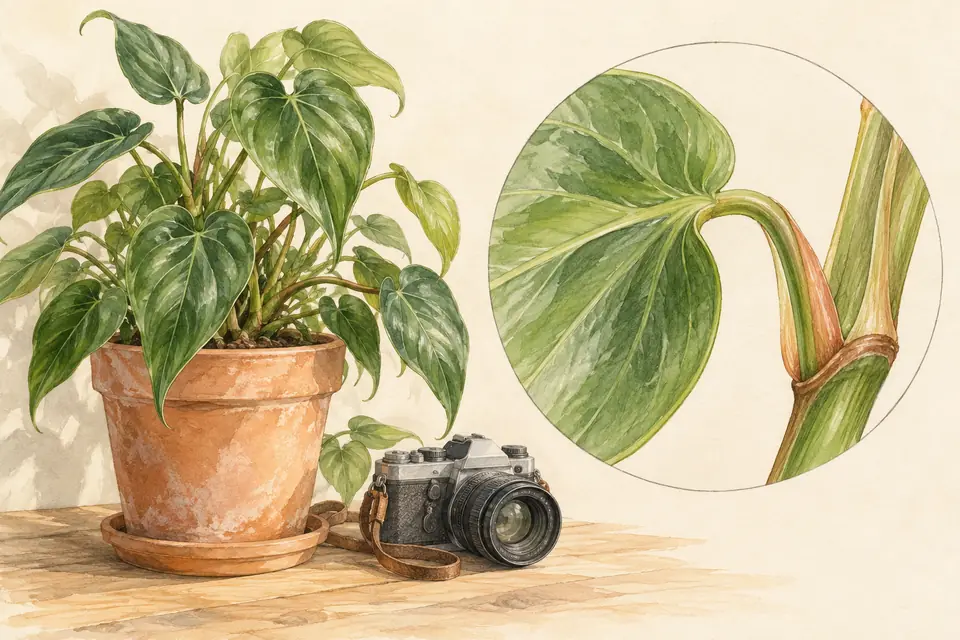
- Spadix: a thick, fleshy flower spike surrounded by a leaf-like bract called a spathe. Many plants in the arum family, including monstera, philodendron, and pothos, flower with a spathe and spadix.
- Spikelet: a small spike, characteristic of grasses and sedges. It is a unit inside a larger inflorescence, not the whole cluster.
Umbel: flower stalks from a single point
In an umbel, the individual flower stalks all emerge from the tip of the main stalk, and they are of roughly equal length. As a result, the top of the cluster appears flat or gently rounded, like an open umbrella. Onion is a common example; hogweed and coriander are others.
A compound umbel adds another level of organization. Primary stalks, called rays, emerge from a common point, and each ray ends in a smaller secondary umbel. This arrangement is characteristic of the carrot family (Apiaceae), which includes carrot, parsley, fennel, and also several dangerous plants such as poison hemlock. An umbrella-shaped flower cluster alone never tells you whether a plant is safe; see the wild plant safety guide before handling an unknown member of this family.
How to identify inflorescences in four checks
- Find where the flower stalks begin. If they all start from the same point and reach about the same height, it is an umbel. If each ray ends in a smaller umbel, it is compound.
- Look at the main axis. A long axis with flowers spaced along it points to a raceme or spike. A dense, flattened disc of tiny flowers is a head, covered below.
- Check a mature flower for a stalk. A visible pedicel means raceme. No pedicel means spike.
- Look for branching. A branched raceme is a panicle, and a flat top despite a long axis suggests a corymb.
When you photograph a plant to compare it with references, capture the whole cluster from the side, then a close-up of a few mature flowers so the stalks, or the lack of them, are visible. The plant photo guide explains how to photograph leaves, flowers, and scale for easier comparison.
Similar inflorescences that cause confusion
- Panicle: a branched raceme, where the lateral branches bear stalked flowers. Many grasses and lilacs have panicles.
- Corymb: a racemose inflorescence in which the lower flowers have longer stalks, bringing all the flowers to approximately the same level; the outer flowers open first.
- Head (capitulum): a dense cluster of sessile flowers on a flattened base, characteristic of the daisy family (Asteraceae).
- Cyme: a determinate cluster that is more or less flat-topped, where the central flower opens first and the outer flowers open last.
Common mistakes when naming inflorescences
- Deciding from buds rather than open flowers. It is easiest to observe the stalks after the flowers have matured.
- Treating a single spikelet as the entire spike. In grasses, the spikelet is only a building block.
- Expecting every plant to fit neatly into one category. In some groups, particularly the protea family, the inflorescence is a complex structure made up of many tiny florets, and the terminology becomes ambiguous.
- Overlooking the fruiting stage. The fruiting stage of an inflorescence is called an infructescence, and its shape can still show whether the flowers were stalked.
Inflorescence type is one clue among several. Combine it with flower symmetry, petal count, and leaf arrangement, as described in the step-by-step flower identification guide.
Frequently Asked Questions
Answers to common questions about plant care and this tool.
Related plant guides and tools
View all guides
Further reading and references
- Inflorescence — Wikipedia General overview of racemose and cymose inflorescence types with diagrams. A community-edited reference; cross-check terms against a botanical glossary. [Source ]
- Newcomb’s Wildflower Guide — Lawrence Newcomb, Little, Brown and Company A field guide whose key uses flower symmetry, petal number, and flower arrangement, including whether flowers are single, in spikes, or in clusters.