Find better light for your houseplants.
A room that looks bright to you may offer very different light at each plant. Check the actual position, the hours of sun, and the needs of the species before moving a pot or buying a lamp.
1. Observe the spot through the day
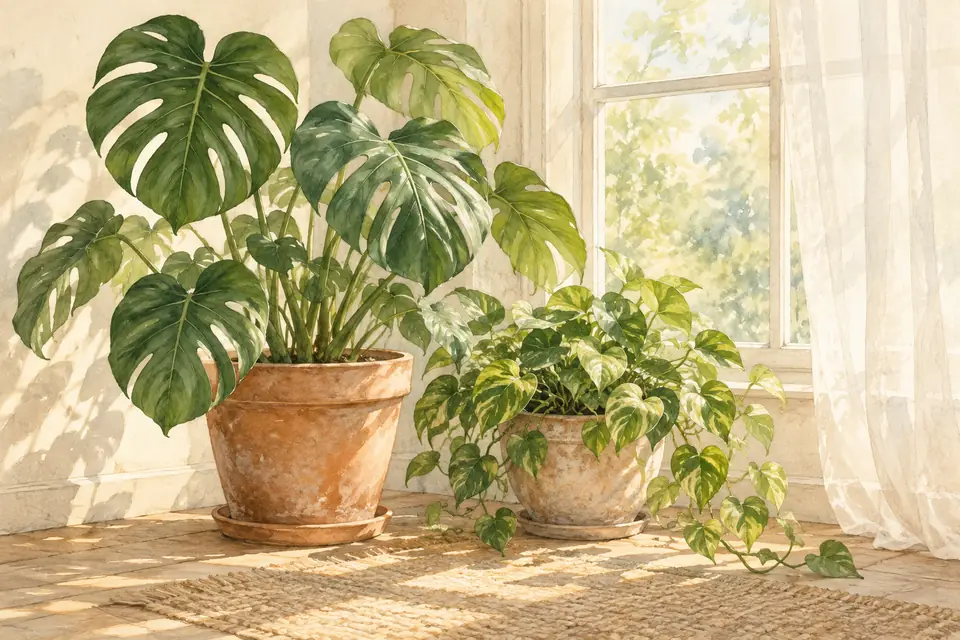
Look at the leaves in the morning, around midday, and later in the afternoon. Record when direct sun reaches them and what blocks it. Buildings, trees, curtains, window coatings, and roof overhangs all matter. Repeat the check when seasons change.
Window direction is a starting point, not a measurement. In much of the Northern Hemisphere, south-facing windows often receive more direct sun; in the Southern Hemisphere, north-facing windows often do. East and west windows can receive morning and afternoon sun respectively, but local obstructions may change the pattern.
Light usually decreases as you move away from a window. A window is an extended opening, so a simple inverse-square formula cannot reliably predict the percentage remaining at your plant. Compare the actual locations instead.
Try the shadow test
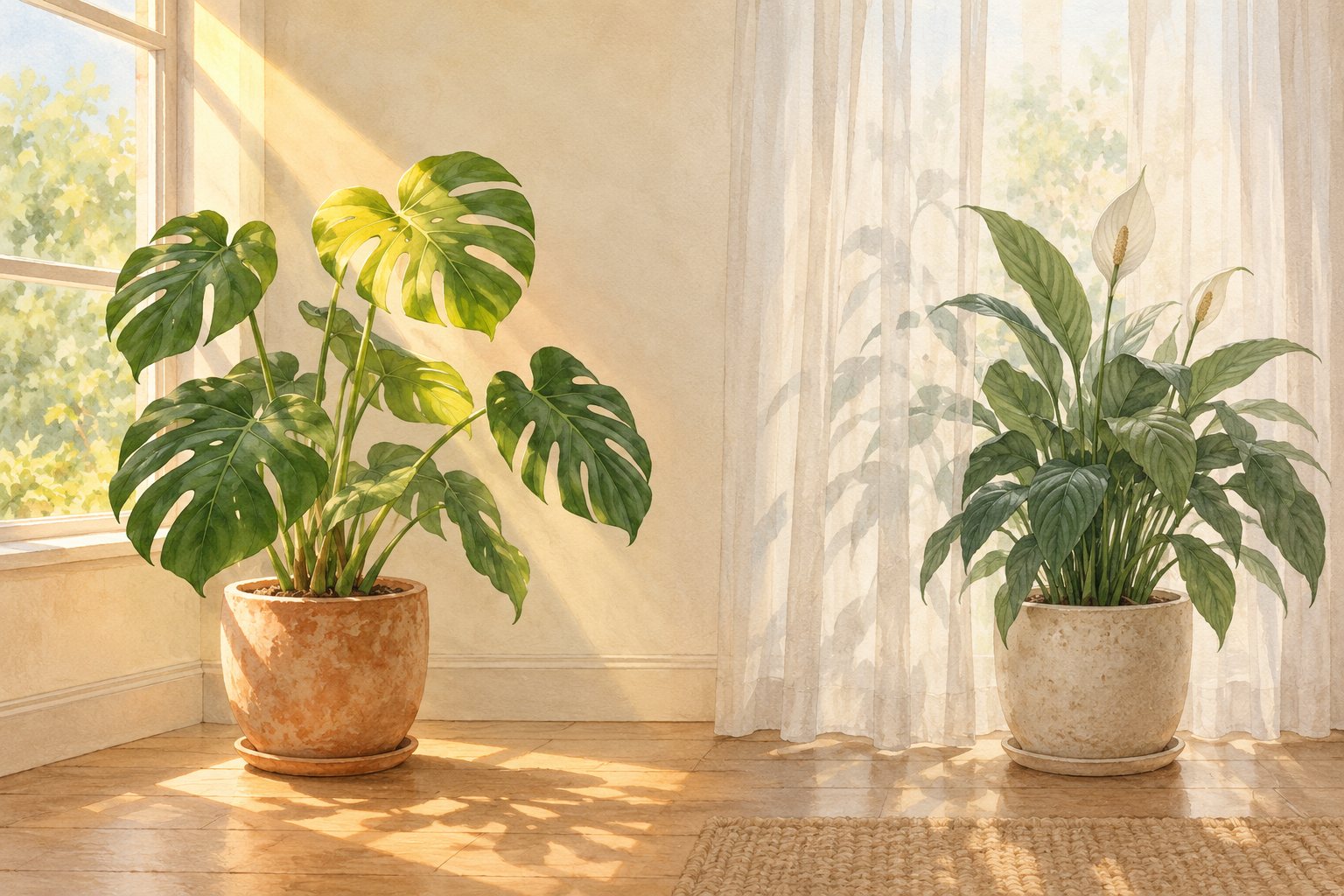
Your eyes adjust quickly, so a room can feel bright while the light at the plant is weak. On a clear day around midday, hold your hand about 30 cm above the leaves. A sharp, dark shadow means direct sun. A soft shadow with blurred edges means bright light without direct sun, which the RHS calls bright shade. A faint shadow, or none, means lower light. The test ranks spots in your home; it does not give a number.
2. Understand the labels
| Light description | What to check |
|---|---|
| Direct sun | Sunlight reaches the leaves without shade. Check how many hours it lasts and whether the plant tolerates it. |
| Bright indirect light | A well-lit position with the foliage out of direct sun. The phrase does not specify one universal meter reading. |
| Lower light | Less light may suit shade-tolerant foliage plants, but every plant still needs light. Growth and water use may slow. |
Match the position to the identified species. A plant tolerating a dim corner does not mean it will grow densely or flower there. Move plants gradually into stronger light and watch for bleaching or scorched patches.
A rough guide to light levels
University of Maryland Extension groups houseplants into broad bands measured in foot-candles (FC). One foot-candle equals about 10.76 lux. The window directions below apply to the Northern Hemisphere, which includes Lebanon.
| Light band | Approximate reading | Typical position | Example plants |
|---|---|---|---|
| Low light | 25–100 FC (about 270–1,080 lux) | North-facing windows, or rooms lit mainly by lamps | Snake plant, cast iron plant, ZZ plant, peace lily |
| Medium light | 100–500 FC (about 1,080–5,400 lux) | East- or west-facing windows | Chinese evergreen, rubber plant, African violet |
| High light | 500–1,000 FC (about 5,400–10,800 lux) | South-facing windows and some west-facing windows | Croton, jade plant, hoya |
| Direct indoor sun | Over 1,000 FC (over 10,800 lux) | 4–6 hours of direct sun, such as an unshaded south-facing bay window | Citrus, cacti and other succulents |
Treat these bands as a rough guide, not a target for one species. Flowering houseplants often need more light than foliage plants.
Choosing a houseplant for a low-light room
Low light means less available light, not darkness. University of Minnesota Extension lists these foliage plants among its low-light choices. Confirm the exact species and its care needs before buying; slower growth and less frequent drying are common in lower light.
| Plant to research | Check before choosing |
|---|---|
| Cast iron plant (Aspidistra) | Compare the proposed position with the growing guidance for the species. |
| Parlor palm (Chamaedorea) | Check the scientific name and leave room for the plant’s mature size. |
| Pothos (Epipremnum) | Plan where the stems will grow and check access by children and pets. |
| Snake plant (Dracaena trifasciata) | Check moisture before watering; a dimmer position may dry more slowly. |
Which low-light plants are suitable around cats and dogs?
Light tolerance and pet toxicity are separate checks. Match the scientific name to a veterinary plant listing. A non-toxic listing does not mean a pet can chew unlimited amounts without stomach upset.
Parlor palm (Chamaedorea elegans) is one option to research: it appears on the low-light list, and ASPCA lists that species as non-toxic to cats and dogs. Confirm the name on the label; sago palm is a different, toxic plant.
Check plant risks for cats and dogs
Can a plant grow in a room without a window?
Artificial lighting can support some plants. A 2024 growth-chamber study tested three foliage species under white LEDs and found that both intensity and daily duration affected growth. Its controlled conditions do not establish one lamp setting for every home or species.
Before choosing a plant for a windowless room, check the lamp’s output, hours of use, and the species’ needs. Use the light worksheet to record measurements, then compare new growth over time.
How light changes through the year
A spot that suits a plant in March may scorch it in July or leave it short of light in December. The RHS notes that many houseplants benefit from a move closer to a south- or west-facing window in winter, when sunlight is weaker. In summer, strong sun through glass can scorch leaves that grew in shade.
In a Mediterranean climate such as Lebanon’s, summers are hot, dry and mostly clear. From late spring to early autumn, move sensitive foliage plants back from unshaded south- and west-facing windows. A sheer curtain in the afternoon also works. Winters are mild but cloudier and wetter, so bring plants closer to the glass and expect the potting mix to dry more slowly.
Clean the windows and wipe dust from large leaves now and then. Both grime and dust reduce the light that reaches the plant.
3. Measure consistently
For a useful comparison, place the same meter at leaf level in each location, with the sensor facing consistently. Note the time and weather. One reading cannot describe a whole day, and phone readings depend on the device, app, and calibration.
- Lux and foot-candles describe illuminance weighted for human vision. They can help compare similar light sources, but do not directly measure plant growth potential.
- PPFD describes the rate of photons reaching a surface within a defined wavelength band. Check the lamp’s measurement conditions, distance, and coverage area.
- DLI describes the accumulated light over a day. A brief bright period and a full day of steady light are different exposures.
There is no single lux-to-PPFD conversion suitable for every lamp and daylight condition. Use species-specific guidance and measurements appropriate to the light source.
How to use the light calculator with this guide
The light calculator turns your own readings into numbers you can compare. It does not choose a spot for you.
- Measure each spot at leaf height, with the same meter and sensor direction.
- Enter a lux or foot-candle reading to convert between those two units.
- Enter a PPFD reading with the hours the light stays near that level. The calculator shows the DLI.
- For daylight that changes, enter up to three periods, each with an average PPFD and its hours.
- Copy the results into the observation record below, with the date and weather.
PPFD needs a quantum meter, also called a PAR meter. The calculator does not convert lux into PPFD, because the conversion depends on the light source.
For example, a grow lamp gives a steady 200 µmol/m²/s at the leaves for 8 hours. The calculator multiplies 200 × 8 × 0.0036 and shows 5.76 mol/m²/day. Compare that figure with guidance for your species, then watch new growth.
Calculator estimates are planning aids. They do not measure your room or replace readings at the leaves.
4. Add a grow light thoughtfully
Choose a fixture with information about its output and coverage at the intended distance. Electrical wattage alone does not tell you how much useful light reaches the leaves. Follow the manufacturer’s mounting and electrical safety instructions.
Use a timer and choose the light period for your species and purpose, allowing an appropriate dark period. Check the plant as it grows toward the fixture. Flowering responses can depend on day length, so leaving a lamp on longer is not always helpful.
University of Maryland Extension advises no more than 16 hours of light a day in total, counting daylight and lamps together. Some flowering plants, such as poinsettia, kalanchoe and Christmas cactus, form buds only when days are short. For these plants, that means about 11 hours of light or less. A lamp or a room light left on every evening can stop them flowering.
5. Review the plant’s response
Track new growth over the following weeks. Long spaces between leaves, leaning, or failure to flower can suggest insufficient light, while bleaching or scorch may follow excessive exposure. These signs are not specific to light: also check watering, temperature, and pests.
Recheck moisture after changing the location. A warmer, brighter spot may dry faster, while a dimmer spot may stay wet longer. Adjust watering to the plant and mix rather than keeping the old calendar unchanged.
| What you see | Possible light cause | What to check | What to do |
|---|---|---|---|
| Long, thin stems that lean toward the window | Too little light | Compare the gaps between new leaves and older ones. | Move the plant closer to the light in stages. Turn the pot a quarter turn every week or two. |
| Variegated leaves turn plain green | Too little light | Look at the newest leaves. | Give the plant a brighter spot without hot afternoon sun. |
| Pale, washed-out leaves or brown dry patches on the sunny side | Too much direct sun | Did the damage appear after a move or a hot spell? | Move the plant back or use a sheer curtain. Damaged patches stay; judge the new leaves. |
| Many leaves drop soon after a move indoors | Adjustment to lower light, common in weeping fig (Ficus benjamina) | Was the plant outdoors or in a brighter room before? | Give it the brightest suitable spot and avoid further moves. |
Frequently Asked Questions
Answers to common questions about plant care and this tool.
Your plant observation record
Keep a dated record you can compare later or take to a local expert. These notes are your observations, not an identification or diagnosis.
Include meter units, leaf height, reading times, weather, curtains, and lamp hours.
Notes stay on this page and are not uploaded or saved automatically. Download them before leaving. Keep photos separately.
Related plant guides and tools
View all guides
Further reading and references
- Lighting for indoor plants — University of Minnesota Extension Guidance on light availability, plant responses, and supplemental lighting. Reviewed in 2026. [Source ]
- Adaptation of indoor ornamental plants to various lighting levels in growth chambers simulating workplace environments — Scientific Reports A 2024 experiment with three foliage species under controlled LED lighting. Its results are not a universal prescription for room lighting. [Source ]
- Parlor Palm — ASPCA Chamaedorea elegans is listed as non-toxic to cats and dogs. Confirm the species before choosing a plant. [Source ]
- Lighting Indoor Plants — University of Maryland Extension Foot-candle bands with example plants, the 16-hour limit, short-day flowering plants, and signs of too little or too much light. [Source ]
- How to help a poorly houseplant — Royal Horticultural Society Signs of too little and too much light, winter positions, and leaf scorch on variegated plants. [Source ]