Potting soil mix calculator
Choose an example recipe and scale its ingredients to your batch size. These proportions are starting points, not tested formulas for every plant or growing environment.
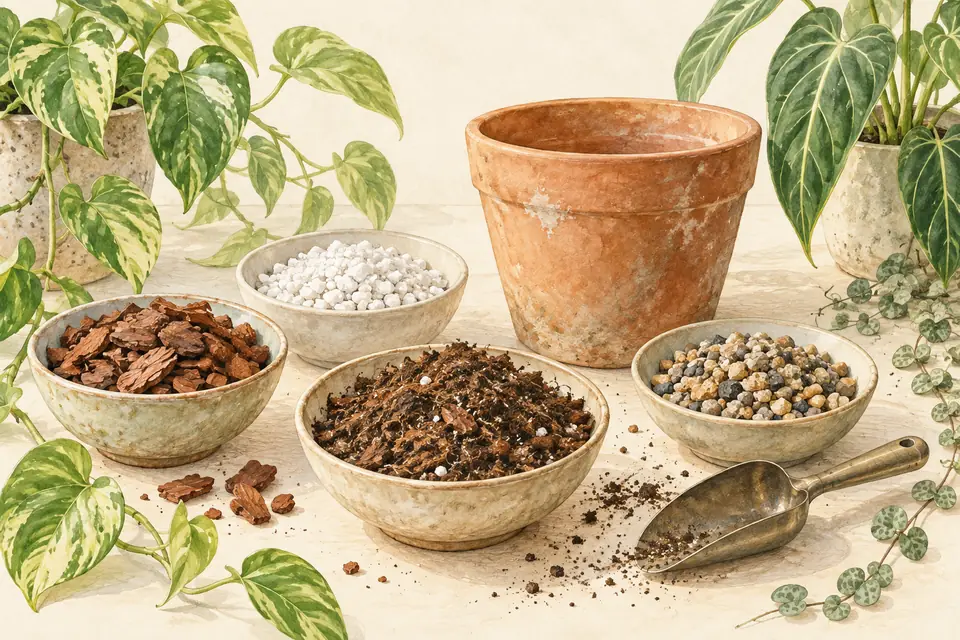
Plan your batch
Use the same measuring container for every ingredient. These are loose volumes, not weights. Follow product instructions for hydration, handling, and dust protection.
Chunky aroid mix
| Component | Ratio | Required Amount | Alternative (cups) |
|---|
How the quantities are calculated
Each ingredient volume equals the batch volume multiplied by its share of the recipe. For example, 35% of a 10-quart batch is 3.5 quarts. Every recipe totals 100%. Rounded displayed amounts may add up slightly differently.
The calculator uses US liquid-quart capacity: 1 quart = 4 US cups = 0.946352946 liters. A US dry quart is a different unit and is not used here. A bag labeled in dry quarts will not match these quart measurements.
Measure ingredients loosely and consistently. Hydrate compressed coir according to its packaging before measuring. Mixing, settling, and differences in particle size can change the final volume, so make a small trial batch before scaling up.
Choose ingredients for the plant and the pot
A ready-made mix labeled for your plant can be a practical choice. Custom mixing lets you adjust texture, but a long ingredient list does not make a mix better. Start with the needs of the species and the way your existing mix dries.
Bark, coir, perlite, pumice, and compost differ between suppliers. Fine particles and coarse pieces behave differently, even when their labels use the same material name. The calculator cannot infer drainage, pH, or nutrient content from percentages alone.
Biochar, compost, and worm castings also vary in their salt and nutrient content. Follow the product label and avoid assuming an ingredient will correct pH or replace a feeding plan. The recipes do not calculate fertilizer or lime doses.
Check the result after repotting
Use a pot with drainage holes and let excess water escape. Empty standing water from saucers or decorative outer pots. Observe moisture below the surface and adjust watering to the plant, rather than treating a coarse mix as protection against overwatering.
Keep a note of the recipe, pot size, date, and how the plant responds. If the mix stays wet too long or dries before you can water, review the container, light, and watering habits as well as the ingredients. Change one factor at a time so you can understand the effect.
Watering CalculatorFrequently Asked Questions
Answers to common questions about plant care and this tool.
Further reading and references
- How to grow houseplants — Royal Horticultural Society General guidance on houseplant compost, watering, and repotting. This source does not validate the example recipe percentages. [Source ]