Wild plant lookalikes: what a photo cannot tell you.
Edible and poisonous plants can share leaves, flowers, and habitats. This guide explains why a photo suggestion, one field mark, or a confidence score cannot establish that a wild plant is safe to eat.
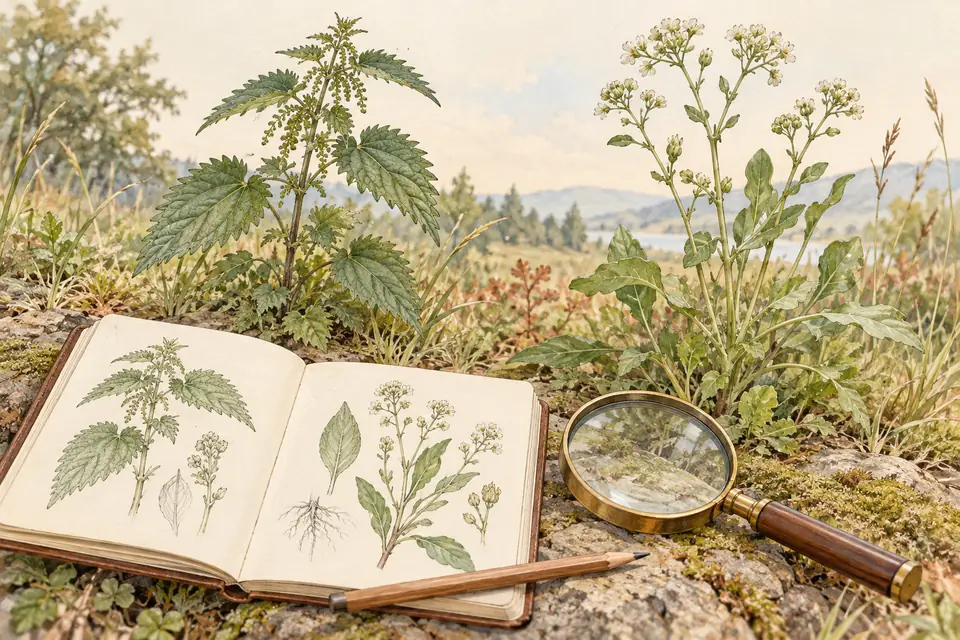
Do not decide edibility from a photo
Do not eat an unfamiliar wild plant or mushroom because an app, smell, or single visible feature suggests a match. If someone may have eaten a poisonous plant, contact a poison center or emergency service promptly; do not wait for symptoms or try a home treatment. In the United States, Poison Control is available at 1-800-222-1222. Elsewhere, use your local poison or emergency service.
Why lookalikes fool careful people
Poison Control notes that people rarely eat poison hemlock on purpose. Modern cases often follow a wrong identification. Four things make these mistakes easy.
- Growth stage. A young rosette of leaves looks very different from the same plant in flower. Lookalikes can be hardest to separate when they are young and tender, which is when foragers pick them.
- Mixed patches. A toxic plant can grow inside a patch of edible greens. If you pull handfuls, one wrong stem can end up in the bunch.
- Regional differences. A field guide from another country may not show the toxic species that grow where you live.
- Memory. A spot that gave you wild greens last spring may hold a different plant this year.
Wild carrot and poison hemlock
The parsley family includes familiar food crops and dangerous lookalikes. Poison hemlock has been mistaken for edible plants, including wild carrot. Stem spots, odor, and other clues can vary with growth stage; Poison Control notes that some familiar signs may be absent. No row in this table is an identification key or permission to eat a plant.
| Possible clue | Why it is insufficient | Safer action |
|---|---|---|
| Purple stem marks | Characteristic markings may not be visible at every growth stage. | Do not rule out poison hemlock because spotting is absent. |
| Umbrella-shaped flowers or finely divided leaves | Related species can share these features, especially in a small photograph. | Ask a qualified local botanist or extension service to compare the whole plant. |
| Smell | Odor descriptions are subjective and cannot establish edibility. | Do not taste or crush a suspect plant as a test. |
Regional field guides and botanical keys can support learning, but an experienced local specialist should confirm a plant before it is considered for food. When important features are missing, leave the plant alone.
The umbrella-shaped cluster itself is called a compound umbel; the inflorescence types guide explains the term and why it describes a whole plant family rather than one species.
What makes poison hemlock so dangerous
Poison hemlock (Conium maculatum) belongs to the carrot family, Apiaceae, with carrot, parsnip, fennel, and dill. Its poisons, mainly coniine, occur in every part of the plant. They act on the nervous system and can cause tremors, paralysis, and breathing failure. The plant is native to Europe and has spread across most of North America.
Poison Control describes a couple who ate “wild celery” from a park. Both felt sick soon afterwards. About 2 hours after the meal, the woman stopped breathing and needed a ventilator. Both recovered in hospital. The lesson is simple: hemlock poisoning can become severe fast, so it must never be managed at home.
Wild onions and death camas
Poisonous bulb-forming plants may resemble edible wild onions in an early growth stage. The US Forest Service identifies death camas as toxic to humans. An onion-like scent or an app match is not enough to confirm an unknown bulb; do not taste it to find out. Local species, season, and growth stage matter, so seek expert identification rather than following a universal smell test.
The same trap exists in Europe. The leaves of lily-of-the-valley (Convallaria majalis) and autumn crocus (Colchicum) have been mistaken for wild garlic (Allium ursinum). The RHS lists both as toxic if eaten. Smell is a poor safeguard here too, because your hands and basket soon smell of garlic once you have picked some.
Common shortcuts that do not establish safety
- Seeing an animal eat a plant does not show that it is safe for people.
- Cooking or boiling an unidentified plant cannot be assumed to remove its toxins.
- A silver spoon changing color is not a test for plant poison.
- Sweetness or bitterness is not a reliable safety test. Never taste an unknown specimen to identify it.
Common mistakes, and why they happen
| Mistake | Why it happens | What to do instead |
|---|---|---|
| Trusting one feature, such as a smell or a leaf shape | One clear clue feels like proof. | Check leaves, stems, flowers, roots, and habitat together with an expert. |
| Picking by the handful | It is faster, and the patch looks uniform. | Cut one plant at a time and check each stem. |
| Treating an app’s high score as a green light | The number looks precise. | Treat the result as a name to check, never as permission to eat. |
| Learning from photos only | Photos are easy to find online. | Learn in the field from an experienced local person. |
| Letting children copy you | Children see an adult eat a leaf and try the plant next to it. | Do not eat wild plants in front of young children, and teach them never to taste plants. |
Foraging in a Mediterranean climate
In Lebanon and other places with mild wet winters, many people gather wild greens after the winter rains and into spring. Toxic plants grow in the same damp ground at the same time. Poison hemlock is part of the flora of the Mediterranean region and grows fast in wet spring weather.
Gather only the species that a trusted local expert has shown you, ideally in the place they showed you. Wash each bunch, then spread it out and look at every plant before it goes into the pot. Do not pick plants from roadsides, sprayed field edges, or dumping sites at any time of year.
Before collecting or eating a wild plant
- Get local confirmation. Compare several plant structures with an authoritative regional guide and a qualified expert. A model score, even a high one, is not an edibility threshold.
- Consider the site. Roadsides, industrial land, and runoff areas may expose plants to contaminants. No fixed distance makes a collection site safe; follow local land and food-safety guidance.
- Prevent accidental exposure. Keep unknown plants separate from food and away from children and pets. Avoid unnecessary handling; use appropriate protection if contact cannot be avoided.
- Act promptly after a possible ingestion. Contact a poison center or emergency service. If it is safe and does not delay care, keep a photograph or remaining plant material for a specialist to examine.
What to do in an emergency
If someone has eaten a wild plant that might be toxic, act now. Do not wait to see whether symptoms develop.
- Call your emergency number at once if the person has trouble breathing, collapses, has a seizure, or cannot be woken.
- Otherwise, call a poison center or emergency service straight away.
- Do not make the person vomit, and do not give food or drink unless a specialist tells you to.
- Find out who else ate the same dish. Each person needs advice, even if they feel well.
- Keep any leftover plant, raw or cooked, in a sealed bag for the doctors.
- Note when the meal was eaten and when each symptom began.
Early signs of plant poisoning can include nausea, vomiting, dizziness, blurred vision, and weakness. Their absence does not mean the person is safe. For poison hemlock, Poison Control advises going to an emergency department rather than treating symptoms at home.
When to get expert help
| Situation | Who can help |
|---|---|
| You want to learn which local plants are edible | An experienced foraging group, a botanical garden, or a university extension service |
| You are unsure about one plant you picked | A local botanist or extension service. If you still have doubts, discard the plant. |
| Someone ate an unknown wild plant and feels well | A poison center, now |
| Someone ate an unknown wild plant and feels unwell | Emergency services or a poison center, at once |
| A pet ate a wild plant | A veterinarian or animal poison service |
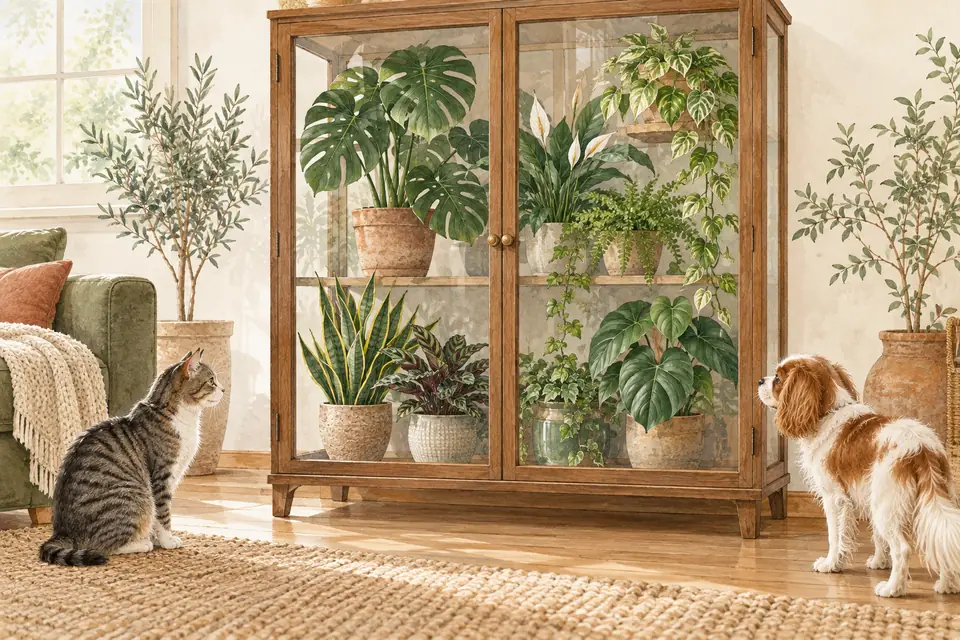
For first aid after skin or eye contact, read the unknown plant safety guide. If a pet was involved, read the guide to toxic plants for cats and dogs.
Frequently Asked Questions
Answers to common questions about plant care and this tool.
Related plant guides and tools
View all guides
Further reading and references
- Can poison hemlock be deadly? — Poison Control Explains mistaken identity, variable visible clues, and the need for prompt expert advice after exposure. [Source ]
- Poisonous and non-poisonous plants: An illustrated list — Poison Control General prevention advice and poison-center contact guidance; the list is not an edibility guide. [Source ]
- Meadow deathcamas species review — US Forest Service Documents toxicity and identification limits for meadow deathcamas. [Source ]
- Reducing lead hazard in gardens and play areas — Oregon State University Extension Discusses lead exposure from soil and dust; site conditions matter more than a universal roadside distance. [Source ]
- Potentially harmful garden plants — Royal Horticultural Society Lists garden plants that are toxic if eaten, including lily-of-the-valley and autumn crocus. [Source ]
- Poisoning — NHS What to do while you wait for medical help, and why you should not make a person vomit. [Source ]