Identify trees and shrubs from leaves, twigs, bark, and regional keys.
Thousands of temperate tree and shrub species can be difficult to tell apart. Identification keys narrow the possibilities using leaf arrangement, simple or compound leaves, winter twigs, and bark.
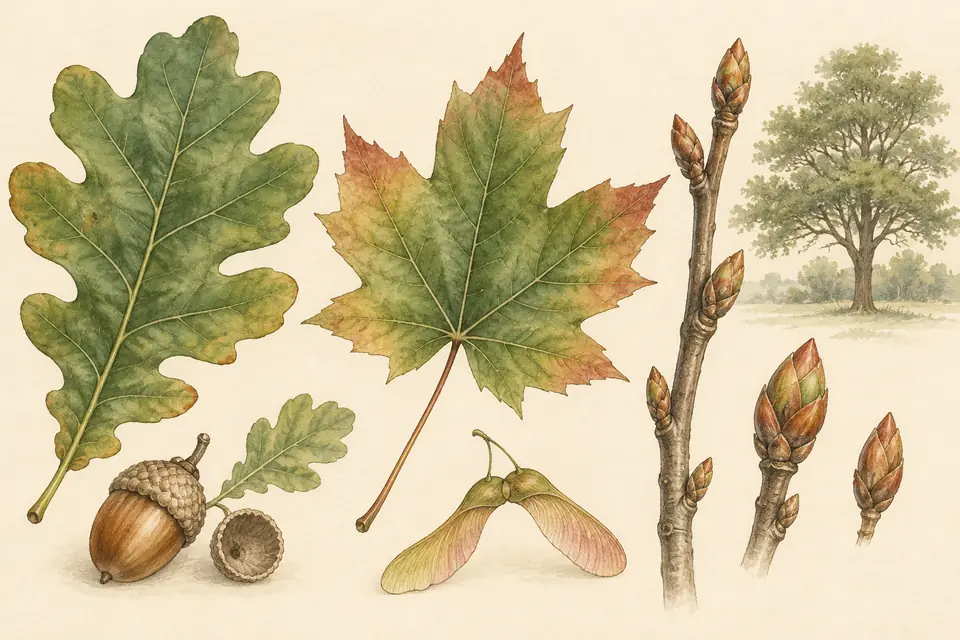
1. Check leaf and branch arrangement
Before comparing leaf shape or color, check: How do leaves, buds, and side twigs attach to the branch?
The "MAD Horse" Rule for Opposite Branching
The great majority of temperate broadleaf trees have alternate branching (one leaf per node, staggered along the stem). Only a select few prominent families exhibit opposite branching (two leaves directly across from each other at each node). Memorize the mnemonic MAD Horse:
- M — Maple (Acer spp.)
- A — Ash (Fraxinus spp.)
- D — Dogwood (Cornus spp.)
- Horse — Horse Chestnut / Buckeye (Aesculus spp.)
This mnemonic is a starting point for some common North American trees, not a worldwide identification key. Other groups also have opposite leaves, and some dogwoods have alternate leaves. Confirm several features with a regional reference.
Alternate & Whorled Branching
With alternate arrangement, one leaf attaches at each node. With opposite arrangement, two attach at a node; with whorled arrangement, three or more do. Crowded leaves near a twig tip can appear whorled, so inspect their actual attachment points.
2. Distinguish simple and compound leaves
A frequent error among beginner botanists is mistaking a single leaflet of a compound leaf for an entire leaf. To determine the true leaf unit, locate the axillary bud on the woody stem:
- Simple Leaf: The blade is single and undivided. An axillary bud sits at the junction where the petiole meets the woody stem (e.g., Oak, Beech, Birch).
- Pinnately Compound: Multiple leaflets line a central axis (rachis) resembling a feather (e.g., Walnut, Hickory, Ash, Mountain Ash). There is never a bud at the base of an individual leaflet.
- Palmately Compound: Leaflets radiate outward from a single central petiole tip like fingers from a palm (e.g., Horse Chestnut, Buckeye).
- Bipinnately Compound: The rachis branches into secondary axes bearing leaflets (e.g., Honey Locust, Kentucky Coffeetree).
Follow a compound leaf to its tip. Some pinnate leaves end in a single leaflet. Others, such as carob (Ceratonia siliqua), end in a pair of leaflets with no leaflet at the tip. That small detail separates many lookalikes.
Do not confuse a deeply lobed simple leaf with a palmately compound leaf. A fig or plane leaf can have deep lobes, but the blade stays joined near the leaf stalk. In a palmately compound leaf, each leaflet is fully separate and can fall on its own.
3. Read the leaf shape, edge, and veins
After arrangement and leaf type, look at the leaf blade itself. Three features help most. The margin is the edge of the leaf. The venation is the pattern of veins. The lobes are rounded or pointed sections of the blade separated by gaps, called sinuses.
| Feature | What you see | Examples |
|---|---|---|
| Entire margin | A smooth edge with no teeth. | Olive, bay laurel, oleander, magnolia. |
| Toothed margin | Small regular teeth along the edge. Look closely, because fine teeth are easy to miss. | Elm, birch, cherry, many willows. |
| Lobed blade | Deep rounded or pointed sections. The gaps do not reach the midrib. | Many oaks, maples, plane trees, fig. |
| Pinnate veins | One main vein down the middle, with side veins branching off like a feather. | Beech, chestnut, oak, elm. |
| Palmate veins | Several main veins spread out from the top of the leaf stalk. | Maple, plane tree, fig, redbud. |
4. Examine winter twigs and bark on deciduous trees
After deciduous trees lose their leaves in autumn, examine their twigs and bark:
| Twig Feature | Clue to inspect | Species Examples |
|---|---|---|
| Buds at the twig tip | Cluster of multiple buds at the twig tip. | Clustered terminal buds can be a useful clue for many oaks. Check the bud shape, leaf scars, bark, and other features in a regional key before deciding. |
| Pith inside the twig | Slice the center of a twig lengthwise to expose the pith. | Chambered pith: Black Walnut (Juglans nigra). Diaphragmed pith: Tuliptree (Liriodendron), Tupelo (Nyssa). Solid pith: Most other hardwoods. |
| Bark Lenticels & Peeling | Raised horizontal pores, called lenticels, and bark that peels in papery layers. | Paper Birch (Betula papyrifera), Black Cherry (Prunus serotina) — smooth bark with horizontal lenticels aging into "burnt potato chip" plates. |
5. Conifer Needle Anatomy: Pine, Spruce, and Fir
For common pines, spruces, and firs, needle attachment can help distinguish groups. Use it alongside cones, buds, and a regional key; individual traits have exceptions.
When a tree or shrub is in flower, the shape of the flower cluster is another clue: the inflorescence types guide explains catkins, spikes, racemes, and umbels. Where the plant grows matters too; the habitat diversity guide shows how soil, water, and light divide a landscape into distinct plant communities.
Pine (Pinus)
Needles are bound together at the base in paper-sheathed bundles called fascicles. Eastern White Pine has 5 needles per fascicle; Red and Scots Pines have 2; Ponderosa and Pitch Pines have 3.
Spruce (Picea)
Needles are attached singly to small woody pegs (sterigmata). When needles drop, the twig remains rough and rasp-like. Needles are stiff, sharp, and 4-sided (roll easily between fingertips).
Fir (Abies)
Needles are flat, blunt, soft to the touch, and attach directly to the twig via suction-cup-like circular bases. When needles fall, the twig remains completely smooth with round scars.
Two other conifer groups are common in parks and gardens. True cedars (Cedrus), such as the cedar of Lebanon (Cedrus libani), carry dense tufts of needles on short side shoots. On new long shoots, the needles grow singly. Larches (Larix) have the same tufts but drop all their needles in autumn.
Cypresses (Cupressus), junipers (Juniperus), and arborvitae (Thuja) have tiny scale leaves pressed flat against the twig. Young junipers often have sharp needle-like leaves instead. Check the cones: cypress cones are round and woody, while juniper cones are fleshy and berry-like.
6. Common trees and shrubs in Mediterranean gardens and hillsides
Most identification keys come from North America or northern Europe. In a Mediterranean climate, many common trees are evergreen, with small, tough leaves that resist summer drought. Use a key written for your own region when you can.
| Tree or shrub | Arrangement and leaf | Other clues |
|---|---|---|
| Olive (Olea europaea) | Opposite. Narrow simple leaves, gray-green above and silvery below. | Gnarled trunk on old trees. Small oval fruit that ripens from green to black. |
| Carob (Ceratonia siliqua) | Alternate. Pinnately compound with a few pairs of round, leathery leaflets and no leaflet at the tip. | Long, flat, brown pods. |
| Oriental plane (Platanus orientalis) | Alternate. Large, deeply lobed simple leaves with palmate veins. | Bark flakes off in patches. Round, bristly fruit balls hang on long stalks. |
| Palestine oak (Quercus calliprinos) | Alternate. Small, stiff, evergreen leaves with spiny teeth, like holly. | Acorns in scaly cups. Common in scrub on rocky hillsides. |
| Oleander (Nerium oleander) | Whorled in threes or opposite. Long, narrow, leathery leaves with an entire margin. | Pink, white, or red flowers in summer. All parts are poisonous. |
| Aleppo pine (Pinus halepensis) | Thin, flexible needles in pairs, about 6 to 10 cm long. | Light gray bark on young trees. Cones point backward on short stalks. |
| Italian cypress (Cupressus sempervirens) | Tiny scale leaves pressed against the twig. | Often narrow and column-shaped. Round woody cones about 2 to 4 cm across. |
Season changes what you can see. After a long, hot, dry summer, many deciduous trees have scorched or early-falling leaves. Pick fresh green leaves for comparison. In a mild, wet winter, deciduous trees such as plane, fig, and pomegranate stand bare. Use their twigs, buds, and bark then.
Oleander needs special care. It is common along roads and in gardens, and all parts are poisonous to people, pets, and livestock. Wear gloves when you prune it. Never burn the cuttings. Fig sap can also irritate skin, especially in sunlight.
7. Worked example: maple or plane tree?
You find a street tree with large leaves that have five pointed lobes. The leaves look like a maple, and an app suggests maple. Here is how to check before you accept that name.
- Look at the arrangement. Maples have opposite leaves. Plane trees have alternate leaves. On this tree, the leaves zigzag along the twig, so they are alternate.
- Check the base of a fallen leaf stalk. On a plane tree, the base is swollen and hollow, because it covered the bud like a cap. On a maple, the bud sits in plain view above the stalk.
- Check the bark. Plane bark flakes off in patches and leaves a cream, green, and gray pattern. Most maples have smoother or ridged bark without this patchwork.
- Check the fruit. Plane trees carry round bristly balls. Maples carry paired winged seeds.
Alternate leaves, a hidden bud, and patchy bark all point to a plane tree. One mismatch in leaf arrangement is enough to reject a suggestion.
8. When to ask an expert
Some situations need a qualified person, not a key or an app.
- A tree may fall. Dead limbs, deep cracks, fungus at the base, or a new lean near a house or power line need a certified arborist. Do not climb or cut the tree yourself.
- A pest or disease spreads. Many trees of one kind dying in the same area can mean a serious pest. Contact your local agricultural extension service or agriculture authority.
- Someone wants to eat the fruit or nuts. Never eat anything from a tree you identified only from photos or a key.
- A child or pet chewed leaves. Call a poison centre or a veterinarian now, especially if the plant could be oleander. Read the unknown plant safety guide for what to do.
Frequently Asked Questions
Answers to common questions about plant care and this tool.
Related plant guides and tools
View all guides
Further reading and references
- Woody Plant Identification and Twig Morphology Keys — Virginia Tech Department of Forest Resources and Environmental Conservation Identification keys using leaf arrangement, bundle scars, and the small pores called lenticels. [Source ]
- Trees and Shrubs Online: Botanical Knowledge Base of Woody Taxa — International Dendrology Society (IDS) Global taxonomic monographs on temperate and subtropical trees, conifers, and gymnosperm needle architecture. [Source ]
- Tree Identification — University of Wisconsin Extension Regional guidance on combining branching, leaves, bark, and other clues. Its examples are from Wisconsin. [Source ]
- Identification of Common Trees of North Carolina — NC State Extension Illustrated explanation of leaf arrangement, leaf margins, lobes, and vein patterns used in tree keys. [Source ]
- Oleander — ASPCA Animal Poison Control Lists oleander as toxic to dogs, cats, and horses because of cardiac glycosides. [Source ]