What plant produces the most oxygen? What the research shows.
The organisms that produce the most oxygen are not trees or houseplants but ocean phytoplankton, microscopic algae and bacteria that drift near the sea surface. Scientists estimate that roughly half of Earth's oxygen production comes from the ocean, and a single tiny photosynthetic bacterium, Prochlorococcus, accounts for up to 20 percent of it. On land, no single plant species tops the list; fast-growing vegetation produces the most. Indoors, research shows that houseplants do not noticeably raise oxygen levels in a ventilated room.
How plants produce oxygen
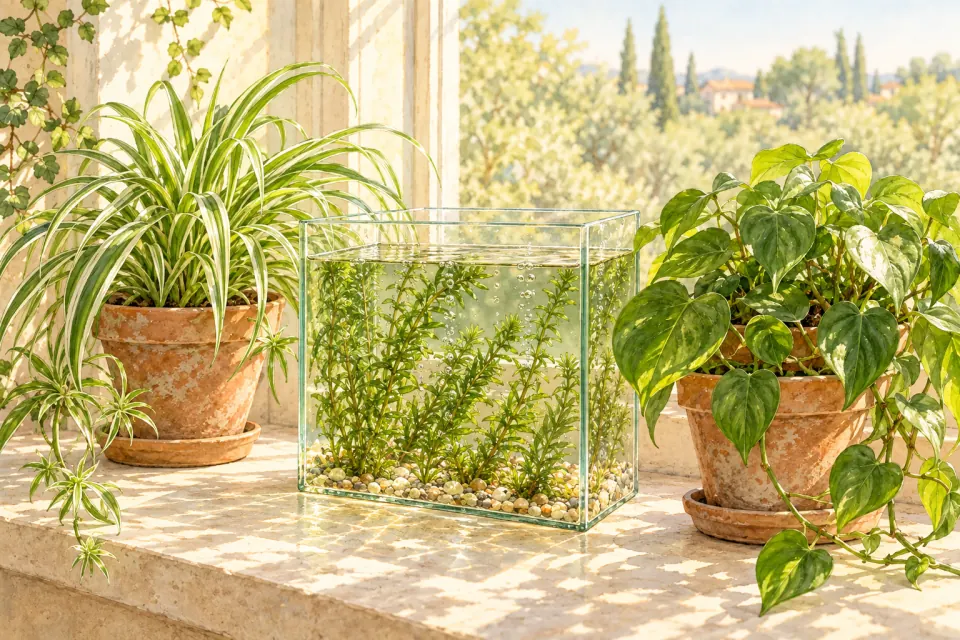
Plants, algae, and some bacteria release oxygen during photosynthesis. Using the energy of light, they split water molecules, keep the hydrogen to build sugars from carbon dioxide, and release the oxygen as a by-product. For every molecule of carbon dioxide turned into sugar, roughly one molecule of oxygen is released.
The same organisms also use oxygen. Respiration, the process that burns sugar for energy, runs day and night in every living cell. In the dark, a plant only consumes oxygen. When an organism dies, the bacteria and fungi that break it down consume oxygen too.
That gives two different ways to answer the question. Gross production is all the oxygen released by photosynthesis. Net production is what is left after the organism's own respiration. Over long periods, an ecosystem adds oxygen to the air only if it stores carbon, for example by building up wood, peat, or sediment, rather than respiring or decaying it all again.
The answer on a global scale: phytoplankton
Phytoplankton are microscopic photosynthetic organisms that live in the sunlit upper layer of oceans and lakes. They include diatoms, other algae, and photosynthetic bacteria called cyanobacteria. Individually they are invisible, but there are so many of them that they rival all land plants in total photosynthesis.
The US National Oceanic and Atmospheric Administration estimates that roughly half of the oxygen production on Earth comes from the ocean. It highlights Prochlorococcus, a cyanobacterium that is the smallest photosynthetic organism known, as producing up to 20 percent of the oxygen in the biosphere. Strictly speaking, Prochlorococcus is a bacterium rather than a plant, which is why the honest answer to the question is not a plant at all.
NOAA also points out that marine life consumes roughly the same amount of oxygen that the ocean produces, through the breathing of animals, the respiration of the plankton themselves, and decay. A large global analysis published in Science in 1998 put the split of the planet's net primary production at a little under half in the oceans and a little over half on land.
What plants produce the most oxygen on land
On land, oxygen output follows growth. The vegetation that fixes the most carbon per year, mainly tropical forests, followed by other forests, savannas, and grasslands, produces the most oxygen. Fast-growing plants such as bamboo, many grasses, and young forests fix carbon quickly while they are building biomass.
There is no reliable ranking of individual species by oxygen output, and claims that one tree or one houseplant produces the most oxygen are not supported by research. Output depends on leaf area, light, temperature, water, nutrients, and age far more than on species alone. A large, healthy tree in full sun produces far more than a small one in shade, whatever the species.
The phrase lungs of the world is often attached to the Amazon rainforest. The Amazon does carry out a vast amount of photosynthesis, but its plants, animals, and microbes use almost as much oxygen as the forest releases, so its net addition to the oxygen in the air is small. Rainforests matter enormously for carbon storage, rainfall, and biodiversity, but they are not a major source of the oxygen we breathe.
Best oxygen producing indoor plants: what the evidence says
Many lists rank houseplants by how much oxygen they produce, usually naming snake plants, pothos, peace lilies, areca palms, or aloe vera. Every healthy houseplant does release a small amount of oxygen when it has light, but the amount is tiny compared with the volume of air in a room, and the air in most homes and offices is constantly replaced through windows, doors, gaps, and ventilation systems.
A 2019 review in the Journal of Exposure Science and Environmental Epidemiology, titled Potted plants do not improve indoor air quality, looked at decades of studies on plants and indoor air. It concluded that the effects measured in small test chambers do not carry over to real buildings, and that ordinary air exchange removes pollutants far faster than a realistic number of potted plants. The same reasoning applies to oxygen: ventilation, not plants, sets the oxygen level indoors.
- Snake plant at night: snake plants use CAM photosynthesis, which means they take in carbon dioxide at night and store it as an acid. The light-driven step that releases oxygen still happens in the daytime, so a snake plant in the bedroom does not supply oxygen while you sleep.
- Plants in the bedroom: at night every plant consumes a little oxygen through respiration. The amount is far too small to matter for people.
- Good reasons to keep houseplants: many people find that plants make a room more pleasant, and caring for them can be enjoyable. Those are good reasons on their own, without claims about oxygen.
If you want healthy houseplants, focus on light, watering, and humidity rather than oxygen rankings. The houseplant care basics guide is a good place to start.
Where the NASA clean air study fits in
Much of the popular belief about air-purifying houseplants traces back to a 1989 NASA report, Interior Landscape Plants for Indoor Air Pollution Abatement, often called the NASA Clean Air Study. Its researchers placed plants in small sealed chambers and measured how quickly levels of chemicals such as benzene, formaldehyde, and trichloroethylene fell. The work was aimed at sealed environments such as spacecraft.
The study did not measure plants raising oxygen in ordinary homes, and its chamber results are often quoted without the context that real rooms are much larger and constantly ventilated. Later reviews, including the 2019 analysis above, concluded that the effect of houseplants on indoor air in normal buildings is negligible. The NASA study was a useful early experiment, but it is not evidence that a few houseplants will change the air you breathe.
Oxygen production compared
| Producer | Share of oxygen production | Net effect on the air |
|---|---|---|
| Ocean phytoplankton | Roughly half of global production (NOAA) | Mostly used again by marine life and decay |
| Land plants as a whole | Roughly the other half | Mostly used again by respiration and decay |
| A mature rainforest | Very high gross production | Small, because the forest uses nearly as much as it makes |
| Houseplants in a room | Tiny | Not measurable against normal ventilation |
The oxygen in the atmosphere today built up over hundreds of millions of years, as photosynthesizers stored carbon in rocks, fossil fuels, and sediments faster than it was released. Year to year, the oxygen in the air is a very large and stable reservoir, and its level does not depend on any one forest or group of plants.
Frequently Asked Questions
Answers to common questions about plant care and this tool.
Related plant guides and tools
View all guides

Further reading and references
- How much oxygen comes from the ocean? — National Oceanic and Atmospheric Administration (NOAA) Estimates that roughly half of Earth's oxygen production comes from the ocean, that Prochlorococcus produces up to 20 percent of biospheric oxygen, and that marine life consumes roughly the same amount. [Source ]
- Primary Production of the Biosphere: Integrating Terrestrial and Oceanic Components — Field et al., Science (1998) Global estimate of net primary production, split between the oceans and land. [Source ]
- Potted plants do not improve indoor air quality: a review and analysis of reported VOC removal efficiencies — Cummings and Waring, Journal of Exposure Science and Environmental Epidemiology Review concluding that ordinary building ventilation outweighs the effect of a realistic number of houseplants on indoor air. [Source ]
- Interior Landscape Plants for Indoor Air Pollution Abatement — Wolverton, Johnson and Bounds, NASA (1989) The original sealed-chamber study behind claims about air-purifying houseplants. [Source ]