Types of eucalyptus: how to tell common species apart by bark.
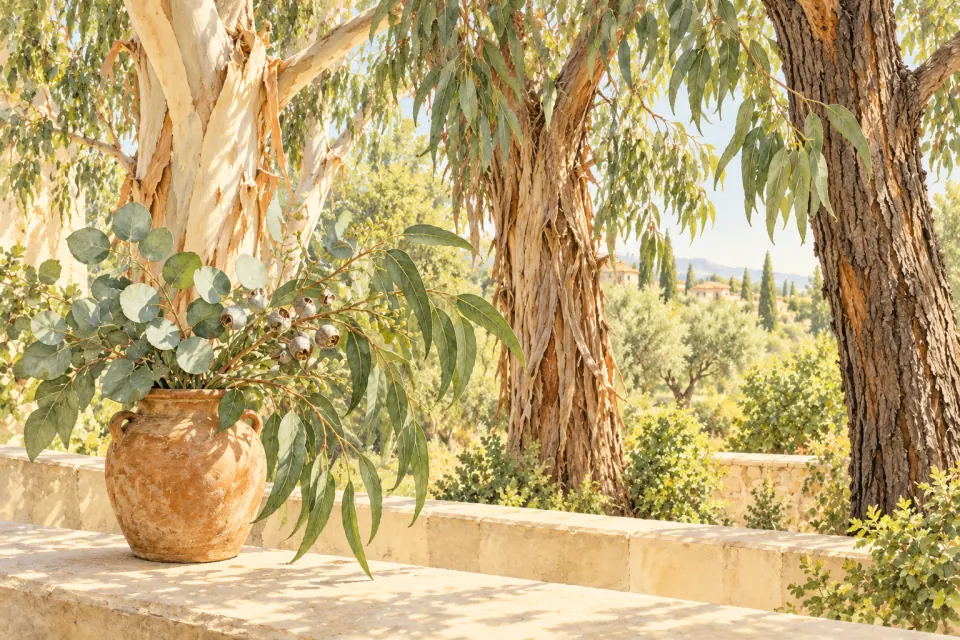
Bark is the fastest way to sort the many types of eucalyptus. Gums shed their outer bark each year and have smooth, often patchy trunks. Stringybarks keep thick bark that pulls away in long fibres. Ironbarks have hard, dark, deeply furrowed bark. Boxes have short-fibred or flaky bark that breaks into small pieces. Once you have placed a tree in one of these bark groups, the shape of its leaves, buds, and gum nuts points to the species.
What counts as a eucalyptus tree
Eucalyptus is a genus in the myrtle family, Myrtaceae, with more than 700 species. Nearly all of them are native to Australia, where eucalyptus trees dominate most forests and woodlands. A handful of species grow naturally in New Guinea, Indonesia, and the Philippines, including the rainbow eucalyptus.
Two related genera are also called eucalypts. Corymbia, separated from Eucalyptus in 1995, includes the bloodwoods, the lemon-scented gum, and the spotted gum. Angophora contains the apples, such as the smooth-barked apple of the Sydney region. Field guides often treat all three together because they look alike from a distance.
A few features hold for almost every eucalypt. The flower bud is covered by a cap, the operculum, which falls off when the fluffy stamens open; the name eucalyptus means "well covered" in Greek. The fruit is a woody capsule, the gum nut. And the leaves are leathery and scented with oil, which you can smell by crushing one.
The main bark groups compared
| Bark group | What the bark looks like | Examples |
|---|---|---|
| Gum | Smooth; the outer layer peels off in strips or flakes each year, leaving patches of white, grey, cream, or orange | River red gum, Tasmanian blue gum, snow gum |
| Stringybark | Thick, soft, and fibrous; pulls away in long strings | Messmate stringybark, brown stringybark |
| Ironbark | Hard, dark grey to black, deeply furrowed, often stained with red resin | Red ironbark, grey ironbark |
| Box | Short-fibred, flaky, or broken into small squares; usually grey | Yellow box, grey box |
| Bloodwood | Broken into small, scaly plates like a chequerboard | Red bloodwood (Corymbia) |
Some species combine two types. Mountain ash, for example, has a rough, fibrous "stocking" at the base of the trunk and smooth, ribbon-shedding bark above it. Look at the whole trunk, not only at eye level.
Smooth-barked gums
Gums are the most photographed eucalyptus trees because their peeling bark leaves colourful patches on the trunk.
- Tasmanian blue gum (Eucalyptus globulus): smooth bark that sheds in long ribbons, square-sectioned young stems, and blue-grey juvenile leaves held in pairs. Adult leaves are long and sickle-shaped. It is one of the most widely planted eucalyptus trees in the world and a main source of eucalyptus oil.
- River red gum (Eucalyptus camaldulensis): a large, spreading tree of inland rivers and floodplains with smooth white, grey, and cream bark. It is the most widespread eucalypt in Australia and is known for dropping large limbs without warning.
- Snow gum (Eucalyptus pauciflora): a twisted, often multi-stemmed tree of high, cold country with smooth white bark streaked in yellow, green, and red. It tolerates hard frost.
- Rainbow eucalyptus (Eucalyptus deglupta): a tropical tree whose freshly exposed bark turns green, blue, purple, orange, and maroon as it ages, giving the trunk vertical stripes of colour.
- Lemon-scented gum (Corymbia citriodora): tall and straight with powdery white to pink bark and leaves that smell strongly of lemon when crushed.
Rough-barked eucalypts: stringybarks, ironbarks, and boxes
Rough bark stays on the trunk for years, so it can be read by feel as well as by eye.
- Stringybarks: push a finger into the bark. If it is soft and comes away in long fibres, the tree is a stringybark. Messmate stringybark (Eucalyptus obliqua) also has leaves with an uneven base, which the species name obliqua describes.
- Ironbarks: the bark is hard, almost black, and deeply cracked into ridges. Red ironbark (Eucalyptus sideroxylon) is planted for its dark trunk and its pink to red flowers.
- Boxes: the bark is grey and finely fibrous or flaky, closer to a woven texture than to strings. Yellow box (Eucalyptus melliodora) is a valued source of honey.
Leaves, buds, and gum nuts confirm the species
Many eucalypts carry two kinds of leaves. Juvenile leaves on young plants and regrowth are often round or heart-shaped, paired, stalkless, and covered in a blue-grey wax. Adult leaves on mature branches are usually long, narrow, curved like a sickle, and hang vertically, which reduces sun exposure in the heat of the day.
Eucalyptus varieties sold for gardens and cut foliage often show off the juvenile leaves. The cider gum (Eucalyptus gunnii) is a hardy garden tree in cooler climates, and the silver dollar gum (Eucalyptus cinerea) is grown for its round, silvery leaves.
Buds and fruit are the features botanists rely on. Note how many buds sit in each cluster, whether they have stalks, and the shape of the cap. On the gum nuts, look at the size and whether the valves at the top stick out or sit below the rim. A photo of a bud cluster and a few nuts next to a coin for scale is worth more than many photos of the canopy.
Safety and growing notes
- Toxicity: eucalyptus leaves and oil are toxic to dogs, cats, and horses, and concentrated oil can poison a child who swallows it.
- Falling limbs: large eucalypts, especially river red gum, can shed heavy branches on calm, hot days. Avoid parking or camping directly under them.
- Fire: the oil-rich leaves and loose, shedding bark burn readily, which matters when planting near buildings in fire-prone regions.
- Invasiveness: outside Australia some species spread into natural habitats and are regulated, so check local advice before planting.
Common mistakes when naming eucalyptus
- Comparing juvenile and adult leaves. A young cider gum and a mature one look like two different trees. Collect leaves from the same part of the crown each time.
- Reading bark only at the base. Half-barked species have rough bark below and smooth bark above.
- Ignoring the season. Gum bark looks different just before and just after it sheds.
- Expecting a single answer from bark alone. Bark narrows the group; buds and fruit confirm the species.
For broadleaf trees and conifers in general, the outdoor tree and shrub identification guide uses the same step-by-step approach.
Frequently Asked Questions
Answers to common questions about plant care and this tool.
Related plant guides and tools
View all guides
Further reading and references
- Eucalyptus — Wikipedia Overview of the genus, its bark types, juvenile and adult leaves, and the split of Corymbia. A community-edited reference; cross-check details against botanical sources. [Source ]
- EUCLID: Eucalypts of Australia — Centre for Australian National Biodiversity Research Identification key and species descriptions for Australian eucalypts, with bark, bud, and fruit characters. [Source ]
- Eucalyptus — ASPCA Animal Poison Control Toxicity of eucalyptus to dogs, cats, and horses. [Source ]