Deciduous forest plants: trees, shrubs, and wildflowers to know.
Temperate deciduous forest plants grow in layers. Broadleaf trees such as oak, maple, beech, and hickory form the canopy and drop their leaves every autumn. Beneath them grow smaller trees and shrubs such as dogwood and hazel, and on the forest floor ferns, mosses, and wildflowers such as trillium and bluebells. The whole forest runs on a seasonal rhythm: many floor plants flower in early spring, before the canopy leafs out and shades the ground.
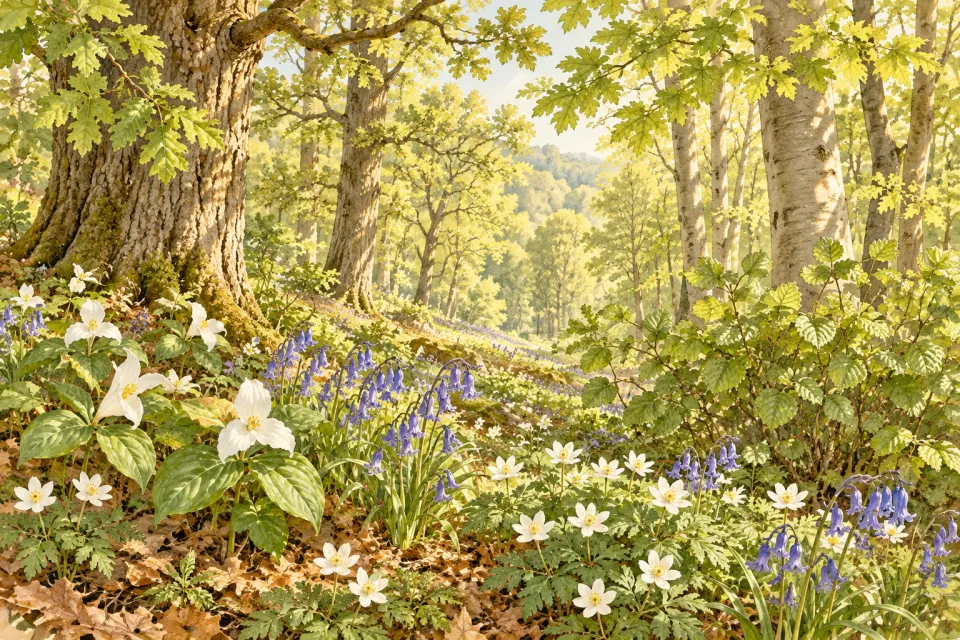
What a temperate deciduous forest is
A temperate deciduous forest is a forest dominated by broadleaf trees that shed their leaves for the winter. It grows where summers are warm, winters are cold enough for frost and often snow, and rain or snow falls fairly evenly through the year. The largest areas are in eastern North America, western and central Europe, and eastern Asia.
The word deciduous describes the leaf habit, not the place. Temperate forests also include coniferous forests and mixed forests, where pines, spruces, or hemlocks grow among broadleaf trees. When people search for temperate forest plants, they usually mean the deciduous type, with its obvious autumn colour and bare winter branches.
Soils in these forests are often fertile, because the leaves that fall each year decompose into a layer of humus. That leaf litter feeds fungi, insects, and other decomposers, and it returns nutrients to the trees.
The layers of a deciduous forest
| Layer | What grows there | Examples |
|---|---|---|
| Canopy | Tall broadleaf trees | Oak, maple, beech, hickory, ash, basswood |
| Understory | Smaller, shade-tolerant trees | Flowering dogwood, hornbeam, redbud, holly |
| Shrub layer | Woody plants under a few meters tall | Hazel, witch hazel, spicebush, viburnum |
| Herb layer | Wildflowers, ferns, and grasses | Trillium, bluebell, wood anemone, ferns |
| Ground layer | Mosses, lichens, and fungi | Mosses on logs and rocks, mushrooms in leaf litter |
Canopy trees of the temperate deciduous forest
The canopy trees decide how much light reaches everything else. Which species dominate depends on the region, the soil, and the history of the site, but a handful of genera turn up across the Northern Hemisphere.
- Oaks (Quercus): recognizable by their acorns and, in many species, by leaves with rounded or pointed lobes. Oaks are central to the forest food web, supporting a very large number of insect species.
- Maples (Acer): leaves with palmate lobes and winged seeds that spin as they fall. Sugar maple is known for its bright autumn colour and for maple syrup.
- Beech (Fagus): smooth grey bark and oval, toothed leaves. Young beeches often keep their dead leaves into winter.
- Hickory and walnut: compound leaves made of several leaflets, and hard-shelled nuts.
- Ash and basswood: ash has compound leaves in opposite pairs; basswood, or linden, has heart-shaped leaves and fragrant summer flowers.
The outdoor tree and shrub identification guide explains how to use leaf shape, bark, and buds to tell these trees apart, including in winter.
Understory trees and shrubs
Under the canopy, smaller trees and shrubs live in partial shade. Many of them leaf out or flower early, taking advantage of the light before the canopy closes, and many produce berries that birds eat and spread.
In eastern North America, flowering dogwood and redbud bloom in spring under the still-bare canopy, and spicebush and witch hazel are common shrubs. In Europe, hazel, hawthorn, holly, and elder are typical of the shrub layer. Hazel was traditionally cut back to the base every few years, a practice called coppicing, which produces straight poles and lets more light reach the forest floor.
Wildflowers and the spring rush on the forest floor
The forest floor is brightest in early spring, when the days are getting longer but the trees have not yet opened their leaves. Many deciduous forest plants on the floor use this short window. Spring ephemerals such as trout lily, spring beauty, bloodroot, and Dutchman's breeches come up, flower, and set seed within a few weeks, then die back once the canopy closes. Their underground bulbs, corms, or rhizomes carry them through the rest of the year.
Other floor plants stay green longer and tolerate shade. Trilliums, wild ginger, and mayapple are common in North American woods, while bluebells, wood anemone, wild garlic, and lesser celandine carpet many European woods in spring. Ferns and mosses take over the shadier, damper patches through summer.
Some woodland plants are toxic if eaten, and several edible ones have poisonous look-alikes. Wild garlic, for example, can be confused with lily of the valley, which is poisonous. Read the wild plant safety guide before you consider picking any woodland plant to eat.
Plants in temperate forests on three continents
The same layered structure appears wherever this forest type grows, but the species change from one continent to another.
- Eastern North America: one of the richest deciduous forests in the world, with many oaks, maples, and hickories, along with tulip tree, American beech, and black cherry. The southern Appalachian mountains are especially diverse.
- Europe: fewer tree species, largely because of the effects of past ice ages. Pedunculate and sessile oak, European beech, ash, hornbeam, and lime are typical, with hazel and hawthorn below.
- Eastern Asia: forests in China, Korea, and Japan share many genera with North America, including maples, oaks, magnolias, and hydrangeas, and they are rich in species.
Because the genera are often shared, a gardener who knows the maples or oaks of one continent can usually recognize their relatives on another, even when the species differ.
How deciduous forest plants adapt to the seasons
- Dropping leaves: before winter, trees pull nutrients back from their leaves and seal off the leaf stalk. The green chlorophyll breaks down, which reveals yellow and orange pigments, and some species make new red pigments, producing autumn colour.
- Protected buds: next year's leaves and flowers form in late summer inside buds covered by scales, which protect them through the cold.
- Timing: floor plants flower early, understory plants leaf out early, and canopy trees leaf out last. Each layer gets its share of light.
- Storage organs: bulbs, corms, and rhizomes let wildflowers store energy below ground and regrow quickly in spring.
Tips for identifying plants in temperate forests
- Note the season. The plants you can see change through the year. Spring ephemerals are gone by summer, and winter identification relies on buds, bark, and twigs.
- Check leaf arrangement. Leaves in opposite pairs narrow the options a lot: maples, ashes, dogwoods, and viburnums have opposite leaves, while oaks, beeches, and hickories have alternate leaves.
- Look at the whole plant. For wildflowers, count the petals, note the leaf shape, and look at how the flowers are arranged on the stem.
- Photograph several parts. A photo of the leaf, the bark or stem, and any flowers or fruit gives a much better identification than a single picture.
The step-by-step flower identification guide walks through the checks to make on a wildflower, from symmetry to petal count.
Frequently Asked Questions
Answers to common questions about plant care and this tool.
Related plant guides and tools
View all guides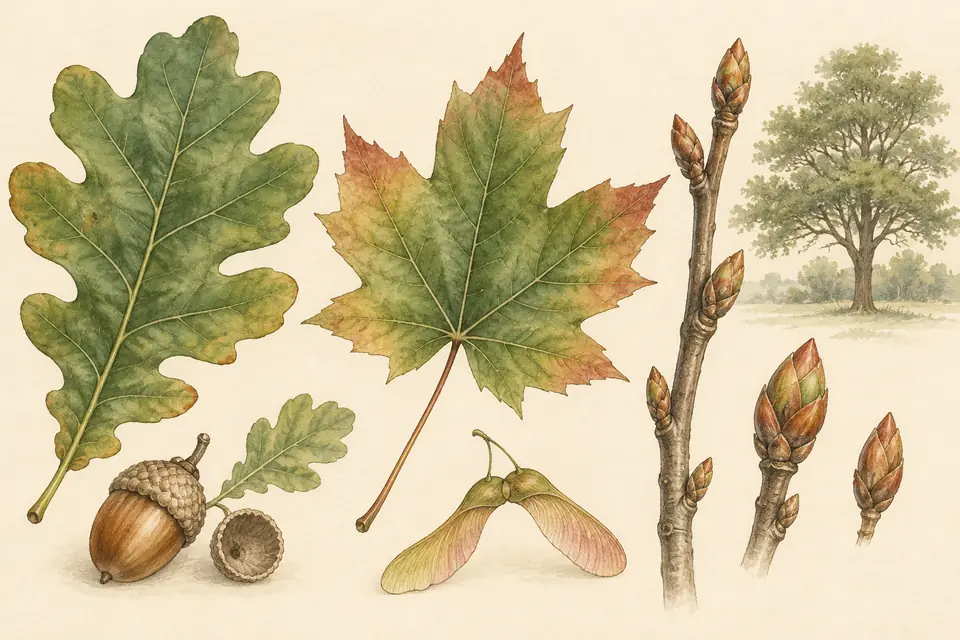
Further reading and references
- Temperate deciduous forest — Wikipedia Overview of where temperate deciduous forests grow, their climate, and their typical trees. A community-edited reference; check details against its cited sources. [Source ]
- Spring ephemeral — Wikipedia How woodland wildflowers complete their growth before the tree canopy closes, with examples. [Source ]