Palm tree types: how to tell common palms apart by leaf shape.
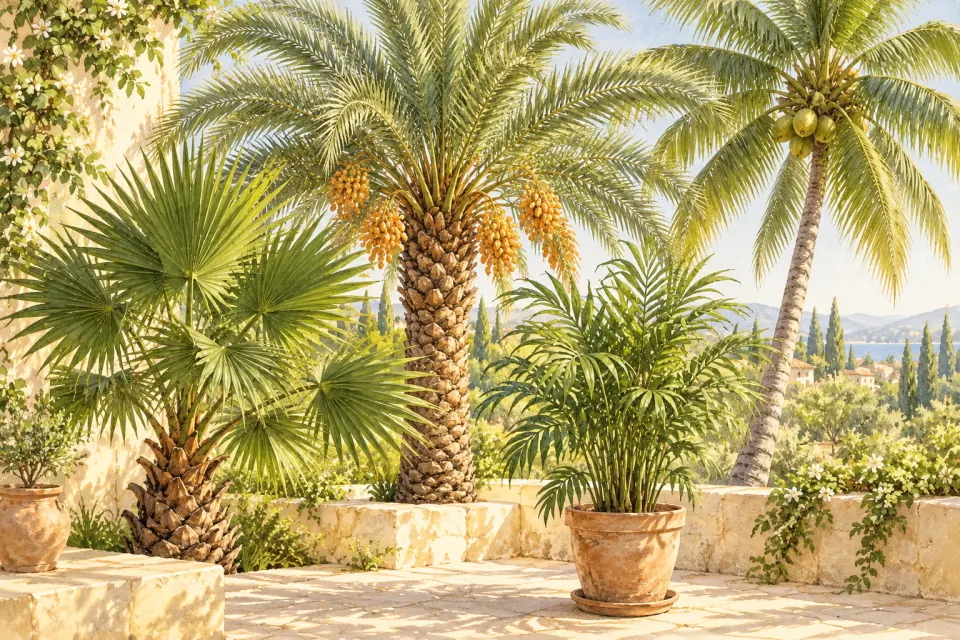
The quickest way to sort the different types of palm trees is to look at one leaf. A fan palm has a leaf that spreads out from a single point like an open hand. A feather palm has a long central stalk with narrow leaflets lined up on both sides. A fishtail palm has leaflets that are divided again and end in a ragged, wedge-shaped tip. Once you know the leaf type, the trunk, the leaf stalks, and the growth habit narrow it down to a handful of common palms.
What makes a palm a palm
All true palms belong to one plant family, Arecaceae, which older books call Palmae. There is no single palm tree scientific name: each palm has its own genus and species name, and the family name is what ties them together. Botanists count roughly 2,600 species in about 180 genera, most of them in tropical and subtropical regions.
Palms are monocots, the same broad group as grasses, lilies, and orchids. That explains several things you can see from the ground. A palm grows from a single bud at the top of the stem, so most palms do not branch. The trunk does not lay down annual rings or widen much as it ages. And the leaves are large, long-lived, and attached to the trunk by a sheathing base that often leaves rings, scars, or fibres behind when the leaf falls.
Because of that single growing bud, the leaf is the most reliable feature for telling palms apart. Flowers and fruit help too, but many palms flower high up or only once they are mature, while leaves are always there to examine.
The four leaf shapes that sort different kinds of palm trees
| Leaf type | What it looks like | Common examples |
|---|---|---|
| Palmate (fan) | Leaf segments spread from one point at the end of the stalk, like fingers on a hand | Windmill palm, Mexican fan palm, European fan palm |
| Costapalmate | A fan leaf whose stalk runs into the blade as a short midrib, so the leaf folds or curves | Cabbage palmetto, many Sabal species |
| Pinnate (feather) | A long central rachis with separate leaflets arranged along both sides | Date palm, coconut palm, queen palm, kentia palm |
| Bipinnate (fishtail) | A feather leaf whose leaflets are divided again into wedge-shaped segments with jagged tips | Fishtail palms (Caryota) |
To check the leaf type, follow a single leaf from the trunk to its tip. If the stalk ends abruptly and the segments radiate from that point, it is a fan leaf. If the stalk continues as a long axis with leaflets on both sides, it is a feather leaf. Costapalmate leaves sit in between: the stalk pushes a short way into the fan, which makes the leaf look slightly folded down the middle.
Fan palms: leaves like an open hand
Fan palms are common in gardens and streets because several of them are tough and tolerate wind, heat, and occasional cold. Use the trunk and the leaf stalks to separate the usual candidates.
- Windmill palm (Trachycarpus fortunei): a single, fairly slim trunk wrapped in brown, hair-like fibres. The leaf stalks have small teeth or none, and the fan is stiff and deeply divided. It is one of the most cold-tolerant palms grown outdoors in cooler climates.
- Mexican fan palm (Washingtonia robusta): a very tall, slender trunk with a small crown and spiny leaf stalks. Old leaves often hang down as a brown skirt unless they are pruned.
- California fan palm (Washingtonia filifera): similar to its Mexican relative but with a much stouter trunk and pale, thread-like fibres hanging from the leaf edges. The species name filifera means "thread-bearing".
- European fan palm (Chamaerops humilis): a low, clumping palm with several stems, spiny leaf stalks, and small, stiff fans. It is native to the western Mediterranean, one of only two palms native to Europe.
Feather palms: a central stalk with leaflets
Feather palms include the palms most people picture first, from the coconut on a beach to the date palm in a desert oasis. The leaflets, the base of the leaf, and the trunk surface separate them.
- Date palm (Phoenix dactylifera): stiff, grey-green, V-shaped leaflets, with the lowest leaflets turned into long, sharp spines near the trunk. The trunk is covered in diamond-shaped leaf bases, and older plants often grow suckers at the base.
- Canary Island date palm (Phoenix canariensis): a heavier trunk and a dense, rounded crown of greener leaves. It shares the spines at the leaf base, so treat both Phoenix palms with care when pruning.
- Coconut palm (Cocos nucifera): a curved or leaning trunk, soft, drooping leaflets, and large coconuts in the crown. It needs a truly tropical climate.
- Queen palm (Syagrus romanzoffiana): a smooth grey trunk and long, arching leaves whose leaflets stick out in several planes, which gives the leaf a soft, feathery look.
- Royal palm (Roystonea regia): a smooth, pale trunk that often bulges, topped by a glossy green crownshaft, a column of leaf bases just below the leaves.
A crownshaft is a useful clue. When the bases of the living leaves form a smooth green column at the top of the trunk, you are looking at a palm such as a royal palm or an areca palm rather than a date or coconut palm, which have no crownshaft.
Fishtail palms and indoor palms
Fishtail palms (Caryota) are the only palms with bipinnate leaves. Each leaflet is divided again into small segments shaped like a fish tail, with a jagged outer edge. Some fishtail palms flower from the top of the stem downwards and die after fruiting, which surprises owners who expected a long-lived tree.
Several feather palms are sold as houseplants because they tolerate lower light:
- Parlour palm (Chamaedorea elegans): small, with thin green stems and soft, arching leaves. It copes with shade better than most palms.
- Kentia palm (Howea forsteriana): dark green, gracefully drooping leaves on long stalks. It comes from Lord Howe Island and grows slowly indoors.
- Areca palm (Dypsis lutescens): clumping stems with yellowish leaf stalks and a lighter, more upright look. It wants bright, indirect light and steady moisture.
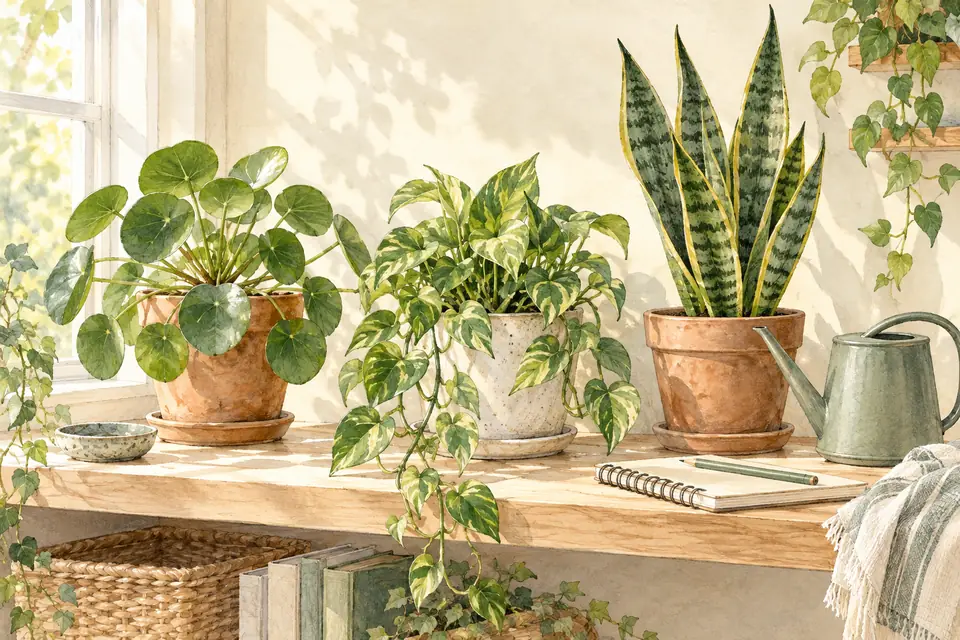
Indoor palms rarely flower, so leaf shape and stem habit carry most of the identification. The houseplant care basics guide covers light and watering for these plants.
Plants called palms that are not palms
Several popular plants carry "palm" in their common names but belong to other families. Telling them apart matters, partly for care and partly for safety.
- Sago palm (Cycas revoluta): a cycad with stiff, glossy, feather-like leaves and a short, thick trunk. All parts are poisonous, and it is a serious risk to dogs and cats.
- Ponytail palm (Beaucarnea recurvata): a succulent from the asparagus family with a swollen base and long, narrow, curling leaves.
- Traveller's palm (Ravenala madagascariensis): a relative of the bird of paradise, with huge paddle-shaped leaves arranged in a flat fan.
- Cabbage tree (Cordyline australis): sometimes sold as a "palm", it has sword-shaped leaves and branches after flowering, which true palms rarely do.
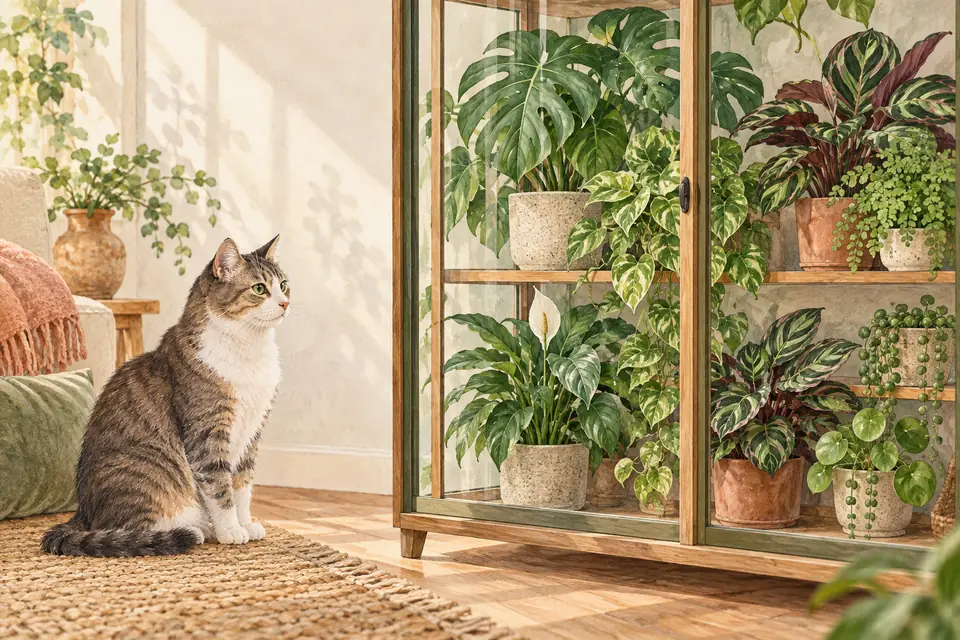
If a plant labelled as a palm might be eaten by pets or children, check it against a toxicity list before you bring it home.
How to identify a palm in five checks
- Leaf type. Fan, costapalmate, feather, or fishtail.
- Leaf stalk. Look for teeth or spines along the edges and for spines at the base of feather leaves, which point to Phoenix.
- Trunk. Note fibres, diamond-shaped leaf bases, smooth rings, a bulge, or a green crownshaft.
- Habit. One trunk or several stems growing as a clump.
- Setting. A palm growing outdoors in a frosty climate is most likely a windmill palm or a European fan palm.
Photograph a whole leaf, a close-up of the leaf stalk, and the trunk at eye level before comparing references. The plant photo guide explains how to frame these views.
Common mistakes when naming palms
- Judging from a young plant. Seedlings of many palms have simple, undivided leaves that look nothing like the adult leaf.
- Relying on height. Height depends on age and climate. A short Washingtonia is still a Washingtonia.
- Trusting the plant label. Nursery names such as "fan palm" or "bamboo palm" are used for several different plants.
- Ignoring the trunk after pruning. Clean-trimmed trunks lose their fibres and leaf bases, so check the leaf stalks and leaflets as well.
Palms are only one group of trees you can learn by leaf and bark. The outdoor tree and shrub identification guide covers broadleaf trees and conifers with the same approach.
Frequently Asked Questions
Answers to common questions about plant care and this tool.
Related plant guides and tools
View all guides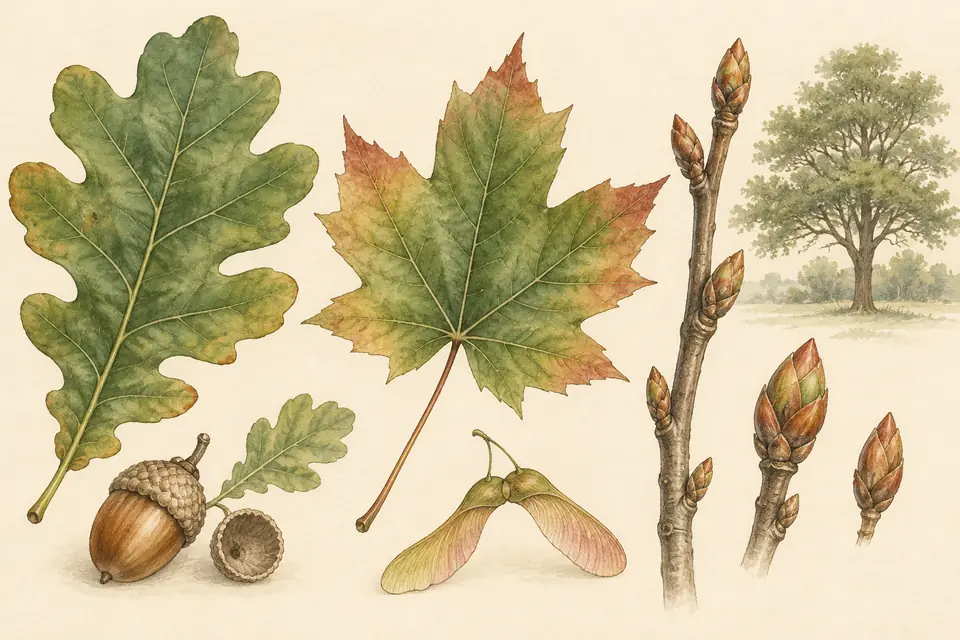
Further reading and references
- Arecaceae — Wikipedia Overview of the palm family, its leaf types, and its number of genera and species. A community-edited reference; cross-check details against botanical sources. [Source ]
- Arecaceae Bercht. & J.Presl — Plants of the World Online, Royal Botanic Gardens, Kew Accepted family name and the list of accepted palm genera and species. [Source ]
- Sago palm — ASPCA Animal Poison Control Toxicity of Cycas revoluta to dogs, cats, and horses. [Source ]