Plant veins: what leaf vein patterns can tell you about a plant.
Plant veins are the bundles of conducting tissue that run through a leaf, carrying water in and sugars out. Their arrangement, called venation, is one of the most useful clues in plant identification. Most grasses, lilies and other monocots have veins running side by side, while most broadleaf plants have a branching net. Within that net, a feather-like pattern from one midrib and a hand-like pattern from the leaf base separate many common trees and shrubs.
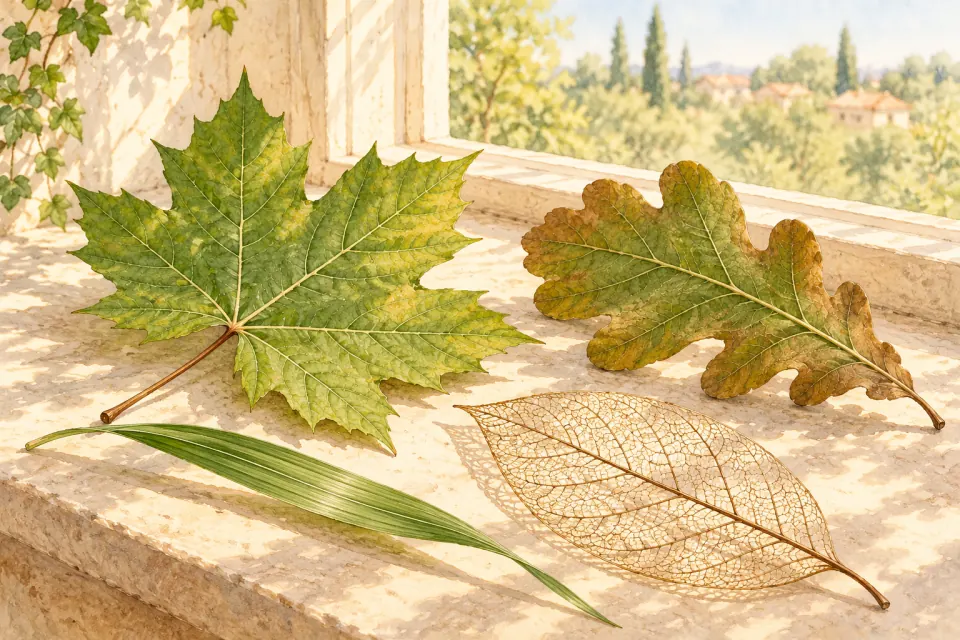
What the veins of a leaf do
Each vein in a leaf is a vascular bundle, a strand that contains two kinds of tissue:
- Xylem: brings water and dissolved minerals from the roots into the leaf, where water is used in photosynthesis and lost through the stomata.
- Phloem: carries sugars made in the leaf out to the stems, roots, flowers and fruits.
Veins also act as a framework. The thicker veins stiffen the blade so it can be held flat toward the light, and the finer veins spread through the soft tissue so that no cell is far from a supply of water. If you hold a thin leaf up to the light, you can usually see several orders of veins, from the thick midrib down to a fine mesh.
Vein density varies a great deal between plant groups. Flowering plants generally pack far more minor veins into each part of a leaf than ferns or conifers do. Studies of leaf evolution link that denser network to higher rates of photosynthesis, because water reaches every cell more quickly and the leaf can keep its stomata open longer without drying out. That helps explain why the broad, thin leaves of fast-growing plants are so finely veined.
What are the veins in leaves called?
Botanists use a short set of terms for leaf veins:
- Midrib or midvein: the main central vein that continues from the leaf stalk to the tip.
- Secondary veins: the veins that branch from the midrib toward the leaf edge.
- Tertiary and minor veins: the smaller veins between the secondaries, forming the visible mesh.
- Venation: the pattern made by all the veins together.
In everyday speech the veins of a leaf are sometimes called ribs or nerves. The French word for leaf veins, nervures, comes from the same idea, and it explains why the nerve plant got its name.
The main leaf vein patterns
| Pattern | What it looks like | Examples |
|---|---|---|
| Pinnate | One midrib with secondary veins branching along it, like a feather | Beech, cherry, elm, magnolia |
| Palmate | Several main veins spreading from the base of the blade, like fingers from a palm | Maple, grape, ivy, sycamore |
| Parallel | Main veins running side by side along the leaf | Grasses, lilies, tulips, corn |
| Arcuate | Secondary veins curving toward the leaf tip along the margin | Dogwood, plantain |
| Dichotomous | Veins forking repeatedly into equal pairs, with no midrib | Ginkgo, many ferns |
Pinnate, palmate and arcuate leaves all belong to the broader group of net-veined, or reticulate, leaves, because their fine veins join into a mesh. Parallel venation is typical of monocots, while net venation is typical of most other flowering plants. There are many exceptions, so treat vein pattern as one clue among several.
Using plant veins to identify a plant
Vein pattern is quick to check and does not depend on the season, as long as leaves are present. These checks narrow the options:
- Parallel or net? Hold the leaf to the light. Side-by-side veins point toward a monocot such as a grass, lily, orchid or palm. A visible mesh points to most other flowering plants.
- One main vein or several? A single midrib means pinnate or arcuate. Three to seven main veins spreading from the base mean palmate.
- Do the secondaries reach the edge? In many oaks and beeches they run straight to the margin. In dogwood they curve and run along it toward the tip.
- Compare with other features. Combine venation with leaf arrangement, margin and lobing. Two leaves with the same outline can have different vein patterns, and that difference is often what separates them.
A clear photograph of the underside of a leaf usually shows veins better than the top. The outdoor tree and shrub guide covers the other leaf features that matter for identification.
The vein plant: houseplants grown for their veins
When people search for a vein plant, they usually mean the nerve plant, Fittonia. It is a low, spreading houseplant from the rainforests of South America with green leaves marked by a fine network of white, pink or red veins. It likes bright indirect light, steady moisture and high humidity, and collapses dramatically when it dries out, then usually recovers after watering. The ASPCA lists Fittonia as non-toxic to cats, dogs and horses.
Several other houseplants are grown for striking veins:
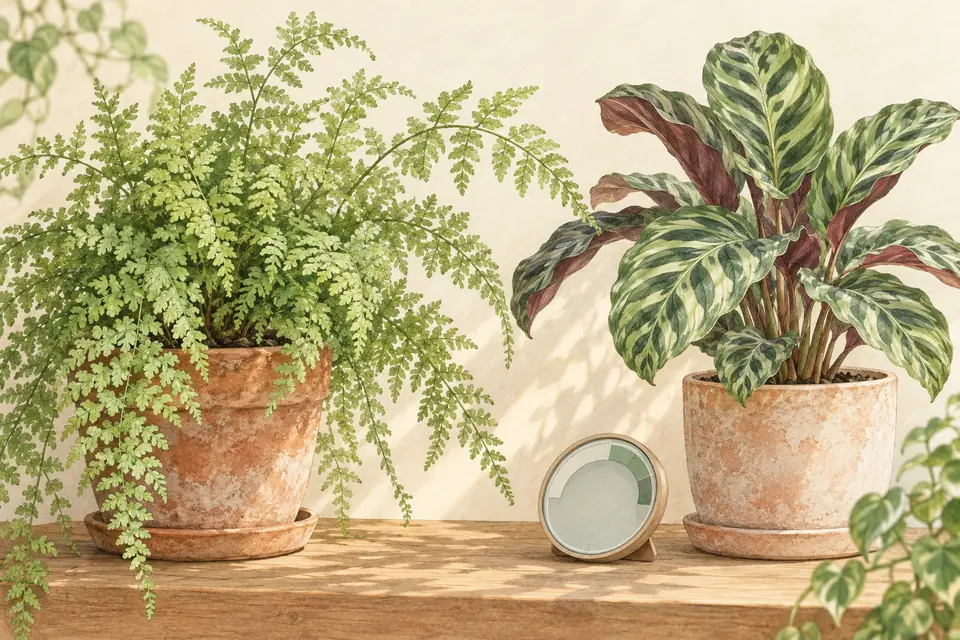
- Prayer plants (Maranta): herringbone patterns of red or pale veins along a dark green leaf.
- Calatheas: painted-looking patterns that follow the secondary veins.
- Alocasia: dark arrow-shaped leaves with bold pale veins in several popular hybrids.
These plants need humidity and careful watering. See the guide to ferns, calatheas and humidity-loving plants for practical care.
What vein colour can tell you about plant health
Changes in vein colour are useful early clues. The pattern matters more than the colour alone:
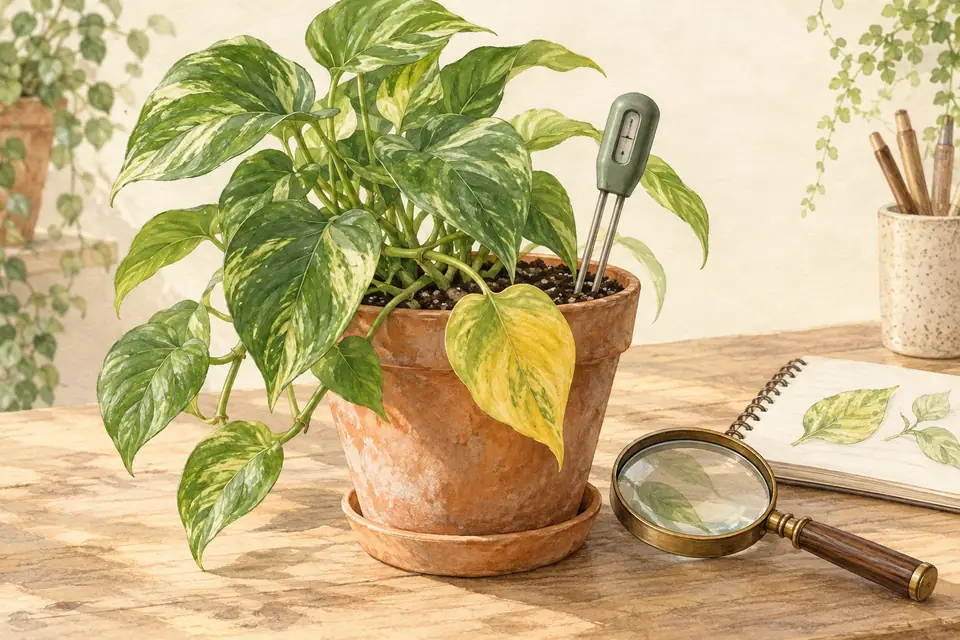
- Yellow between green veins: often a sign of a nutrient shortage. On new leaves this commonly points to iron; on older leaves, to magnesium. High soil pH can cause iron shortage even when iron is present.
- Pale or yellow veins on a green leaf: can follow virus infection, root damage or some herbicides.
- Brown or black veins: may indicate bacterial disease, frost or chemical damage.
None of these is a diagnosis on its own. Check roots, watering, light and recent treatments before deciding on a cause. The plant health guide walks through those checks.
Leaf skeletons: seeing veins clearly
The vein network is tougher than the soft tissue around it. When fallen leaves decay slowly in damp places, the soft tissue can rot away and leave a lace-like skeleton of veins. These natural leaf skeletons, often from magnolia, oak or holly, show the full vein hierarchy better than a living leaf. Crafters make them deliberately by soaking tough leaves until the soft tissue can be brushed off. A leaf skeleton held against a window is one of the easiest ways to see how fine the minor veins are.
Frequently Asked Questions
Answers to common questions about plant care and this tool.
Related plant guides and tools
View all guides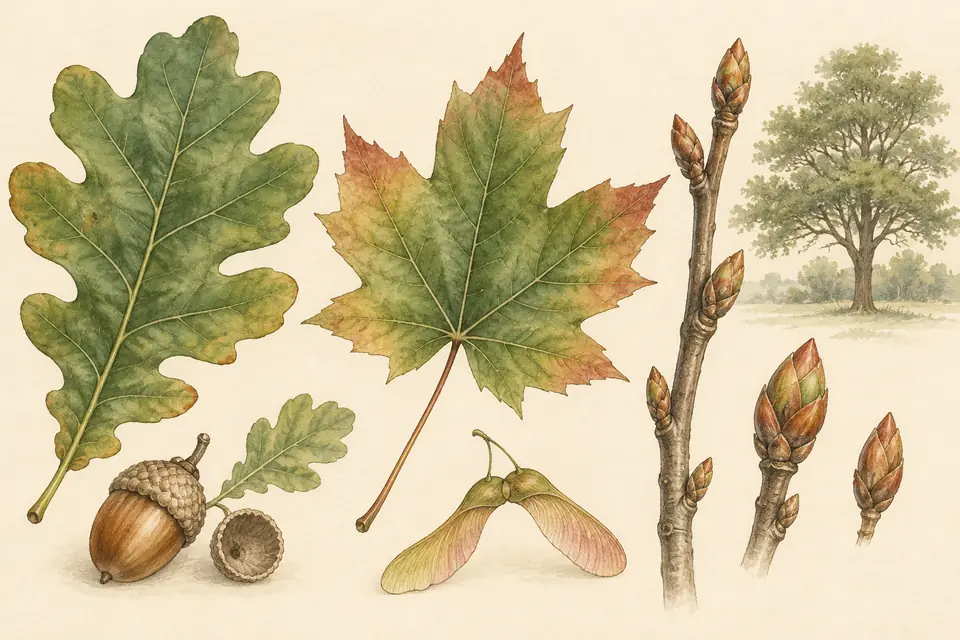
Further reading and references
- Leaf — Wikipedia Overview of leaf anatomy and venation types, including the general monocot and eudicot patterns and their exceptions. A community-edited reference; check the cited sources. [Source ]
- Vascular bundle — Wikipedia Explains the xylem and phloem that make up each vein. [Source ]
- Nerve plant — ASPCA Animal Poison Control Lists Fittonia as non-toxic to dogs, cats and horses. [Source ]