Balance moisture and humidity for ferns and Calatheas.
Brown leaf edges are a reason to inspect growing conditions, not proof of one problem. Many tropical ferns and plants sold as Calathea benefit from steady moisture and humid air, but their requirements are not identical.
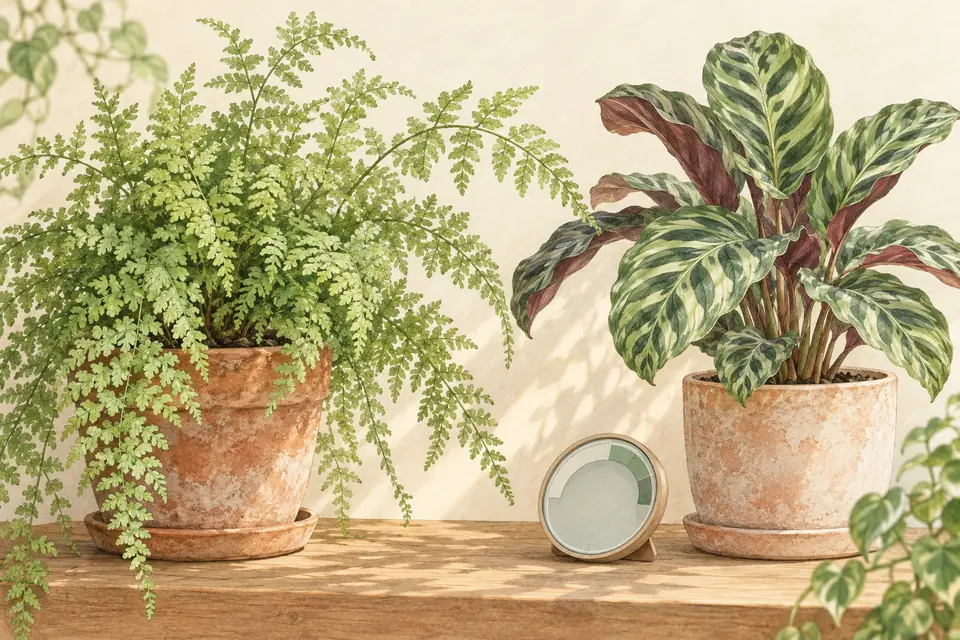
1. Identify the plant and its location
Plants sold as Calathea may carry botanical names such as Goeppertia, Ctenanthe, or Stromanthe. Ferns are also diverse: some need more drying between waterings than others, and plants called asparagus ferns are not true ferns. Check the specific plant rather than relying on the common name alone.
Choose a position with suitable indirect light, away from cold drafts and direct heater output. A humid bathroom is useful only if it also has enough light and an appropriate temperature. Check hanging baskets carefully because air near the ceiling can be warmer and drier.
The table below shows how a few common plants in this group differ. Use it as a starting point, then check the label or a reliable guide for your own plant.
| Plant | What to know |
|---|---|
| Boston fern (Nephrolepis exaltata) | Likes evenly moist potting mix and bright, indirect light. Dry roots often show first as shedding leaflets. |
| Maidenhair fern (Adiantum) | Fine fronds can shrivel after one bad drying. Check this plant more often than the others. |
| Bird’s nest fern (Asplenium nidus) | Fronds grow from a central rosette. Water the potting mix and do not leave water standing in the center. |
| Calathea (Goeppertia and related plants) | Needs bright light without direct sun and steady warmth. The leaves fold up at night, which is normal. |
| Asparagus fern (Asparagus) | Not a true fern. It has fleshy roots that store water, so it can usually tolerate more drying than a true fern. |
2. Keep moisture steady without waterlogging
For Calatheas and many tropical ferns, aim for evenly moist potting mix during active growth. Potting mix is the growing material in the pot. Evenly moist means it feels like a wrung-out sponge, not a wet cloth. Check the surface and the moisture below it, and follow the species’ guidance on how much drying to allow.
Water the root zone, allow excess to drain, and empty the saucer or outer pot. Use a moisture-retentive but well-drained potting mix. A fixed ingredient recipe cannot guarantee a particular air content in every container.
When growth slows or light decreases, the pot may dry more slowly. Keep checking rather than automatically repeating a summer schedule. Avoid both repeated deep drying of moisture-loving plants and adding water to an already wet pot.
How to check and water, step by step
- Push a finger 2 cm into the potting mix near the edge of the pot.
- Lift the pot and note its weight. A pot that is light for its size is usually dry.
- If the top 1 to 2 cm feels dry and the pot feels light, water the plant.
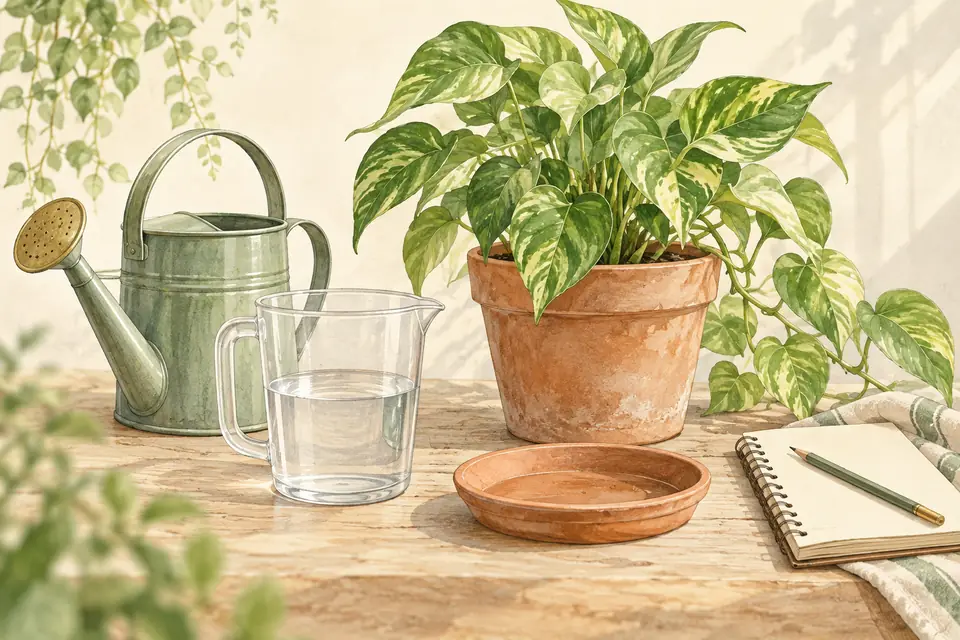
- Pour room-temperature water slowly over the whole surface until water runs out of the drainage holes.
- Wait 10 to 15 minutes, then empty the saucer.
- If the potting mix still feels wet, wait and check again in two or three days.
A small pot of maidenhair fern on a warm windowsill can need water twice a week in summer. A large Calathea in a cool room may need it every ten days in winter. The check tells you more than the calendar.
3. Assess the air around the leaves
Humidity here means relative humidity: how much water vapor the air holds compared with the most it can hold at that temperature. A humidity meter near the plants can help you compare conditions over the day. Do not assume one humidity percentage suits every fern and prayer plant. Temperature, airflow, and the plant’s condition also matter.
Misting wets leaves briefly and is not a reliable substitute for managing persistently dry room air. If using a room humidifier, follow its cleaning and placement instructions, keep nearby surfaces dry, and maintain air circulation. Raising humidity must not create a damp, poorly ventilated room.
Grouping plants may help locally, but leave room for air to move and inspect the leaves. Terrariums suit selected small species; a sealed container is not a universal solution for every fern or Calathea.
Make a pebble tray
A pebble tray adds a little moisture to the air just around one plant. It works best as a small help, not as the main fix for a very dry room.
- Choose a tray that is wider than the pot.
- Fill it with gravel or clay pebbles.
- Add water until it reaches just below the top of the gravel.
- Stand the pot on the gravel, not in the water.
- Top up the water as it evaporates, and rinse the tray every few weeks.
A worked example: a Calathea next to a heater
A Calathea sits on a shelf 1 m from an electric heater. In winter the leaf edges turn crisp, and the potting mix dries in three days. Hot, dry air is probably pulling water from the leaves faster than the roots can replace it. Move the plant 2 to 3 m away from the heater and out of its airflow. Then check the potting mix more often for the first two weeks. If new leaves open clean, the move solved the problem.
4. Review water and fertilizer
Water quality varies by location. If leaf problems persist, check your water supply and feeding history rather than assuming all tap water is toxic. Rainwater or suitable low-mineral water may help some sensitive plants. Avoid routine use of salt-softened water for ferns.
Leaving water in a jug does not remove dissolved mineral salts. Standing it for 24 hours lets some chlorine escape, but the minerals stay. A filter’s effect depends on its design, so check what it actually removes. Do not add aquarium conditioners or other chemicals to plant water without a clear, appropriate reason and product guidance.
Feed according to the plant’s growth and the product label, accounting for nutrients already in the potting mix. Excess fertilizer can damage sensitive foliage and roots. More feeding is not an automatic remedy for pale or brown leaves.
Hard tap water often leaves a white crust on the pot rim or the surface of the potting mix. If you see it, flush the pot: pour water through it slowly for a minute and let it drain fully. Flushing washes out some of the built-up salts.
Seasonal care in a Mediterranean climate
In a climate like Lebanon’s, summers are long, hot and dry, and winters are mild and wet. Both seasons bring their own risks for ferns and Calatheas.
Hot, dry summer
Pots dry faster, so check them more often. Air conditioners and fans move dry air across the leaves. Keep plants out of the direct path of the airflow. Strong afternoon sun through glass can scorch Calathea leaves quickly. Use a sheer curtain or move the plant back from the window. Dust settles fast in dry weather; wipe large leaves gently with a damp, soft cloth.
Mild, wet winter
Many homes are not heated all day. Rooms can be cool and damp, and the potting mix stays wet much longer. Water less often, and check before each watering. The RHS suggests 16 to 21 °C for Calatheas. Keep them away from cold window glass at night and from the hot air of portable heaters.
5. Track changes before changing everything
| Observation | Useful check |
|---|---|
| Dry, brown edges | Review root moisture, dry air, recent feeding, and water quality. The appearance alone does not identify the cause. |
| Wilting in wet potting mix | Check drainage and root condition before adding more water. Consider recent cold exposure as well. |
| Spreading spots or visible pests | Inspect both leaf surfaces and nearby plants. Keep an affected plant separate while investigating. |
| Calathea leaves curl inward | This usually means the plant is losing water faster than it takes it up. Check the potting mix first, then look for heat, sun or dry air. |
| Pale speckles and fine webbing | These are signs of spider mites, which are tiny sap-feeding pests. Check leaf undersides with a magnifier and separate the plant. |
| Water-soaked patches in winter | This can be edema: leaf cells burst when roots take up more water than the leaves can lose. Water less, and give more light and warmth. |
| Fern sheds many small leaflets | Check whether the potting mix dried out completely. Also check for low light or a recent move. |
Record watering, position, and changes in new growth. Brown dead tissue will not turn green again, so judge improvement by whether damage stops spreading and healthy growth continues. Seek local plant advice if the decline persists.
Common mistakes and why they happen
- Watering on a fixed day. The plant’s need changes with the season, so a schedule that worked in July can drown roots in January.
- Treating brown tips as a humidity problem only. Dry roots, fertilizer salts and heat can cause the same sign, so check all of them.
- Using a pot with no drainage holes. Water collects at the bottom, and the roots there run short of air.
- Moving the plant every few days. Each move changes light and temperature, and the plant needs weeks to adjust.
- Repotting into a much larger pot. The extra potting mix stays wet for a long time. Choose a pot only one or two sizes larger.
Frequently Asked Questions
Answers to common questions about plant care and this tool.
Related plant guides and tools
View all guides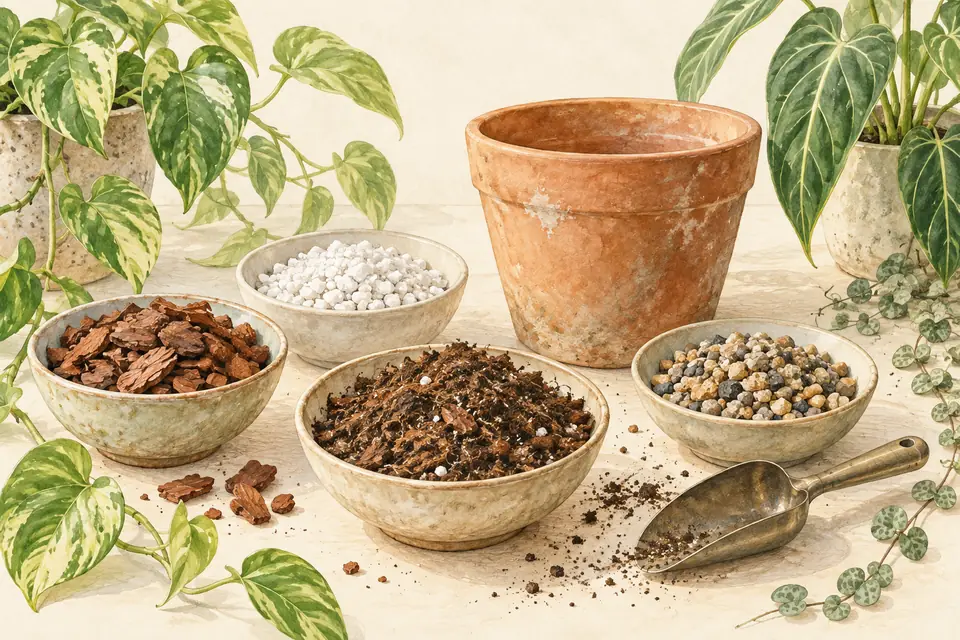
Further reading and references
- How to grow calatheas — Royal Horticultural Society Calathea light, temperature, moisture, feeding, and seasonal care. [Source ]
- Tropical ferns — University of Minnesota Extension Fern-specific differences, watering, humidity, and fertilizer precautions; reviewed in 2026. [Source ]
- How to grow houseplants — Royal Horticultural Society Tap water, chlorine, softened water, humidity, and pest signs such as spider mite webbing. [Source ]
- Calathea — ASPCA Animal Poison Control Listed as non-toxic to dogs, cats, and horses. [Source ]
- Boston fern — ASPCA Animal Poison Control Listed as non-toxic to dogs and cats. [Source ]
- Asparagus fern — ASPCA Animal Poison Control Listed as toxic to dogs and cats. [Source ]