Poison sumac vs sumac: how to tell them apart before you touch.
The difference between sumac and poison sumac shows most clearly in the fruit and the place where the shrub grows. Poison sumac carries loose, drooping clusters of small greyish-white berries, has smooth-edged leaflets on red stalks, and grows in swamps, bogs, and other wet ground. The common sumacs, such as staghorn and smooth sumac, hold dense, upright cone-shaped clusters of red, fuzzy fruit, have toothed leaflets, and grow on dry, open sites like roadsides and field edges. If the berries are white and the ground is wet, keep your hands off.
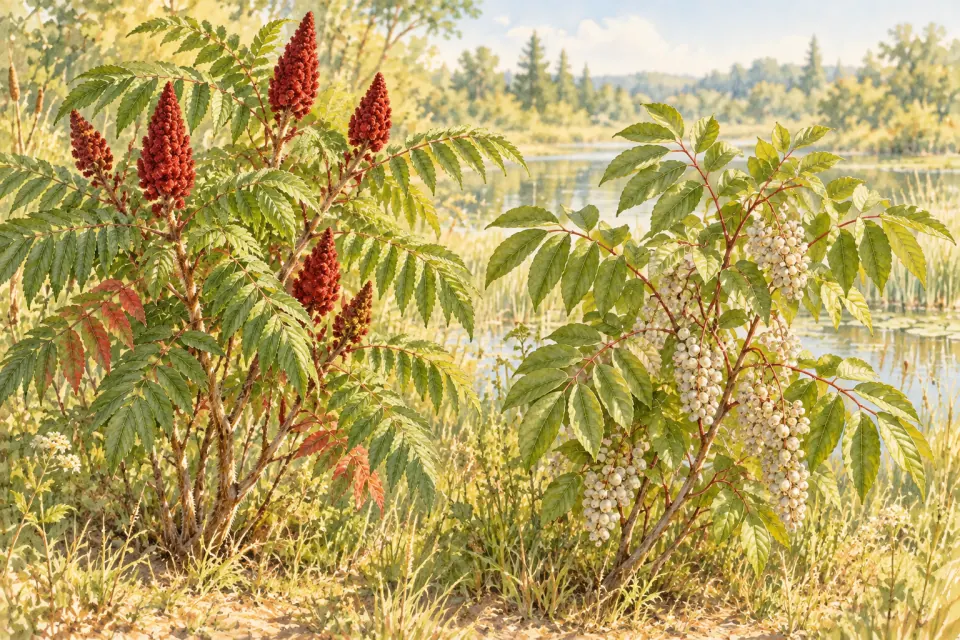
Why poison sumac matters
Poison sumac (Toxicodendron vernix) belongs to the same genus as poison ivy and poison oak. Every part of the plant, from roots and bark to leaves, flowers, and fruit, contains urushiol, the oily resin that causes an itchy, blistering allergic rash in most people who touch it. Urushiol stays active on gloves, tools, clothing, and pet fur, so you can react without touching the shrub directly.
Burning it is especially dangerous. Smoke from burning poison sumac carries urushiol and can inflame the airways and lungs, which can be life-threatening. Extension services rate its poison severity as high for this reason.
Poison sumac is native to the eastern United States and the far south-east of Canada. It does not grow wild in the Middle East or Europe, so readers there are far more likely to meet the edible sumac used as a spice, covered further down.
Poison sumac vs staghorn sumac and smooth sumac
| Feature | Poison sumac | Staghorn sumac | Smooth sumac |
|---|---|---|---|
| Fruit | Small greyish-white berries in loose, drooping clusters | Fuzzy red fruit in dense upright cones | Red fruit in upright clusters, less fuzzy |
| Leaflet edges | Smooth, sometimes slightly wavy | Toothed (serrated) | Toothed (serrated) |
| Leaflets per leaf | 7 to 13 | 11 to 31 | Usually 11 to 31 |
| Stems | Smooth; leaf stalks often red | Densely velvety, like antlers in velvet | Smooth and hairless |
| Habitat | Swamps, bogs, wet woods | Dry, open, often disturbed ground | Dry, open ground and roadsides |
| Contains urushiol | Yes | No | No |
Poison sumac identification in five checks
- Read the ground first. Poison sumac needs wet soil. It grows in swamps, peat bogs, and the soggy edges of ponds and streams. A sumac on a dry roadside bank is almost certainly not poison sumac.
- Look at the fruit clusters. Hanging clusters of creamy or greyish-white berries mean poison sumac. Tight, upright, red cones mean one of the harmless sumacs. Only female plants fruit, so a shrub without fruit needs the other checks.
- Check the leaflet edges. Poison sumac leaflets have smooth, untoothed margins. Staghorn and smooth sumac leaflets are clearly toothed along the edge.
- Count the leaflets. Poison sumac usually has 7 to 13 leaflets per leaf, often with the stalk and midribs tinged red. The harmless sumacs commonly have many more, up to 31.
- Feel the twigs with your eyes, not your hands. Staghorn sumac twigs are covered in dense velvety hair. Poison sumac twigs are smooth and greyish. Judge texture from a close look or a photo rather than by touch.
Poison sumac never has just three leaflets per leaf, which separates it from poison ivy and poison oak. If you find a three-leaflet plant in a swamp, you are dealing with a different hazard.
Telling them apart through the seasons
The fruit is the easiest clue, but it is not on the shrub all year. Each season leaves different evidence, so it helps to know what to look for at any time of year.
- Spring: new poison sumac leaves are often reddish as they unfold, and the leaf stalks stay red into summer. Staghorn sumac shoots are covered in rust-coloured hair from the start.
- Early summer: poison sumac flowers are small and greenish, in loose clusters that hang from where the leaves join the stem. Staghorn and smooth sumac flower in dense, upright clusters at the tips of the branches.
- Late summer and autumn: the fruit ripens. Poison sumac berries turn from green to dull yellowish-white, while the harmless sumacs turn bright red. Leaves of both colour up strongly.
- Winter: with the leaves gone, poison sumac often keeps its pale berry clusters, and its smooth twigs are grey. Staghorn sumac holds dark red cones through the winter on thick, velvety twigs. Urushiol is still present in bare stems, so winter is not a safe season to handle unknown shrubs.
The sumac you can eat
The tangy red spice sold as sumac comes from Rhus coriaria, a shrub native to southern Europe and western Asia. Its dried, crushed fruit gives za'atar its sour note and is sprinkled on salads, grilled meat, and onions across the Middle East, including Lebanon. This plant belongs to the same family as poison sumac, the cashew family, but to a different genus, and it does not contain urushiol.
The North American staghorn and smooth sumacs also have edible fruit. Soaking the red clusters in cold water and straining the liquid gives a lemony drink sometimes called sumac-ade. Only gather from shrubs you have identified with certainty, never from wet ground with white berries, and buy your spice from a food supplier rather than foraging if you have any doubt.
If you touch poison sumac
- Wash quickly: rinse exposed skin with soap and plenty of cool water as soon as you can. The sooner urushiol is removed, the milder the reaction tends to be.
- Clean what touched it: wash clothing, gloves, tools, and the dog separately. Urushiol on an unwashed glove can cause a rash weeks later.
- Do not scratch blisters open: the fluid inside does not spread the rash, but broken skin can become infected. Cool compresses and anti-itch creams help with mild cases.
- Get medical help: if the rash covers a large area, affects the face, eyes, or genitals, or if you have trouble breathing after exposure to smoke.
Common mistakes
- Assuming every sumac is dangerous: most sumacs you see on roadsides are harmless, and some are cooked with.
- Relying on autumn colour: both poison sumac and the harmless sumacs turn brilliant red in autumn, so colour tells you nothing.
- Judging a shrub without fruit: male plants and young plants carry no berries, so fall back on habitat, leaflet edges, and leaflet count.
- Burning cleared brush: never burn a pile that might contain poison sumac.
Frequently Asked Questions
Answers to common questions about plant care and this tool.
Related plant guides and tools
View all guides
Further reading and references
- Toxicodendron vernix — NC State Extension Plant Toolbox Leaf and fruit description of poison sumac, with urushiol as the toxic principle and the danger of burning it. [Source ]
- Rhus typhina — NC State Extension Plant Toolbox Staghorn sumac leaflet count, toothed margins, fuzzy twigs, and red fruit clusters. [Source ]
- Toxicodendron vernix — Wikipedia Overview of poison sumac, its range, habitat, and fruit. Community-edited; cross-check with extension sources. [Source ]
- Rhus coriaria — Wikipedia The Mediterranean and western Asian sumac whose dried fruit is the spice used in za'atar. [Source ]
- Outsmarting Poison Ivy and Other Poisonous Plants — U.S. Food and Drug Administration Consumer guidance on urushiol, washing after contact, and treating the rash. [Source ]