Black pepper, capers, and nutmeg: which plant part is the spice?
Each of these three spices comes from a different part of a plant. Black pepper is the dried unripe fruit of a tropical climbing vine, Piper nigrum. Capers are the unopened flower buds of the caper bush, Capparis spinosa, picked before they bloom and preserved in salt or brine. Nutmeg is the seed inside the fruit of the nutmeg tree, Myristica fragrans, and mace, a second spice, is the red lacy covering wrapped around that seed. Knowing the plant part explains why the spices look, taste, and keep the way they do.
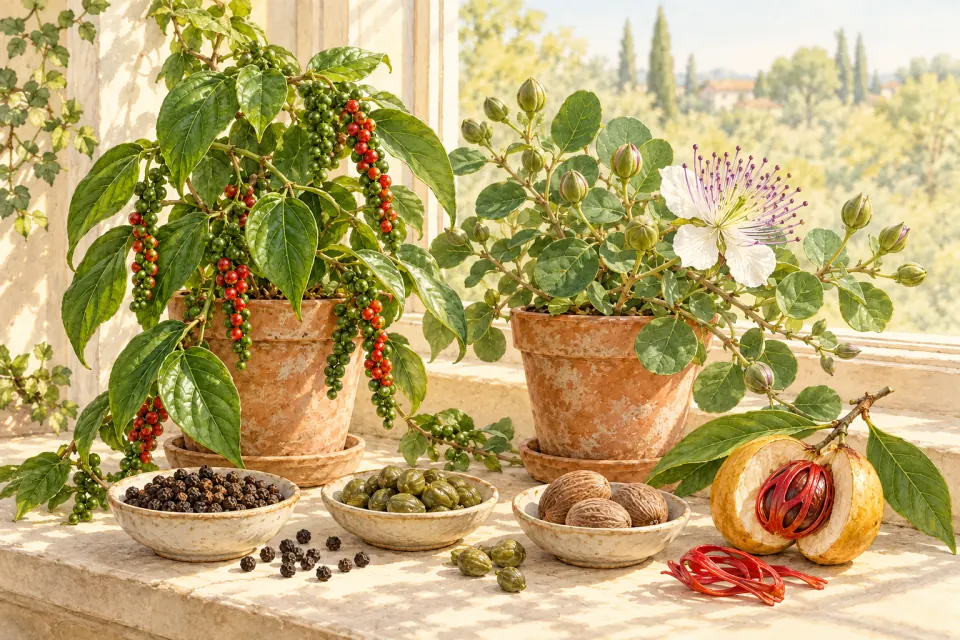
Black pepper: the dried fruit of a vine
Black pepper grows on a perennial woody vine that climbs trees, poles, or trellises to about 4 metres. It is native to the tropical forests of the Malabar Coast in south-western India, which supplied the ancient spice trade. The flowers hang in slender spikes, and each spike ripens into a string of small round fruits. Botanically each peppercorn is a drupe, a stone fruit with a single seed, about 5 millimetres across.
The colour of a peppercorn depends on when the fruit is picked and how it is processed, not on a different plant:
- Black pepper: green, unripe fruit, briefly cooked in hot water and dried until the skin shrinks into a dark, wrinkled layer.
- Green pepper: unripe fruit dried or preserved so that it keeps its colour.
- White pepper: ripe red fruit soaked until the outer flesh softens and is rubbed off, leaving only the seed. It tastes different because the outer layer is gone.
- Pink peppercorns: not black pepper at all. They are the dried berries of the Peruvian peppertree and related trees in the cashew family, so people allergic to cashews should be cautious with them.
The heat of black pepper comes from piperine, a different compound from the capsaicin in chilli peppers. Chillies belong to a separate plant family altogether, despite sharing the name pepper.
Capers: flower buds picked before they open
The caper bush is a tough, sprawling perennial with rounded, slightly fleshy leaves and large white to pinkish-white flowers with long purple stamens. It grows around the Mediterranean basin, including Lebanon, Syria, and Palestine, and often roots in cracks in old stone walls and rocky slopes where little else survives the summer drought.
The caper sold as a spice is the flower bud, picked while it is still tight and dark olive green. The smallest buds are the most valued, so pickers often harvest every morning. Fresh buds taste bitter. The sharp, peppery, mustard-like flavour develops only after they are packed in salt or a salt and vinegar brine, which releases a sulphur compound called glucocapparin.
If a bud is left on the bush, it opens into a flower and then forms a fruit about the size of an olive. That fruit is sold separately as a caperberry. So the capers spice and the caperberry come from the same plant at two different stages: bud and fruit.
Foraging capers is common in the eastern Mediterranean, but a few other Capparis species look similar and are poisonous. Only pick from bushes you have identified with confidence.
Nutmeg and mace: one seed, two spices
The nutmeg tree is a dark-leaved evergreen native to the Banda Islands in the Maluku province of Indonesia, still the main producer. Its fruit looks a little like an apricot. When ripe, it splits open to show a brown seed wrapped in a bright crimson, net-like covering called an aril.
- Nutmeg: the seed. It is dried slowly for weeks until the kernel rattles in its shell, then cracked out. A whole dried nutmeg is egg-shaped, about 2 to 3 centimetres long, and weighs 5 to 10 grams.
- Mace: the aril, peeled off the seed and dried until it fades from crimson to orange or tan. It tastes like a milder, more delicate nutmeg.
Nutmeg needs one warning. In ordinary cooking amounts it is safe, but large amounts are toxic because of a compound called myristicin. Symptoms of nutmeg intoxication can begin from about 5 grams of ground nutmeg, roughly two teaspoons, and include dizziness, confusion, nausea, a racing heart, and in severe cases hallucinations. Keep whole nutmegs away from children, and call a poison control centre if someone has eaten a large amount.
Which plant part every common spice comes from
| Spice | Plant part | Plant |
|---|---|---|
| Black pepper | Dried unripe fruit | Piper nigrum, a climbing vine |
| Capers | Unopened flower buds | Capparis spinosa, a shrub |
| Nutmeg | Seed | Myristica fragrans, a tree |
| Mace | Aril around the seed | Myristica fragrans |
| Cloves | Dried flower buds | Clove tree |
| Cinnamon | Inner bark | Cinnamon tree |
| Saffron | Stigmas of the flower | Saffron crocus |
| Ginger and turmeric | Rhizome, an underground stem | Plants of the ginger family |
| Vanilla | Cured fruit (pod) | Vanilla orchid |
| Allspice | Dried unripe berry | Pimenta dioica, a tree |
| Cumin | Dried fruit, sold as seeds | Cumin plant, carrot family |
| Star anise | Star-shaped dried fruit | Chinese star anise tree |
| Sumac | Dried, crushed fruit | Rhus coriaria, a shrub |
Two entries deserve a closer look. Cloves are flower buds, just like capers, but dried rather than brined. Cumin seeds are technically whole dry fruits, each holding a seed, which is common in the carrot family. Star anise also has a toxic relative, Japanese star anise, whose fruit looks very similar, so buy it only from food suppliers.
Why the plant part matters in the kitchen
Seeds and dried fruits such as peppercorns, nutmeg, and cumin hold their aroma for a long time when kept whole, because the oils are sealed inside a hard coat. Grind them just before use for the strongest flavour. Delicate parts such as flower buds, stigmas, and arils lose their aroma faster once dried or ground, so buy saffron, mace, and cloves in small amounts and store them away from light and heat.
Brined capers are different again. They keep for months in the fridge, but they are very salty, so rinse them before cooking if you want their sharpness without extra salt.
Of the three, capers are the easiest to grow at home in a Mediterranean climate. The bush wants full sun, sharp drainage, and very little water once established, which is why it thrives in walls and rocky ground. Black pepper is harder: it needs steady tropical warmth and humidity, and kept as a houseplant in a cooler climate it grows leaves far more readily than peppercorns. Nutmeg trees are large tropical trees, and only female trees bear fruit, so they are not practical outside the tropics.
Frequently Asked Questions
Answers to common questions about plant care and this tool.
Related plant guides and tools
View all guides
Further reading and references
- Black pepper — Wikipedia The pepper vine, its fruit, and how black, green, and white pepper are produced. Community-edited; cross-check key facts. [Source ]
- Caper — Wikipedia The caper bush, its distribution around the Mediterranean, its edible buds and caperberries, and how capers are cured. [Source ]
- Nutmeg — Wikipedia The nutmeg tree, the seed and aril, mace production, and the risks of high doses. [Source ]
- Myristicin — Wikipedia The compound behind nutmeg intoxication and the dose at which symptoms have been reported. [Source ]
- Pink peppercorn — Wikipedia Why pink peppercorns are not related to black pepper and why they may affect people with cashew allergies. [Source ]
- Illicium anisatum — Wikipedia Japanese star anise, the toxic look-alike of culinary star anise. [Source ]