Types of cherry trees: flowering and fruiting varieties compared.
Cherry trees divide into two groups that matter for anyone choosing or naming one. Fruiting cherries are grown for their fruit: sweet cherries for eating fresh and sour cherries for pies and preserves. Flowering cherries are grown for their spring blossom and give little or no useful fruit. A third group, wild cherries such as the black cherry and the bird cherry, grows in woods and hedges. All of them belong to the genus Prunus and share the same shiny, banded bark.
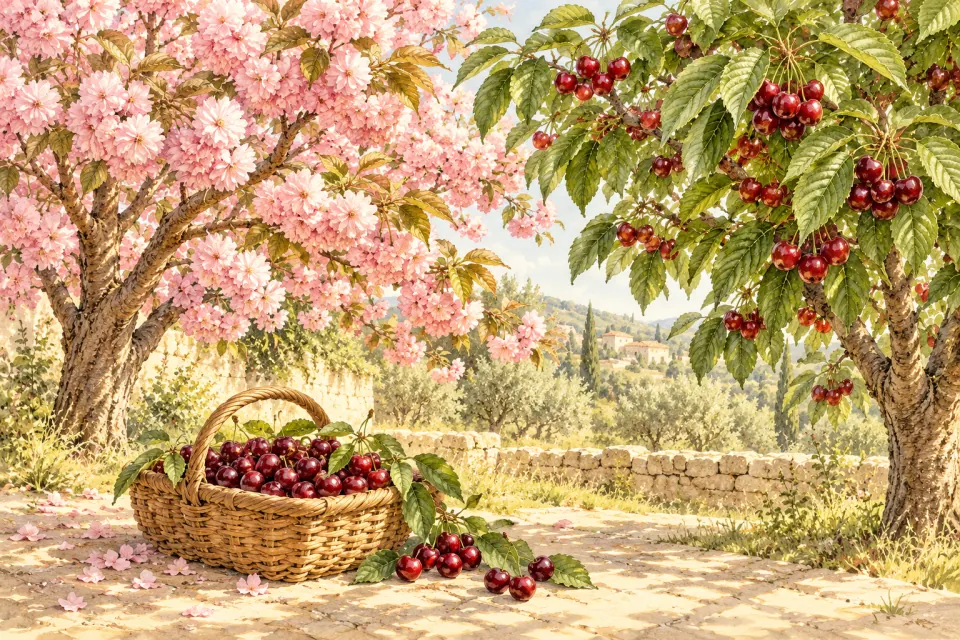
What makes a cherry tree
Cherry trees belong to Prunus, a genus in the rose family (Rosaceae) that also includes plums, apricots, peaches, and almonds. True cherries carry their fruit, a small drupe with a single hard stone, on long stalks, often in clusters.
Even without flowers or fruit, cherry trees are easy to recognize as a group. The bark is smooth and often glossy, marked with horizontal bands of pores called lenticels, and on many species it peels in horizontal strips. The leaves are oval, pointed, and finely toothed. Many species also have one or two tiny glands on the leaf stalk just below the leaf blade, a small detail that helps separate cherries from other trees with similar leaves.
Cherry tree types compared
| Type | Grown for | Typical flowers | Examples |
|---|---|---|---|
| Sweet cherry | Fresh fruit | White, single, in clusters | Bing, Rainier, Stella, Lapins |
| Sour cherry | Cooking, pies, preserves | White, single | Montmorency, Morello |
| Japanese flowering cherry | Spring blossom | Pink or white, single or double | Kanzan, Yoshino, Okame |
| Wild cherry | Woodland, wildlife, timber | White, in clusters or long sprays | Black cherry, bird cherry, chokecherry |
Sweet cherry varieties
Sweet cherries come from Prunus avium, a species that also grows wild across Europe and western Asia, where it is known as wild cherry or gean. Cultivated cherry tree varieties differ in fruit colour, size, and harvest time, and in whether they need a pollination partner.
- Bing: large, dark red to almost black fruit with firm flesh. It needs a compatible pollinator nearby.
- Rainier: yellow skin with a red blush and pale, very sweet flesh. It also needs a pollination partner.
- Stella: dark red fruit on a self-fertile tree, so a single tree can crop on its own and pollinate other varieties.
- Lapins and Sweetheart: dark red, self-fertile varieties that ripen later in the season.
Sweet cherry trees grow into large trees on vigorous rootstocks. Semi-dwarfing rootstocks such as Gisela 5 keep them small enough to net against birds, which take a large share of the crop in many gardens. Rain just before harvest can split ripe fruit, so varieties described as crack-resistant are worth choosing in wet climates.
Sour cherries for cooking
Sour cherries, Prunus cerasus, are smaller trees with brighter red, softer fruit that is too tart for most people to eat raw but holds its flavour when cooked. Most sour cherries are self-fertile, which makes them a good choice when there is room for only one tree.
- Montmorency: bright red skin with clear juice. It is the main tart cherry grown for pies and dried fruit in North America.
- Morello: dark red skin and red juice. In Europe it is often trained against a north-facing wall, where few other fruits ripen.
Crosses between sweet and sour cherries, called duke cherries, sit in between, with fruit that is sweet enough to eat fresh but still slightly tart.
Flowering cherry trees
Flowering cherries, often called by the Japanese word sakura, are selected for the size, colour, and number of their petals rather than for fruit. Many are complex hybrids grouped under Prunus serrulata or named only by cultivar.
- Kanzan: large, double, deep pink flowers that open as the bronze young leaves appear. It is one of the most planted street cherries and sets no fruit.
- Yoshino cherry (Prunus × yedoensis 'Somei-yoshino'): single, almond-scented, very pale pink flowers that open before the leaves. It is the main cherry of Japanese parks and the tidal basin in Washington, DC.
- Okame: small, bright pink flowers very early in spring, on a compact tree.
- Weeping higan cherry (Prunus × subhirtella 'Pendula'): pale pink flowers on long, hanging branches.
- Autumn-flowering cherry (Prunus × subhirtella 'Autumnalis'): small, semi-double flowers that open in mild spells from late autumn to spring.
Because many ornamental cherries are grafted, shoots that grow from below the graft belong to the rootstock and will flower differently or not at all. Remove them while they are small.
Wild cherries and look-alikes
- Black cherry (Prunus serotina): a North American forest tree with dark, flaky bark on old trunks, white flowers in long drooping sprays, and small, dark fruit. The timber is valued for furniture.
- Bird cherry (Prunus padus): a European and Asian tree whose small, almond-scented white flowers hang in long sprays rather than in clusters, followed by bitter black fruit.
- Chokecherry (Prunus virginiana): a North American shrub or small tree with flower sprays and astringent red to black fruit.
Several plants called cherries are not Prunus at all. Cornelian cherry is a dogwood, and Barbados cherry and Surinam cherry belong to other families. Their fruit and leaves differ, so do not use cherry safety rules for them.
Safety: which parts of a cherry tree are toxic
The ripe flesh of sweet and sour cherries is safe. The leaves, twigs, bark, and the kernel inside the stone contain cyanogenic glycosides, compounds that release cyanide when the plant tissue is crushed or chewed. Wilted leaves after storms or pruning are a known risk to grazing animals, and dogs and cats should not chew branches or swallow pits.
How to identify a cherry tree in four checks
- Bark. Look for smooth, shiny bark with horizontal lenticels or horizontal peeling.
- Leaf stalk. Check for tiny glands just below the leaf blade.
- Flower arrangement. Flowers in small clusters on long stalks suggest a sweet, sour, or Japanese cherry; long sprays suggest black cherry or bird cherry.
- Fruit. Large, sweet fruit means a fruiting variety; little or no fruit after heavy blossom points to an ornamental.
Photograph the bark, a leaf with its stalk, and a flower cluster to compare against references. The outdoor tree and shrub identification guide shows how to build a reliable identification from several features.
Frequently Asked Questions
Answers to common questions about plant care and this tool.
Related plant guides and tools
View all guides

Further reading and references
- Cherry — Wikipedia Overview of sweet and sour cherries, wild species, and cultivation. A community-edited reference; cross-check details against horticultural sources. [Source ]
- How to grow cherries — Royal Horticultural Society Sweet and acid cherries, pollination partners, self-fertile varieties, and rootstocks such as Gisela 5. [Source ]
- Cherry — ASPCA Animal Poison Control Toxicity of cherry stems, leaves, and seeds to dogs, cats, and horses. [Source ]