Clover species: how to identify common types by leaf and flower.
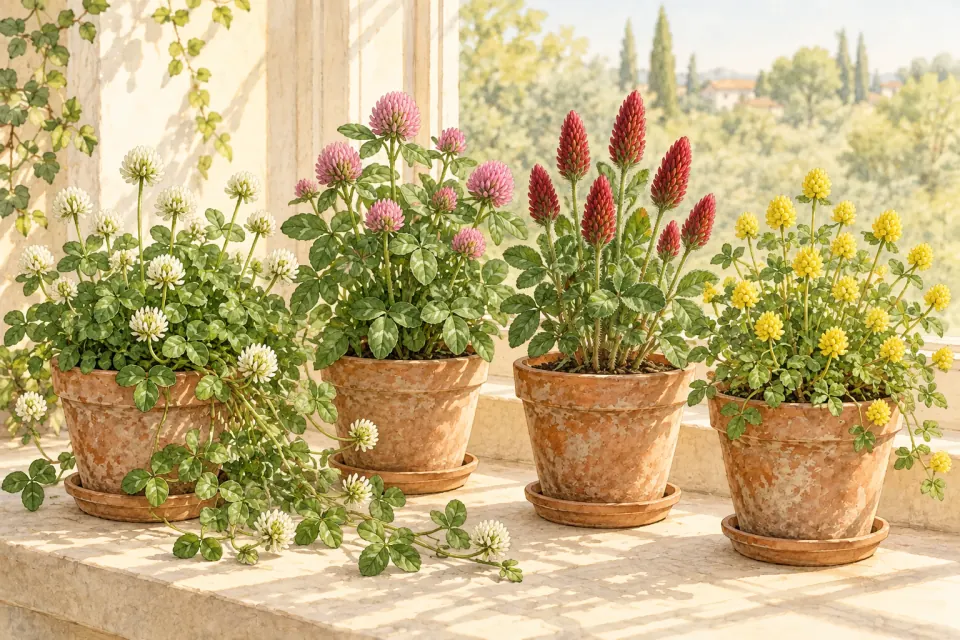
Clover is any plant in the genus Trifolium, a group of roughly 250 to 300 species depending on the source. Clover leaves are green, usually with three leaflets, and often carry a pale V-shaped mark. Flower color helps separate the species: white clover is white to pale pink, red clover pinkish-purple, crimson clover deep red, rabbitfoot clover silky gray, and hop clover yellow. To name a particular clover, check the flower color and head shape, the leaf marking, whether the stems are hairy, and whether the plant creeps or stands upright.
How many types of clover are there?
There is no single agreed count. Reference works give totals between about 240 and 300 species, because botanists continue to revise the status of borderline species, and molecular studies have reorganized the subdivisions of the genus. The exact figure matters little in the field.
In practice you will meet only a handful of species. A regional flora for a single US state or European country typically lists a dozen or so Trifolium taxa, and white, red, alsike, crimson, rabbitfoot, and hop clovers appear on most of those lists.
Some plants called clover are not Trifolium at all. Sweet clover (Melilotus) and burclover (Medicago) are related genera in the pea family that share the common name. Most of the descriptions in this guide concern North American and European plants, so if you live elsewhere, consult your regional flora.
What color is clover?
The leaves are green. In several species a pale V-shaped or angular mark, sometimes called a chevron or watermark, shows on each leaflet and is a useful identification clue, as described below.
Flower color is the second clue. Clover flowers range from white through pink to red, while the hop clovers have small yellow flowers. Color alone is not enough, though. White clover is usually white but may be tinged pink, and alsike clover can be white, pink, or both on the same plant. Combine flower color with the leaf and stem features in the next section.
Common clover species compared
| Species | Flowers | Leaf and growth clues |
|---|---|---|
| White clover (Trifolium repens) | White, sometimes pink-tinged, in rounded heads | Low, under about 12 cm (5 in). Leaves and flowers rise on separate stalks from a creeping stem. Leaflets usually carry an inverted white V. |
| Red clover (T. pratense) | Rose-purple, in heads about 2 to 2.5 cm (¾ to 1 in) across | Upright stems, hairy leaves and stems, white V on the leaflets. |
| Alsike clover (T. hybridum) | Pale pink to pinkish-white | No white V. Stems hairless or nearly so. |
| Crimson clover (T. incarnatum) | Crimson red, in cone-shaped heads 2.5 to 5 cm (1 to 2 in) tall | Hairy stems. Lacks the V found on red and white clover. |
| Rabbitfoot clover (T. arvense) | Usually grayish, occasionally light pink to light purple, in soft cylindrical heads | Narrow, hairy leaflets. A winter annual of poor, sandy soils. |
| Strawberry clover (T. fragiferum) | Pink heads that swell after flowering into round, puffy, strawberry-like fruiting heads | Creeping, rooting at the stem joints like white clover, but the leaflets lack the pale V mark. |
| Large hop clover (T. aureum) | Yellow, hop-like heads up to about 2.5 cm (1 in) across | Upright, to about 45 cm (1.5 ft). All three leaflets are stalkless. |
White clover is the one most people know. It is a true perennial and among the most widely grown clovers in the United States, and white and red clover are the most widely cultivated species worldwide.
How to identify a clover step by step
- Examine the leaves. White clover leaflets are rounded with fine teeth along the edges. Most clovers have three leaflets, although a few species regularly have five or more.
- Look for a pale V marking. If the leaflets have one, you are probably looking at white or red clover. If they are plain, consider alsike or crimson clover.
- Observe the flower heads. A round, ball-like head suggests white clover; a cone-shaped head suggests crimson clover; a soft cylinder suggests rabbitfoot clover; and a small cluster resembling yellow hops suggests a hop clover.
- Feel the stems. Densely hairy stems point to red, crimson, or rabbitfoot clover. Smooth or nearly smooth stems point to alsike clover.
- Note the growth habit. Creeping stems with separate leaf and flower stalks indicate white clover. An upright plant suggests red clover or one of the other species.
Plants often mistaken for clover
- Yellow wood sorrel (Oxalis). Each leaflet is heart-shaped rather than oval, the leaflet edges are smooth, and the yellow flowers have five separate petals.
- Black medic (Medicago lupulina). The central leaflet sits on a short stalk, the leaflets lack the pale watermark that clover leaves often show, and the small yellow flowers form tight heads about the size of a pencil eraser.
Black medic and the small hop clovers are the hardest pair to separate. Both have tiny yellow heads. The stalked-central-leaflet test does not fully settle it, because the smaller hop clovers (T. campestre and T. dubium) have a short-stalked central leaflet too. If the identification matters, check a regional flora or ask a local botanist.
Clover through the year in a Mediterranean climate
The Mediterranean basin is one of the main centres of clover diversity. Many of its wild clovers are annuals, so the season decides what you can see. A regional flora matters more here than a North American list.
- Autumn. The first rains wake the seeds of annual clovers. Small seedlings with three leaflets appear in fields and lawns.
- Winter. In a mild, wet winter the plants grow leaves but rarely flower. Leaves alone often give only a genus, not a species.
- Spring. Most annual clovers flower now. This is the best time to identify them, because you can see the flower heads and leaves together.
- Summer. In a hot, dry summer, annual clovers die and leave dry brown heads full of seed. White clover stays green only in watered lawns and gardens.
Subterranean clover (T. subterraneum) shows how odd the annuals can be. It has small, pale flower heads. After flowering, the flower stalks bend down and push the developing seed heads into the soil.
Common identification mistakes
- Checking a freshly mown lawn. Mowing removes the flower heads and keeps every plant low. Look at an uncut edge or wait a week.
- Relying on color alone. Several species share pink or white flowers. Confirm with the leaf mark, the stem hairs, and the head shape.
- Judging from dry heads. Old brown heads lose the color and shape of the flowers. Look for a fresh head on the same plant.
Four-leaf clovers and shamrocks
A four-leaf clover is an uncommon variation seen in several three-leaved species. It is not a separate species. Most botanists and historians consider the true shamrock to be Trifolium dubium or T. repens, although the name is sometimes applied to Oxalis species instead.
Photograph clover so the features show
Take one wide shot that shows whether the plant creeps or stands upright. Then take a close-up of a single leaf showing all three leaflets, and a flower head from the front and from the side. The plant photo guide recommends starting with the whole plant and then adding attached-leaf and flower views, and it warns that no photo technique guarantees a correct identification.
Doofer’s photo identifier returns possible matches and shows how uncertain each one is, so compare any suggestion with the traits in the table above before you rely on it.
Frequently Asked Questions
Answers to common questions about plant care and this tool.
Related plant guides and tools
View all guides
Further reading and references
- PLANTS Database: Trifolium L. (clover) — USDA Natural Resources Conservation Service Search the genus for distribution maps and accepted names of clover species recorded in the United States and its territories. [Source ]
- Trifolium — Wikipedia General overview of the genus and its species list. A community-edited reference; confirm details against a regional flora. [Source ]
- White Clover (Trifolium repens) — University of California Statewide IPM Program Describes the creeping stems that root at the nodes, the pale mark on the leaflets, the flowering season in California, and how strawberry clover differs. [Source ]