Heterophylly explained: why one plant can have different leaves.
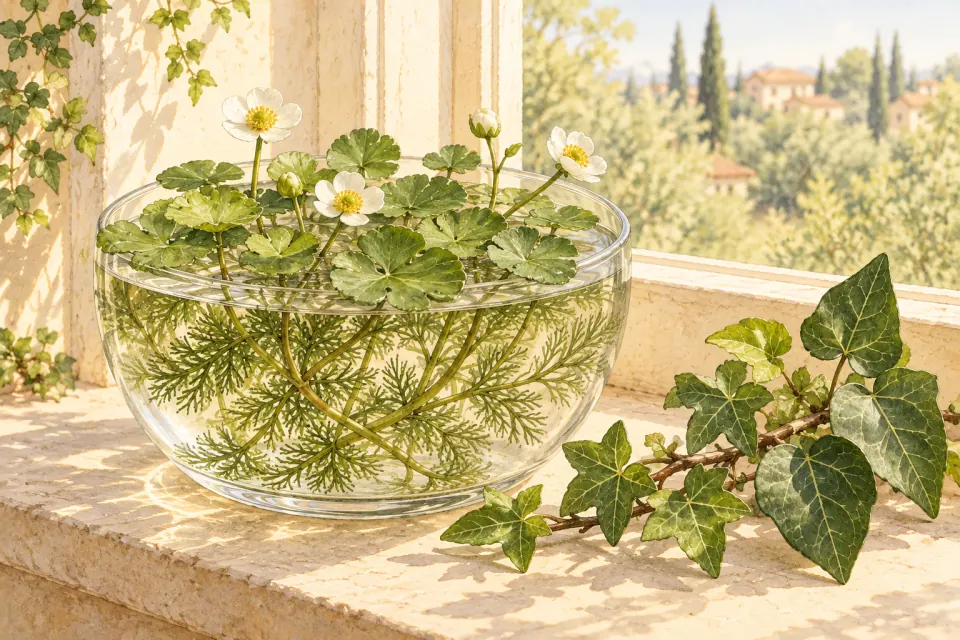
Heterophylly is the growth of clearly different leaf shapes on the same plant. It usually happens because the leaves form in different conditions, such as under water and in air, or at different stages of the plant’s life. The best-known example is the water buttercup, which grows fine, thread-like leaves under water and broad, lobed leaves at the surface. Ivy, eucalyptus and holly show other forms of the same idea.
What heterophylly means
The word comes from Greek: hetero, different, and phyllon, leaf. A heterophyllous plant does not just have leaves that vary a little in size. Its leaves differ in shape, thickness or texture enough that a single leaf could be mistaken for another species.
Researchers use the term in two ways. In the broad sense, any plant with distinctly different leaves is heterophyllous. In the narrower sense used in much recent research, heterophylly means a change in leaf form caused by the environment, while a change that follows the plant’s age is called heteroblasty. Both are covered here, because field guides and gardeners usually use the broad meaning.
| Type | What causes the change | Examples |
|---|---|---|
| Environmental heterophylly | Water, light, temperature or damage where the leaf forms | Water buttercups, arrowhead, lake cress, holly |
| Heteroblasty | The age or developmental stage of the shoot | Ivy, eucalyptus |
| Leaf polymorphism on one shoot | Natural variation among leaves of the same age | Sassafras, mulberry |
Buttercup heterophylly: the classic water example
Water buttercups, also called water crowfoots, belong to a group of Ranunculus species that grow in ponds, ditches and slow streams. Many of them carry two kinds of leaf on the same stem:
- Submerged leaves: divided into many fine, thread-like segments. They are thin and flexible, bend with the current, and have a large surface for taking in gases and nutrients directly from the water.
- Floating or aerial leaves: broad and lobed, often kidney-shaped, resting on the surface or held above it. They are thicker and have stomata, the pores that let a leaf exchange gases with the air.
Water crowfoot (Ranunculus aquatilis) is the species most often shown in textbooks. Heterophylly in buttercup species has also been studied in detail in Ranunculus trichophyllus and the North American yellow water buttercup, Ranunculus flabellaris, which grows deeply lobed leaves under water and more shallowly lobed leaves on land.
Not every water buttercup does this. Within the aquatic group, some species keep a single leaf type wherever they grow. Two buttercups from the same pond may therefore behave differently, which is one reason the group is hard to identify to species.
Why aquatic plants change their leaves
Air and water make very different demands on a leaf. Under water, light is weaker, carbon dioxide diffuses slowly and the water itself supports the leaf. Thin, narrow, finely divided leaves suit those conditions. Above water, a leaf must hold itself up, resist drying and control gas exchange through stomata. Broad, thicker leaves with a waxy surface work better there.
A 2019 review of heterophylly in aquatic and amphibious plants describes the general pattern: submerged leaves tend to be thin and narrow and to lack a cuticle and stomata, while terrestrial leaves are thicker and expanded, with a cuticle and stomata. Being able to switch gives these plants a way to cope with water levels that rise and fall through the year.
What triggers the change
The plant does not decide leaf shape after a leaf has formed. The signal acts on young leaves while they are still developing at the shoot tip. Studies of aquatic and amphibious species have identified several triggers:
- Submergence: the main trigger in aquatic plants. Exactly how a plant senses that it is under water is still not fully understood.
- Plant hormones: the submerged leaves of Ranunculus trichophyllus have more ethylene and less abscisic acid than aerial leaves, and the two hormones push leaf development in opposite directions. Gibberellin can also shift leaf form in some aquatic species.
- Temperature: in North American lake cress (Rorippa aquatica), lower temperatures produce more finely divided leaves that resemble submerged ones.
- Light: light intensity changes leaf margins and depth of division in some species.
On land, mechanical damage can also act as a trigger. Holly is the familiar case, covered below.
Land plants with more than one leaf shape
Heterophylly is not limited to ponds. Several common land plants show it clearly:
- Ivy (Hedera helix): climbing, non-flowering shoots carry the familiar three- to five-lobed leaves. Mature shoots that flower carry unlobed, oval to diamond-shaped leaves. Cuttings from the adult shoots often keep the adult leaf shape.
- Eucalyptus: many species have round or oval juvenile leaves, often blue-grey and paired, and long, narrow, sickle-shaped adult leaves. The juvenile foliage is what florists sell as silver dollar eucalyptus.
- Holly (Ilex aquifolium): leaves low on the tree, within reach of browsing animals, tend to be spiny, while leaves higher up are often smooth-edged. Browsing damage is linked to the production of spiny leaves.
- Sassafras: one tree can carry unlobed oval leaves, two-lobed mitten-shaped leaves and three-lobed leaves at the same time.
- Arrowhead (Sagittaria): ribbon-like leaves under water and arrow-shaped leaves above it.
For more on how leaf shape, margin and vein pattern help name trees and shrubs, see the outdoor tree and shrub identification guide and the guide to leaf vein patterns.
What heterophylly means for identifying plants
A plant with two leaf forms can easily be named wrongly from a single leaf. A few habits help:
- Look at the whole plant. Check leaves from the base, middle and tip of several shoots, and from both submerged and floating parts of water plants.
- Note where each leaf grew. Write down whether a leaf was under water, in shade, on a climbing shoot or on a flowering shoot.
- Use flowers and fruit. Reproductive parts change far less than leaves and are usually what keys rely on.
- Photograph both forms. When you use an app or compare reference images, include each leaf type and a flower if one is present.
Do not confuse heterophylly with leaf changes caused by problems. Mottling, curling, twisting or stunted new growth points more often to pests, virus infection or chemical damage, which the plant health guide covers.
Frequently Asked Questions
Answers to common questions about plant care and this tool.
Related plant guides and tools
View all guides

Further reading and references
- Heterophylly: phenotypic plasticity of leaf shape in aquatic and amphibious plants — Li, Hu, Hou and Kimura, Plants (2019) Review of heterophylly research, including Ranunculus, lake cress, the heterophylly and heteroblasty distinction, and hormonal and environmental triggers. [Source ]
- A molecular basis behind heterophylly in an amphibious plant, Ranunculus trichophyllus — Kim and colleagues, PLOS Genetics (2018) Study showing that ethylene and abscisic acid control the switch between aquatic and terrestrial leaves. [Source ]
- Heterophylly — Wikipedia General overview with land and water examples. A community-edited reference; check the cited sources. [Source ]