Savanna plants: trees and grasses that thrive in fire and drought.
Savanna plants are mostly grasses, with trees and shrubs scattered widely enough that their crowns never form a closed canopy. The grasses grow fast in the wet season, dry out in the dry season, and regrow from protected buds after fire. The trees that persist among them, such as acacias, baobabs, and eucalypts, survive with deep roots, thick bark, water storage, and thorns. Fire, drought, and grazing animals shape which plants grow in the savanna as much as rainfall does.
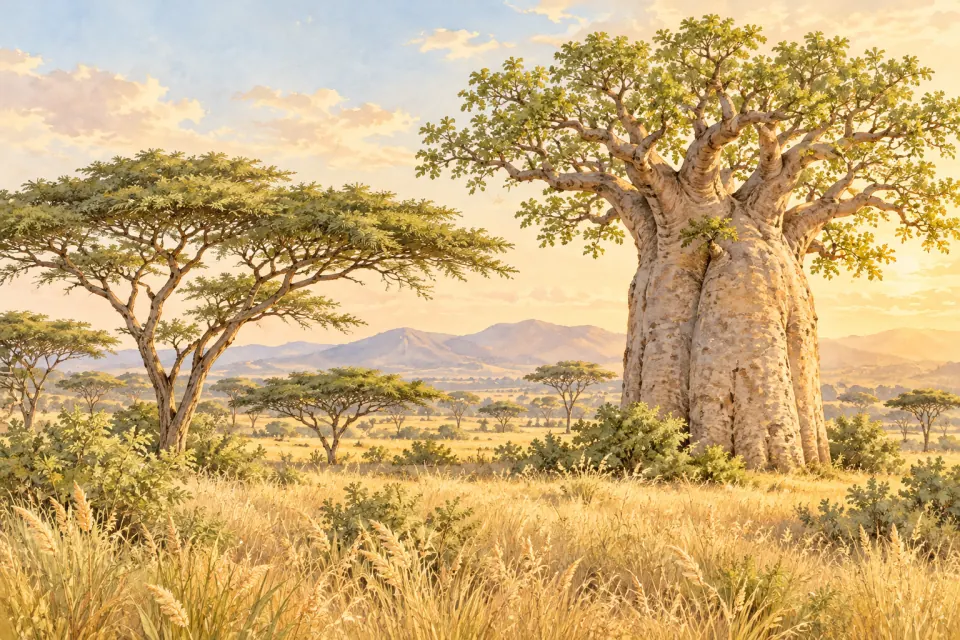
What makes the savanna biome different
A savanna is a mixed woodland and grassland ecosystem. Trees are present, but they are spaced far enough apart that sunlight reaches the ground, so a continuous layer of grass grows between them. That open structure is the defining feature: in a forest the tree canopy closes and shades out the grass, while in a pure grassland trees are almost absent.
Most savannas are tropical or subtropical and have a strongly seasonal climate. A warm wet season alternates with a long dry season that can last several months. During the dry months the grass cures into dry fuel, and fires, whether started by lightning or by people, sweep through regularly. Large grazing and browsing animals add a third pressure by eating grass, leaves, and young trees.
Savannas cover a large share of the tropics. The best-known examples are the East African savannas of Kenya and Tanzania, but the same biome includes the cerrado of central Brazil, the llanos of Venezuela and Colombia, the miombo woodlands of southern Africa, and the tropical savannas of northern Australia.
Savanna biome plants at a glance
| Plant | Where it grows | Main survival trait |
|---|---|---|
| Red oat grass (Themeda triandra) | African and Australian savannas | Resprouts from buds at the base after fire |
| Umbrella thorn acacia | East and southern Africa | Deep roots, small leaflets, and paired thorns |
| Baobab | African savannas | Stores water in a massive trunk; leafless in the dry season |
| Marula | Southern and East Africa | Drops its leaves in the dry season |
| Eucalypts | Northern Australia | Thick bark and buds under the bark that sprout after fire |
| Cerrado trees | Central Brazil | Corky bark and deep roots that reach permanent groundwater |
Savanna grasses: the plants that carry the fire
Grasses make up most of the plant cover in the savanna and most of the food for grazing animals. Tall bunch grasses such as red oat grass, elephant grass, and various species of Hyparrhenia can grow more than a meter high in a good wet season. When the rains stop, the leaves die back and the standing dry grass becomes the fuel that carries fire across the landscape.
Grasses survive these fires because their growing points sit at or just below the soil surface, protected inside the tussock. The flames burn the old leaves but leave the buds intact, and new green shoots appear within days or weeks, especially if rain follows. Many savanna grasses also use the C4 photosynthetic pathway, which works efficiently in strong light and high temperatures and uses water economically.
Burning and grazing actually help many of these grasses. Removing the dead material lets light reach the new shoots, and the flush of regrowth after a fire draws grazing animals, which in turn keeps the grass short in some patches and tall in others.
Savanna trees and how they survive
Savanna trees have to cope with two problems that grasses solve differently: they need to reach water through the dry season, and they need to survive fires and animals while they are still small. Young trees are especially vulnerable, because a fire that scorches a sapling's crown can kill the shoot above ground. Many savanna trees respond by resprouting from the root, and some saplings stay trapped at grass height for years until a few fire-free seasons let them grow tall enough to escape the flames.
- Acacias: African savannas are known for flat-topped thorn trees, such as the umbrella thorn, now usually placed in the genus Vachellia. Their small leaflets lose little water, deep roots reach moisture far below the surface, and paired thorns deter browsers, although giraffes still feed on them.
- Baobab: the African baobab (Adansonia digitata) stores large amounts of water in its soft, swollen trunk and drops its leaves during the dry season. Its thick bark also helps it tolerate fire.
- Marula and other deciduous trees: many savanna trees shed their leaves when the dry season begins, cutting water loss until the rains return.
- Australian eucalypts: in the savannas of northern Australia, eucalypts dominate the tree layer. Many carry dormant buds under their bark that sprout along the trunk and branches after a fire.
- Cerrado trees: in Brazil's cerrado, small twisted trees with thick, corky bark are typical, and many have deep roots that reach permanent groundwater.
Fire, drought, and grazing: why the trees stay scattered
Rainfall sets an upper limit on how many trees a savanna can support, but in many savannas the actual tree cover is well below that limit. Researchers explain the gap with disturbance. Frequent fires kill or set back young trees, and elephants, giraffes, and other browsers eat or break trees of every size. Remove fire and large animals from a wetter savanna and trees tend to become more numerous over time, a process often called woody encroachment.
Drought acts more slowly. A long dry season favors plants that can stop growing and wait, such as grasses that die back to their bases, trees that drop their leaves, and species that store water or reach deep into the soil. Plants that need steady moisture year-round tend to be confined to river banks and other wet spots, where a strip of taller woodland often follows a watercourse through otherwise open country.
Plants in the savanna by region
The savanna biome looks broadly similar on different continents, but the plants that fill it come from different families.
- East Africa: red oat grass and other bunch grasses, umbrella thorn and whistling thorn acacias, baobabs, and sausage trees along watercourses.
- Southern Africa: mopane woodland and miombo woodland, where trees can be denser, mixed with marula, acacias, and tall grasses.
- South America: the cerrado, a highly diverse savanna with thousands of plant species, and the seasonally flooded llanos of Venezuela and Colombia.
- Australia: tropical savannas across the north of the continent, with eucalypts and other trees over grasses such as spinifex and tall annual sorghum in many areas.
- South and Southeast Asia: savanna-like grasslands with scattered trees occur in parts of India and mainland Southeast Asia, often maintained by fire and grazing.
How to recognize savanna trees in the field or in photos
If you are trying to identify a savanna tree from a photo or on a trip, a few features narrow the options quickly.
- Look at the crown shape. A flat, spreading umbrella crown is typical of several acacias, while a massive bottle-shaped trunk with short branches points to a baobab.
- Check the leaves. Fine, feathery leaves divided into many small leaflets suggest an acacia or another legume. Long, narrow, often grey-green leaves that hang down point to a eucalypt in Australia.
- Look for thorns. Paired thorns at the base of the leaves are common in African acacias. Their length and shape help separate species.
- Note the season. Many savanna trees are bare in the dry season, so leaf features may not be available. Bark, trunk shape, and seed pods on or under the tree become more useful then.
Photos that show the whole tree, a close-up of leaves or thorns, and any flowers or pods give an identification tool or a field guide far more to work with than a single distant shot. The outdoor tree and shrub identification guide covers how to photograph trees for identification.
Common misconceptions about savanna plants
- That savannas are degraded forests. Many savannas are ancient ecosystems with plants that evolved alongside fire and grazing. They are not simply forests that have been cut down, although some cleared forests can look similar.
- That fire always damages them. Regular, moderate fires are part of how savannas work. Very intense fires or fires at the wrong time of year can still cause damage.
- That all savanna trees are acacias. Acacias are the image most people have of African savannas, but savanna trees include baobabs, marula, mopane, eucalypts, and hundreds of cerrado species.
Comparing the savanna with other biomes makes these features easier to see. The guide to habitat diversity explains how different habitat types support different plant communities.
Frequently Asked Questions
Answers to common questions about plant care and this tool.
Related plant guides and tools
View all guides
Further reading and references
- Savanna — Wikipedia Summary of savanna types and of the roles of fire and herbivores in keeping tree cover low. A community-edited reference; check details against its cited sources. [Source ]
- Vachellia tortilis — Wikipedia The umbrella thorn acacia, its flat-topped crown, thorns, and range. [Source ]
- Adansonia digitata — Wikipedia The African baobab, its water-storing trunk, and its seasonal leaf loss. [Source ]