Tree fungus identification: common types and what they mean for the tree.
Fungus on a tree is the visible fruiting body of an organism that lives inside the wood or roots. Some tree fungus types feed only on dead wood, while others rot the heartwood or roots of living trees and can make them unstable. You can narrow down most tree fungi by checking where they grow, their shape, the underside, and the host tree, but identification is a starting point for deciding whether a tree needs a professional inspection, not a reason to eat what you find.
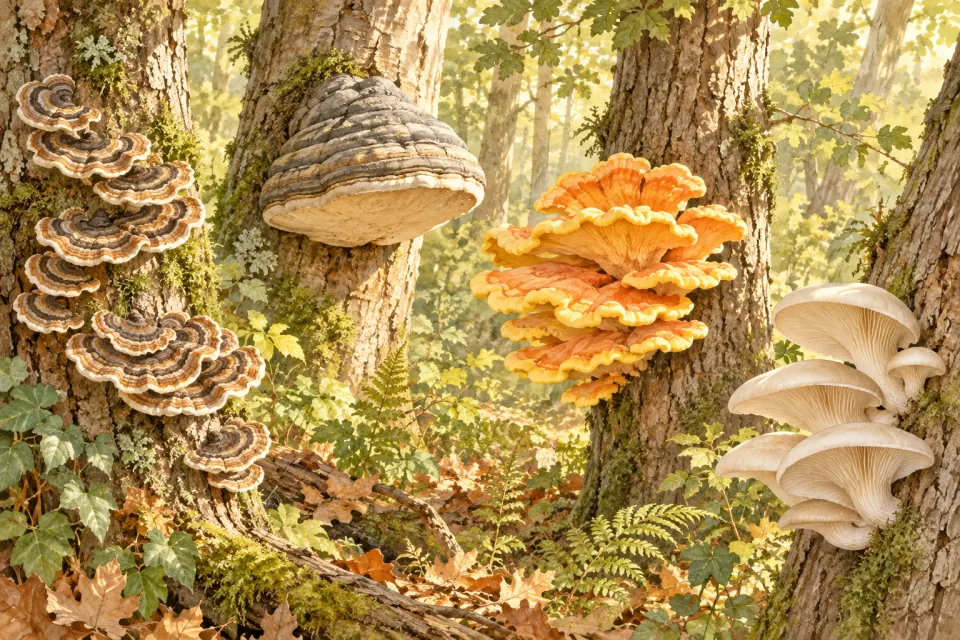
Never eat a wild fungus because of an article, a photo, or an app
Several edible tree fungi have toxic lookalikes, and some edible species still make people ill. This guide is for understanding tree health, not for foraging.
What a tree fungus actually is
The shelf, bracket, or mushroom you see is only the fruiting body, the part that releases spores. The main body of the fungus is a network of fine threads called mycelium that grows through the wood or soil, sometimes for many years before anything appears on the surface. When a bracket shows on a trunk, the fungus has usually been decaying the wood for a long time.
Wood-decay fungi fall into two broad groups. White rot fungi break down both lignin and cellulose and leave pale, stringy, or spongy wood. Brown rot fungi break down mainly cellulose and leave brown, dry wood that cracks into cubes and crumbles. Both weaken the wood, but brown rot can make a trunk or branch brittle and liable to snap with little warning.
Most bracket fungi belong to the polypores, a group with tiny pores or tubes on the underside instead of gills. Checking the underside is one of the first steps in tree fungus identification.
How to identify tree fungus: five checks
- Where it grows. Note whether the fungus is on a fallen log, a dead branch, the main trunk, or the base and roots. Fungus at the base or on roots is the most important for tree safety.
- Shape and texture. Is it a thin leathery shelf, a thick woody hoof, a soft fleshy bracket, a clump of capped mushrooms, or a mass of hanging spines?
- The underside. Look for pores, gills, or teeth, and note the colour. Some species change colour when scratched.
- Lifespan. Annual fungi appear in summer or autumn and rot away. Perennial brackets stay for years and add a new layer each season.
- Host tree. Several fungi grow on only one kind of tree, so identifying the tree narrows the list. The tree identification guide can help.
Common tree fungus types
| Fungus | Appearance | Where it grows | What it means |
|---|---|---|---|
| Turkey tail | Thin, leathery shelves with bands of brown, grey, and cream; white pores | Dead branches, stumps, logs | White rot of dead wood; usually low concern |
| Artist's bracket | Large, flat, hard, brown top; white underside that bruises brown | Trunks and bases of broadleaf trees | Perennial white rot; get the tree inspected |
| Hoof fungus | Grey to brown, hoof-shaped, woody, layered | Birch and beech trunks | White rot; trunks can snap |
| Chicken-of-the-woods | Bright yellow and orange overlapping shelves | Oak, cherry, willow, yew, and others | Brown rot of heartwood; brittle wood |
| Birch polypore | White to tan, smooth, rounded bracket | Only on birch | Brown rot; usually weakened or dead birch |
| Giant polypore | Large clumps of brown, fan-shaped caps; pores blacken when bruised | Base of beech and other trees | Root decay; high risk of the tree falling |
| Honey fungus | Clumps of honey-brown mushrooms with a ring on the stem | Base of trees and shrubs, stumps, soil | Kills roots; spreads underground |
Bracket fungi on trunks and branches
- Turkey tail (Trametes versicolor): one of the most common fungi in the world. Its thin, flexible brackets grow in overlapping rows and have concentric bands of colour like a turkey's tail. It mostly feeds on dead wood and is a normal part of a woodland's decay cycle.
- Artist's bracket (Ganoderma applanatum): a flat, perennial bracket that can grow to about 50 cm across. Its white pore surface turns brown when scratched, which is why people draw on it. Ganoderma species cause white rot in the lower trunk and roots of many broadleaf trees.
- Hoof fungus (Fomes fomentarius): a thick, woody, hoof-shaped bracket on birch and beech that lasts for years. It causes white rot, and trees with several brackets often break at the point where they grow. It was once used as tinder.
- Birch polypore (Fomitopsis betulina): a smooth, pale bracket that grows almost only on birch. It causes brown rot and usually appears on birches that are already weak, dying, or dead.
- Chicken-of-the-woods (Laetiporus sulphureus): soft, bright yellow and orange shelves that fade to pale beige with age. It causes brown rot in the heartwood, which can make large trunks brittle.
Fungus at the base of a tree and on the roots
Fungi at the base of a trunk or coming up from the roots are the most serious for safety because root and butt decay can let a tree fall in one piece, sometimes while the crown still looks healthy.
- Honey fungus (Armillaria): several species that attack and kill the roots of trees, shrubs, and perennials. Clumps of honey-coloured mushrooms with a whitish ring on the stem may appear in late summer or autumn. The most reliable sign is a white, paper-thin sheet of fungus under the bark at ground level that smells of mushrooms. It spreads through soil using black, root-like cords called rhizomorphs, or bootlaces. There is no chemical control; the infected stump and roots have to be dug out.
- Giant polypore (Meripilus giganteus): large clumps of overlapping brown caps at the base of beech and other broadleaf trees. The pore surface turns black when bruised. It decays roots, and affected trees can fall in strong wind.
- Ganoderma at the base: artist's bracket and related species often grow low on the trunk and indicate decay in the roots and lower stem.
White tree fungus identification
White fungi are among the most searched for, and several unrelated species can look white on a tree:
- Birch polypore: smooth, white to tan brackets on birch only.
- Oyster mushroom (Pleurotus ostreatus): soft, fan-shaped, white to grey caps in tiers on dead or weakened broadleaf wood, with gills running down a short side stem.
- Lion's mane (Hericium erinaceus): a single white clump of hanging spines longer than 1 cm, usually on wounds in old broadleaf trees.
- Artist's bracket underside: the brown bracket has a bright white pore surface below.
- Honey fungus mycelium: a creamy white sheet under loose bark at the base, not a bracket on the surface.
White powder on leaves is usually powdery mildew, and pale grey-green crusts on bark are lichens. Neither is a wood-decay fungus. The plant health guide covers leaf diseases.
Tree fungus and safety: when to call an arborist
Arborist guidance treats fungal fruiting bodies, cavities, and mushrooms at the base of a tree as external signs of decay. A tree with these signs is not always dangerous, because a healthy tree can wall off decay for many years, but the amount of sound wood left can only be judged by inspection, sometimes with tools that measure decay inside the trunk.
Ask a qualified arborist to inspect a tree if you see any of these:
- Brackets or mushrooms on the main trunk, at the base, or on the root area.
- Cracks, cavities, or soft, crumbly wood.
- Dead or hanging branches, thinning foliage, or early autumn colour.
- A new lean, or soil heaving on one side of the trunk.
- Any of the above on a tree that could fall on a house, road, path, or play area.
Cutting off a bracket does not remove the fungus, which lives inside the wood. Avoid wounding trunks and roots with mowers, trenching, or soil compaction, because wounds are where many decay fungi enter.
Why you should not eat tree fungus you have identified online
Chicken-of-the-woods, oyster mushroom, and lion's mane are eaten in many countries, but that does not make a fungus you find safe. Honey fungus clumps can be confused with other brown clustering mushrooms, including toxic ones. Adverse reactions such as vomiting have been reported after eating chicken-of-the-woods, partly because similar species are easily confused with it. Photos and apps cannot show smell, spore colour, or small details that experts check.
If someone, especially a child or a pet, has eaten a wild fungus, contact a poison centre or doctor straight away and keep a sample for identification.
Frequently Asked Questions
Answers to common questions about plant care and this tool.
Related plant guides and tools
View all guides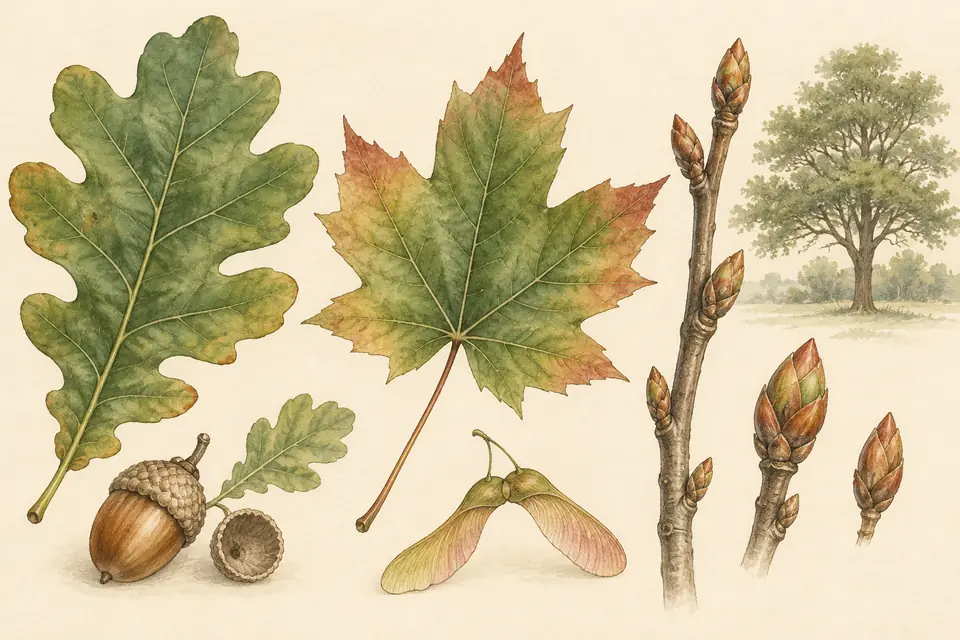
Further reading and references
- Polypore — Wikipedia Overview of bracket and shelf fungi and their pore-bearing undersides. A community-edited reference; cross-check details against expert sources. [Source ]
- Honey fungus — Royal Horticultural Society Symptoms of honey fungus, including white mycelium under bark, rhizomorphs, and autumn mushrooms, and why removal of infected roots is the only control. [Source ]
- Recognizing Tree Risk — International Society of Arboriculture Signs of decay such as fungal fruiting bodies, cavities, and mushrooms at the base, and when to consult a certified arborist. [Source ]
- Meripilus giganteus — Wikipedia The giant polypore, a root-rotting fungus at the base of beech and other trees whose pores blacken when bruised. [Source ]