Types of moss: common species, and is moss actually a plant?
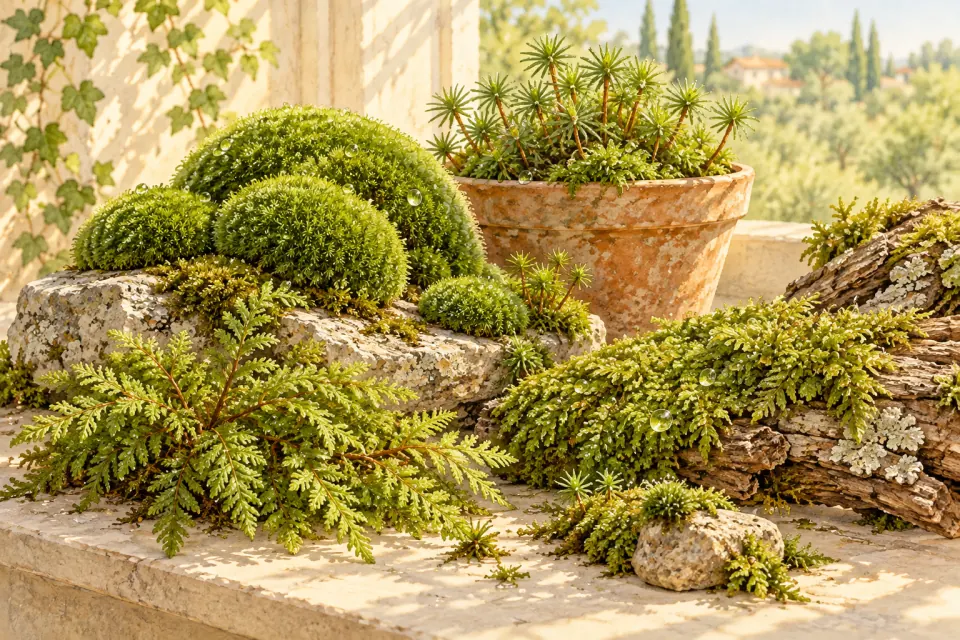
Moss is a plant. Mosses belong to the division Bryophyta, a group of small, non-vascular land plants with roughly 12,000 species. They make their own food by photosynthesis, but they have no true roots, no flowers, and no seeds, and they reproduce with spores. Common types of moss include sheet moss, cushion moss, haircap moss, fern moss, rock cap moss, and peat moss. Several plants called moss, such as Spanish moss and reindeer moss, are not mosses at all.
Is moss a plant?
Yes. Mosses are land plants, and they are among the oldest groups of land plants still living. Like a fern or an oak, a moss contains chlorophyll, captures light, and turns carbon dioxide and water into sugars. What sets mosses apart is what they lack. They have no vascular tissue, the internal system of tubes that moves water and sugars through most plants. Without it, mosses cannot grow tall, and they depend on a moist surface to absorb water directly through their leaves.
Mosses also lack true roots. They anchor themselves with rhizoids, fine threads that grip soil, bark, or stone but do little to take up water. They produce no flowers or seeds. Instead, they reproduce with spores released from small capsules that grow on stalks above the green plant.
The green, leafy moss you see is the gametophyte, the stage of the life cycle that makes eggs and sperm. Sperm need a film of water to swim to the egg, which is one reason mosses thrive in damp places. After fertilization, a stalked capsule called the sporophyte grows from the leafy plant and releases spores.
The moss scientific name and its relatives
True mosses form the division Bryophyta. The word bryophyte is also used more broadly for three groups of non-vascular plants: mosses, liverworts (Marchantiophyta), and hornworts (Anthocerotophyta). Liverworts are often flat and ribbon-like or have leaves in two rows, and hornworts grow horn-shaped sporophytes from a flat green base.
Each moss also has its own two-part scientific name. Common haircap moss is Polytrichum commune, many peat mosses belong to the genus Sphagnum, and the familiar sheet mosses used in gardening are often species of Hypnum.
Common types of moss at a glance
| Moss | Genus | Growth form | Where you find it |
|---|---|---|---|
| Sheet moss | Hypnum | Flat, creeping mat | Logs, rocks, soil, and tree bases in shade |
| Cushion moss | Leucobryum | Pale, rounded mounds | Acidic forest soil and rotting wood |
| Haircap moss | Polytrichum | Tall, upright stems with stiff leaves | Damp, acidic soil and heaths |
| Fern moss | Thuidium | Feathery, fern-like branching | Moist woodland floors and logs |
| Rock cap moss | Dicranum | Dense tufts with curved leaves | Rocks, logs, and forest soil |
| Peat moss | Sphagnum | Soft heads on long stems | Bogs and wet, acidic ground |
Moss types by growth form
Botanists often divide mosses into two broad growth forms, and you can usually tell which one you are looking at without a microscope.
- Acrocarpous mosses: upright mosses that grow in tufts or cushions and produce their spore capsules at the tips of the stems. Haircap, cushion, and rock cap mosses are acrocarpous. They tend to grow slowly and are common on bare soil, rock, and walls.
- Pleurocarpous mosses: creeping, branched mosses that spread sideways and form mats, with capsules on short side branches. Sheet moss and fern moss are pleurocarpous. They cover ground, logs, and rocks quickly in shade.
Peat mosses (Sphagnum) are usually treated separately. They have special dead cells in their leaves that hold water, so a mat of Sphagnum can absorb many times its own dry weight. Over centuries, Sphagnum builds up thick peat deposits in bogs.
Plants called moss that are not moss
Many common names include the word moss even though the plant belongs to a completely different group. These are the ones most often confused with true mosses:
- Spanish moss: Tillandsia usneoides, a flowering plant in the bromeliad family that hangs from trees in the southeastern United States and the American tropics.
- Reindeer moss: a lichen in the genus Cladonia, a partnership between a fungus and an alga.
- Club mosses: lycophytes such as Lycopodium. They have vascular tissue and are more closely related to ferns than to mosses.
- Irish moss: the name is used both for a red seaweed, Chondrus crispus, and for a small flowering garden plant, Sagina subulata.
- Moss rose: Portulaca grandiflora, a succulent flowering plant.
A quick check is to look for flowers: true mosses never flower. If the plant has flowers, it is not a moss.
How to identify a moss
- Note what it grows on. Soil, rock, bark, rotting wood, and wet ground each have their own typical mosses.
- Decide on the growth form. Upright tufts or cushions suggest an acrocarpous moss; flat, branching mats suggest a pleurocarpous moss.
- Look at the leaves with a hand lens. Leaf shape, whether the leaves are curved, and whether they have a midrib are key features. A 10x lens makes a big difference.
- Check for spore capsules. Their shape, the angle at which they are held, and where they grow on the plant help separate genera.
- Wet it. Many mosses look very different when dry and when moist, so compare a dry sample after a few drops of water.
Identifying mosses to species often needs a microscope, but most of the common types above can be told apart in the field. Good close-up photos help, and the plant photo guide explains how to capture fine detail.
Why mosses matter in nature
Mosses are small, but they do a lot of work in many ecosystems. They are often among the first plants to grow on bare rock, walls, and disturbed soil, where they trap dust and organic matter and slowly help build the thin layer of soil that other plants later root into.
A carpet of moss also holds water like a sponge. On a forest floor or a stream bank it soaks up rain, releases it slowly, and helps keep the soil underneath from washing away. Insects, mites, and other small animals shelter in moss, and birds collect it to line their nests.
Peat mosses have the largest effect. In cold, wet bogs, Sphagnum grows on top of its own dead remains, which decay very slowly in the acidic, waterlogged conditions. Over thousands of years this builds up peat, and peatlands hold a large amount of carbon. Draining or digging peat releases that carbon, which is one reason many gardeners now choose peat-free potting mixes.
Moss in gardens and lawns
Moss in a lawn is usually a sign of growing conditions rather than a problem in itself. It does well where grass struggles: in shade, on compacted or poorly drained soil, and on acidic, low-fertility ground. Raking moss out without changing those conditions usually means it returns. Some gardeners embrace it instead, using shade-loving mosses as a low ground cover that needs no mowing.
Indoors, mosses are used in terrariums and as a top dressing for pots. They need high humidity and indirect light, the same conditions that suit many ferns. The fern and calathea humidity guide covers how to keep humidity high around plants indoors.
Frequently Asked Questions
Answers to common questions about plant care and this tool.