Care for Monstera and other aroids thoughtfully.
Monstera belongs to the aroid family, alongside many familiar houseplants. They do not all climb or need the same potting mix. This guide focuses on indoor Monstera, with a framework for checking the needs of related plants.
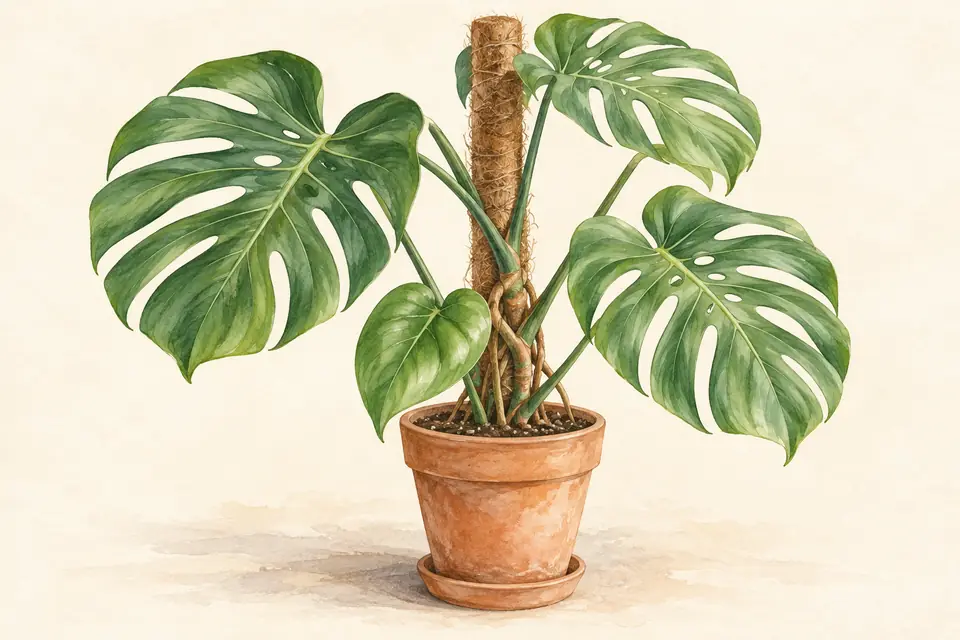
Which plants are aroids?
Aroids are members of the arum family, Araceae. The family includes many popular houseplants that look and grow quite differently. Some climb, some trail and some grow as a clump from the base. Check where your plant fits before you copy care advice from another aroid.
| Plant | Growth habit | Care note |
|---|---|---|
| Swiss cheese plant (Monstera deliciosa) | Large climber | Needs space, a support and bright, indirect light. |
| Monstera adansonii | Smaller climber or trailer | Suits a smaller space. Its leaves have holes but rarely split at the edge. |
| Pothos (Epipremnum aureum) | Trailer or climber | Tolerates lower light than Monstera, but grows slowly there. |
| Philodendron | Climbing or clump-forming, by species | Check the species, because the two habits need different support. |
| Peace lily (Spathiphyllum) | Clump from the base | Prefers evenly moist potting mix. It droops clearly when dry. |
| ZZ plant (Zamioculcas zamiifolia) | Clump from thick underground stems | Stores water and needs the potting mix to dry well between waterings. |
1. Make room for mature growth
A small Monstera can eventually become a large, heavy plant. Choose a stable position with room for new leaves, a pot that resists tipping, and support appropriate to its climbing stems. Keep walkways clear of sprawling stems and aerial roots.
Provide bright indirect light and protect foliage from sudden intense sun. Avoid cold drafts and direct heater output. Observe the plant’s actual position through the day rather than relying only on the direction the window faces.
Young Monstera deliciosa leaves can be solid and heart-shaped. Splits and holes develop with maturity, and light affects leaf development. A leaf without holes is not proof of a deficiency, and a pole cannot guarantee a particular leaf size or pattern.
The RHS suggests 18 to 25 °C all year. An east- or west-facing window works well, or a bright spot set back from a sunny window. Direct midday sun through glass can scorch the leaves.
A worked example: small, solid leaves in a dim corner
A three-year-old Monstera stands 3 m from a north-facing window. Each new leaf is smaller than the last and has no splits. The stems lean toward the window, with long gaps between leaves. The plant is short of light. Move it to within 1 to 2 m of an east-facing window and add a pole. Expect the next few leaves to show the change, not the old ones.
Dust on large leaves blocks some of the light. Wipe both sides with a soft, damp cloth every few weeks. This is also a good moment to look for pests.
2. Support the stem gently
A moss-covered pole or another stable support can help a climbing Monstera grow upright. Position it securely without forcing it through major roots. Larger plants may need another person’s help during repotting or training.
Use soft ties around the main stem, leaving space for growth. Do not tightly bind the stalks that connect individual leaves to the stem. Check ties periodically so they do not cut into expanding tissue.
Aerial roots are normal. Guide them toward a support or the pot where practical; do not force brittle roots into a sharp bend. Keeping a moss pole moist must not leave the pot below permanently waterlogged.
Schematic illustration, not to scale: distinguish the main stem from the stalk of an individual leaf.
- The main stem carries the leaves and is the part to support.
- A soft tie holds the stem near the pole, with space for growth.
- The leaf stalk connects a leaf to the stem. Leave it free to move.
How to prune an overgrown Monstera
First decide whether a larger support or a different position would solve the space problem without cutting. If the plant really is too large, the Royal Horticultural Society recommends pruning Swiss cheese plants in spring. New stems may initially carry smaller leaves with fewer holes; pruning does not produce mature foliage immediately.
Identify the main stem before making a cut, use clean sharp tools, and wear gloves because Monstera can irritate skin. Keep children and pets away from the cut material. If you plan to propagate a removed section, check that it contains suitable stem tissue and a node; a single detached leaf is not a complete cutting.
3. Check the root environment
Choose an open, well-drained potting mix and a pot with clear drainage holes. Potting mix is the growing material in the pot. Bark or other coarse ingredients may help create suitable structure, but one fixed recipe is not essential for every home. A commercial potting mix is not automatically harmful. As one example, the RHS suggests 1 part ericaceous (lime-free) peat-free potting mix to 2 parts orchid mix.
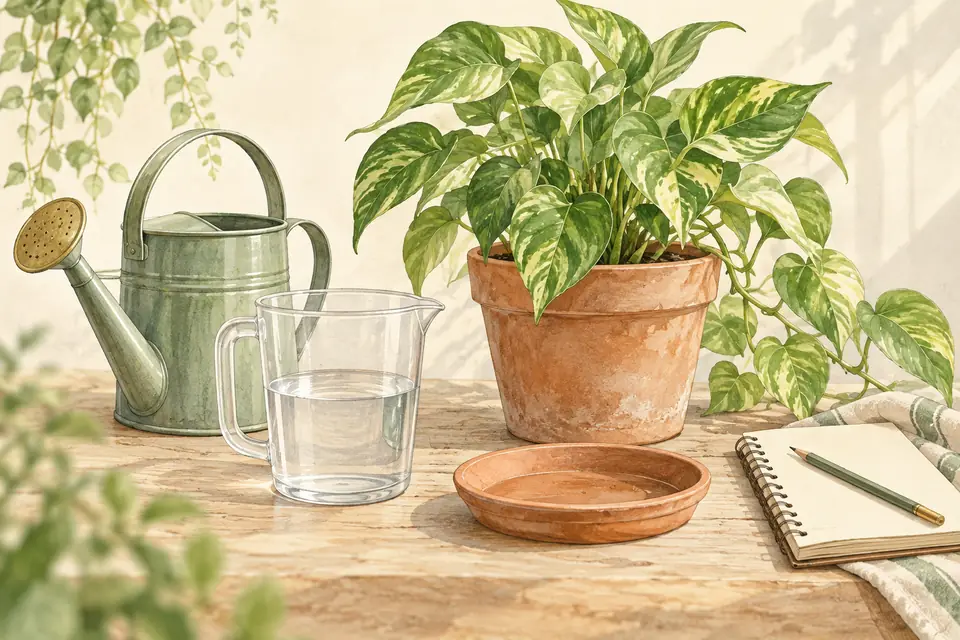
Check moisture before watering. For Monstera, allow the potting mix to approach dryness before watering thoroughly and letting excess drain. Adjust to pot size, temperature, light, and growth; do not extend this routine to every member of the aroid family.
- Push a finger into the potting mix up to the second knuckle, about 5 cm.
- If it still feels damp at that depth, wait and check again in a few days.
- If it feels almost dry, water slowly over the whole surface until water runs from the drainage holes.
- Let the pot drain, then empty the saucer or outer pot.
Repot when root crowding or the state of the potting mix warrants it, usually increasing pot size modestly. A much larger volume of fresh potting mix can remain wet longer than expected. Check whether the potting mix already contains nutrients before adding fertilizer.
4. Investigate changes before treating
| Observation | What to check first |
|---|---|
| Yellowing leaves | Check moisture, drainage, recent feeding, light changes, and which leaves are affected. Color alone cannot confirm a magnesium or iron deficiency. |
| Browning edges | Review watering and the surrounding air, including nearby heaters. Also inspect for pests or physical damage. |
| Damaged new growth | Look for trapped moisture, pests, cold exposure, and handling damage. Do not assume there is one universal cause. |
| Sticky leaves or visible insects | Inspect both leaf surfaces and stem joints. Separate an affected plant while identifying the pest. |
Do not add Epsom salts or extra fertilizer based only on yellowing. If damage spreads or the cause remains unclear, record the growing conditions and seek advice from a knowledgeable grower or plant clinic.
Seasonal care in a Mediterranean climate
In a climate like Lebanon’s, a Monstera grows fast through the long, warm months and slows in the mild, wet winter.
- Summer: pots dry faster, so check them more often. Keep the plant out of the direct airflow of air conditioners and fans.
- Summer sun: a balcony in summer can be too bright and hot. Choose a spot with shade from midday and afternoon sun.
- Winter: unheated rooms can drop below the 18 °C the plant prefers. Growth slows and the potting mix stays wet longer, so water less often.
- Winter nights: move the plant away from cold window glass and from the hot air of portable heaters.
5. Handle and propagate with care
Keep Monstera away from children and pets that might chew it. Wear gloves when cutting or handling damaged tissue and avoid contact with sap. Do not use an identification result as permission to taste any plant part.
Before taking a cutting, identify a suitable section of stem with a node and check the method for your species. A detached Monstera leaf without the necessary stem tissue will not develop into a complete new plant. Use clean tools and avoid taking more growth than the parent can spare.
Rooting success and timing vary with the cutting and conditions. Choose a stable, suitable rooting environment and monitor for deterioration. Do not treat a fixed rooting date or one propagation method as universal across aroids.
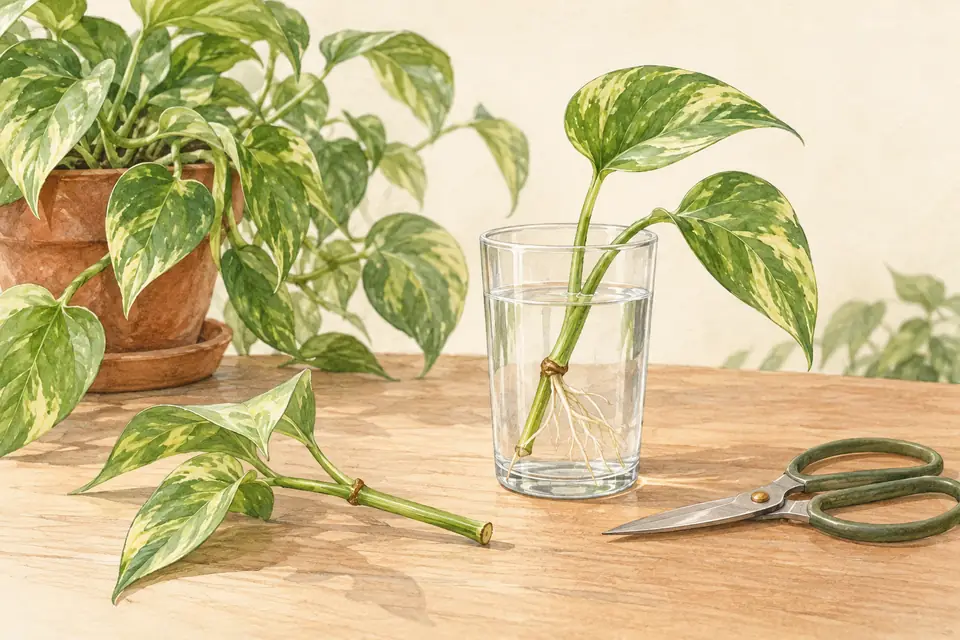
Root a Monstera stem cutting in water
- Take cuttings between spring and late summer, when the plant is growing.
- Wear gloves, and choose a stem section with at least one node and, ideally, an aerial root.
- Cut just below the node with a clean, sharp knife or pruners.
- Stand the cutting in a glass of water so the node is under water and the leaf is above it.
- Keep it in bright, indirect light and change the water every few days.
- Pot it into an airy potting mix once it has a good set of roots.
When to get help
The ASPCA lists Monstera deliciosa, pothos and peace lily as toxic to dogs and cats. These plants contain insoluble calcium oxalate crystals. Chewing them can cause mouth pain, drooling, vomiting and difficulty swallowing. The RHS also advises wearing gloves and keeping Monstera away from children and pets.
- If a pet chews the plant, remove any pieces from its mouth. Then call a vet or an animal poison line.
- If a child chews a leaf, call your local poison center or a doctor. Do not wait for symptoms.
- If sap gets into an eye, rinse it with plenty of clean water and get medical advice.
- Get a second person before you lift or repot a large, heavy plant.
Common mistakes and why they happen
- Moving straight into a much larger pot. The extra potting mix stays wet, and roots in the wet zone can rot.
- Keeping the moss pole soaked. Water runs down into the pot and keeps the potting mix wet all the time.
- Cutting off every aerial root. They help the plant climb and do no harm when guided onto a support.
- Expecting holes in a young plant. Leaf splits come with age and light, not with fertilizer.
- Treating every aroid the same. A ZZ plant and a peace lily need very different watering.
Frequently Asked Questions
Answers to common questions about plant care and this tool.
Related plant guides and tools
View all guides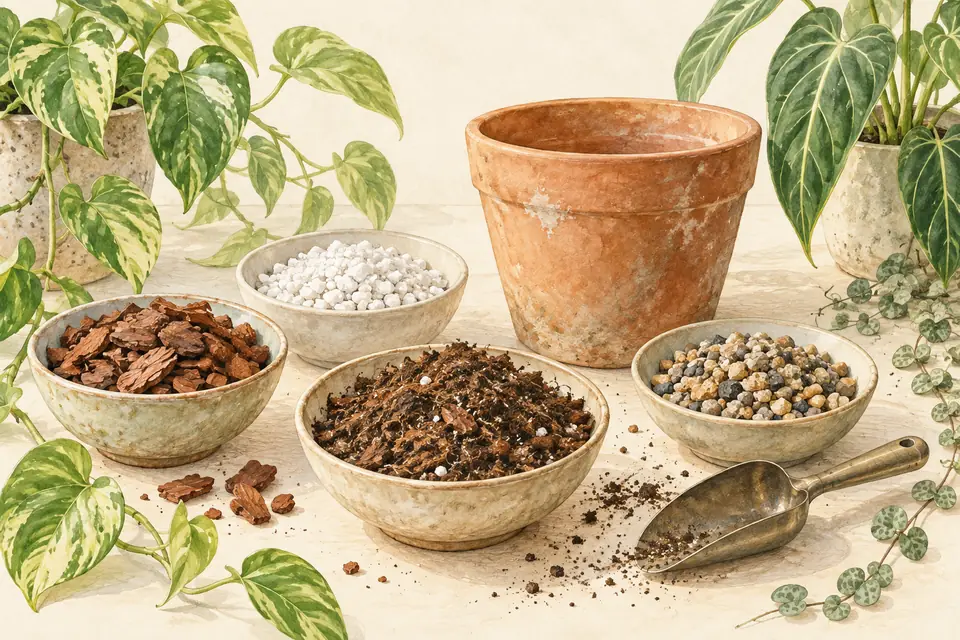
Further reading and references
- How to grow Swiss cheese plants — Royal Horticultural Society Monstera growing conditions, pruning in spring, support, propagation, leaf development, and handling precautions. Other aroids may have different requirements. [Source ]
- Swiss cheese plant — ASPCA Animal Poison Control Monstera deliciosa is listed as toxic to dogs and cats because of insoluble calcium oxalates. [Source ]
- Golden pothos — ASPCA Animal Poison Control Epipremnum aureum is listed as toxic to dogs and cats. [Source ]
- Peace lily — ASPCA Animal Poison Control Spathiphyllum is listed as toxic to dogs and cats. [Source ]