What is acacia? Leaves, species, and where acacia trees grow.
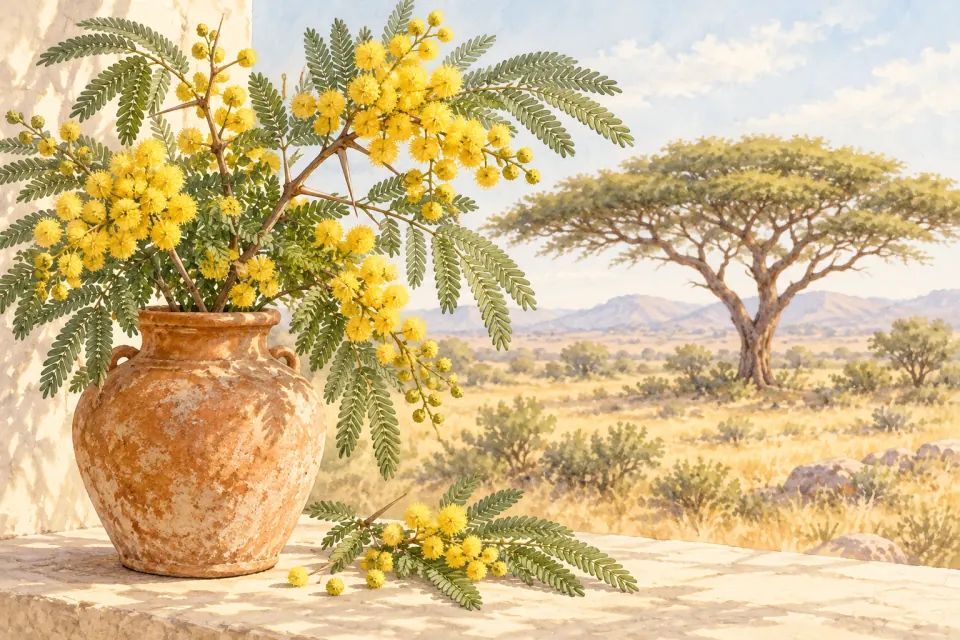
Acacia is a group of trees and shrubs in the legume family, recognised by feathery divided leaves or flattened leaf-like stalks called phyllodes, fluffy yellow or cream flower balls or spikes, and seeds in pods. The word covers two things today. Botanically, Acacia is a genus of about 1,000 mostly Australian species, the wattles. In everyday use, acacia also means the thorny, flat-topped trees of African and Middle Eastern savannas, which botanists now place mainly in Vachellia and Senegalia.
Why the name acacia changed
For most of the twentieth century, Acacia was one huge genus of more than 1,300 species spread across Australia, Africa, Asia, and the Americas. DNA studies showed that this group was not a single natural lineage, so it had to be split. The question was which part would keep the famous name.
At the International Botanical Congress in Vienna in 2005, botanists chose an Australian species as the reference for the name, and the decision was confirmed at the Melbourne congress in 2011. As a result:
- Acacia: now means the roughly 1,000 species centred on Australia, the wattles, many of which have phyllodes instead of true leaves.
- Vachellia: holds most of the African, Asian, and American species with straight paired spines, such as the umbrella thorn, the sweet thorn, and the sweet acacia.
- Senegalia: holds the species with hooked prickles, including the gum arabic tree, Senegalia senegal.
- Smaller genera: Acaciella, Mariosousa, and Parasenegalia hold a few dozen American species.
Field guides written before 2011, and many still in print, use the old names. Both are understood, but searching the new name often finds more recent information.
Acacia leaves: bipinnate leaves and phyllodes
Acacia leaves come in two forms, and many species show both during their lives.
- Bipinnate leaves: true leaves divided twice, giving a soft, feathery look. They are typical of Vachellia, Senegalia, and some wattles, such as the silver wattle sold by florists as "mimosa".
- Phyllodes: flattened leaf stalks that act as leaves. They are usually tough, simple, and often held vertically, edge-on to the sun, which reduces water loss. Most Australian wattles have them.
Seedlings of phyllode-bearing wattles start with a few feathery true leaves, then produce leaves that are half stalk and half blade, and finally plain phyllodes. Finding a seedling with both forms is a neat way to confirm that a narrow-leaved shrub is a wattle and not a willow or a eucalyptus.
Many acacias also carry a small gland on the upper side of the leaf stalk or phyllode. It produces nectar that attracts ants, and it is a useful clue under a hand lens.
Types of acacia trees compared
| Group | Leaves | Thorns | Examples |
|---|---|---|---|
| Wattles (Acacia) | Mostly phyllodes; some bipinnate | Usually none | Golden wattle, silver wattle, blackwood |
| Vachellia | Bipinnate | Straight spines in pairs at each leaf base | Umbrella thorn, sweet thorn, fever tree |
| Senegalia | Bipinnate | Hooked prickles scattered along the stem | Gum arabic tree, black thorn |
The thorns are the quickest field test for the African and Asian species. Straight spines that come in pairs where each leaf joins the stem point to Vachellia. Small hooked prickles that catch on clothing, placed anywhere along the stem, point to Senegalia.
Common acacia species to know
- Golden wattle (Acacia pycnantha): broad, curved phyllodes and masses of bright yellow, scented flower balls in late winter and spring. It is Australia's national floral emblem.
- Silver wattle (Acacia dealbata): silvery, feathery bipinnate leaves and fluffy yellow flowers sold in European markets as mimosa.
- Umbrella thorn (Vachellia tortilis): the flat-topped tree of African savannas and the deserts of Arabia, with paired straight and hooked spines and coiled seed pods.
- Fever tree (Vachellia xanthophloea): a striking African tree with smooth, yellow-green, powdery bark, found near water.
- Whistling thorn (Vachellia drepanolobium): an East African shrub whose swollen thorn bases are hollowed out by ants that defend the plant; wind blowing over the holes makes a whistling sound.
- Gum arabic tree (Senegalia senegal): a small, hooked-prickly tree of the Sahel whose sap provides much of the world's gum arabic.
Acacia flowers and seed pods
Acacia flowers are tiny, but they are packed into dense groups that are easy to see. Each flower has many long stamens, which give the clusters their fluffy look. The clusters take one of two shapes: round balls, as in golden wattle and the umbrella thorn, or narrow cylindrical spikes, as in many wattles from dry Australia and in the gum arabic tree. Colour ranges from pale cream to deep golden yellow, and many species are strongly scented.
After flowering, acacias produce pods, like peas and beans. Some are flat and straight, some twist into coils, and some, such as the pods of the umbrella thorn, are eaten by antelope, goats, and camels, which then spread the seeds. Flower shape and pod shape together narrow a wattle down quickly when you compare it with a regional key.
Where do acacia trees grow?
Acacias grow mainly in warm, dry to seasonally dry places, from semi-desert to open woodland.
- Australia: the centre of Acacia in the strict sense. Wattles grow in almost every habitat, from rainforest margins to the arid interior.
- Africa: Vachellia and Senegalia dominate many savannas and dry woodlands, where their flat crowns and thorns are part of the landscape.
- The Middle East and Asia: umbrella thorn and its relatives grow across Arabia and into the deserts of the Levant and India.
- The Americas: species such as sweet acacia grow from the southern United States to South America.
Like most legumes, acacias work with root bacteria that fix nitrogen, which helps them grow on poor, sandy soils. That same advantage lets some wattles spread beyond their native range. Black wattle and Port Jackson willow, for example, are serious invaders in South Africa and parts of Europe. The savanna plants guide shows how acacia-type trees fit into grassland ecosystems shaped by fire and drought.
Acacia, mimosa, and other mix-ups
- Mimosa: the florists' mimosa is silver wattle, an acacia. The genus Mimosa, which includes the sensitive plant, is a different group in the same family.
- Acacia honey: the pale honey sold under this name in Europe usually comes from black locust (Robinia pseudoacacia), whose name means "false acacia".
- Acacia wood: furniture labelled acacia is often made from plantation wattles such as Acacia mangium, not from African thorn trees.
For trees in general, the outdoor tree and shrub identification guide explains how to combine leaves, bark, and fruit into a confident identification.
Frequently Asked Questions
Answers to common questions about plant care and this tool.
Related plant guides and tools
View all guides

Further reading and references
- Acacia — Wikipedia Overview of the genus, phyllodes, and the 2005 and 2011 decisions on the name. A community-edited reference; cross-check details against botanical sources. [Source ]
- Vachellia — Wikipedia The genus that now holds most former African, Asian, and American acacias, including the umbrella thorn. [Source ]
- WATTLE: Acacias of Australia — Lucid Central Identification key and descriptions for Australian Acacia species, including phyllodes and flower heads. [Source ]